
Saxon Phonics & Spelling is back! After going out
of print for several years, this well-loved phonics and spelling program for
grades K-2 is once again available to homeschoolers. Sporting a new look but
keeping the same content with some additional resources, Saxon Phonics &
Spelling uses an incremental, spiral approach. Concepts are introduced in
small steps while building on previously introduced steps and
continually reviewing. Aligned to the Science of Reading and Orton Gillingham
methodology, this program is well organized with scripted, straightforward
instruction and plenty of multisensory components. Everything is included - you
don’t have to purchase separate readers, worksheets, or other manipulatives.
Handwriting Masters in PDF format for handwriting instruction can be found by
logging in to your free online resources (instructions come with the kit).
Besides incremental
learning, Saxon has several other effective strategies to teach phonics and
spelling. The unique coding system Saxon uses (breve marks to label short
vowels, macrons for long vowels, putting a box around suffixes, using accent
marks, dividing syllables, etc.) is a helpful tool for children to identify
sounds and read words. In fact, many of their coding symbols are the same
pronunciation symbols used in dictionaries. Saxon also has a thorough teaching
of syllabication and includes weekly spelling lists (starting in grade 1) based
on the rules learned. I believe their coding system, along with the syllable
division practice helps tremendously with the spelling (especially for a
dyslexic child). The study of morphology also helps kids understand the meaning
of roots, prefixes, and suffixes, which supports their vocabulary and reading
comprehension. The fluency and decodable readers only include controlled text
to build confidence and reading fluency. Oral and written assessments occur
after every fourth lesson to ensure children are mastering concepts before
moving on.
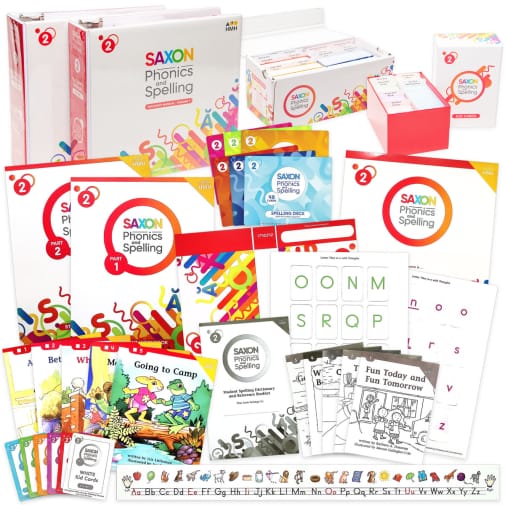
Kit components for
each level include a two-part Teacher Manual, two Student Workbooks, colorful
Fluency Readers, Review Card Decks, Kid Cards, Letter Tiles, black and white
Decodable Readers, a Spelling Dictionary and Reference Booklet (for 1st
and 2nd grade), a Homework Folder, and Alphabet Handwriting Strip.
Student kits for additional students include Student Workbooks, Decodable
Readers, Letter Tiles, Alphabet Handwriting strip, Homework Folder and Spelling
Dictionary and Reference Booklet.
The Teacher
Manual comes in two large binders. Don’t let this overwhelm you, though.
The binders are very organized, with tabs referencing different sections such
as a scope and sequence, lesson overview, phonological awareness instruction,
fluency instruction, handwriting instruction, reading and spelling word lists,
the scripted lessons, and more. Instruction is written for a classroom, but it
is very easy to adapt for homeschool use.
Answers to the student workbooks are also included within each lesson. I
love how each scripted lesson has a three-hole-punched thin booklet so you can
take it out of the binder and use it for the lesson. There is mention of an
additional teacher resource binder and wall charts. These are not included in
the homeschool kit and are for classroom use only.
Student Workbooks
come in two volumes and include all the worksheets, assessments, and recording
forms. The spelling word lists and spelling test sheets are also included. The
black and white workbook pages are perforated for easy tear out with activities
on both sides.
Fluency Readers
are colorful engaging readers that use fully controlled text, containing only
words your child has been taught. The teacher guide shows you when to introduce
each reader. Grade K includes 15 readers and grades 1 and 2 include 26 readers.
The teacher guide mentions three different levels of readers, A for struggling
readers, B for average, and C for advanced readers. The homeschool kit includes
only the Level B Fluency Readers that provide grade-level content.
Comprehension questions appear in the back of each reader.
Review Decks
are colorful 4 x 5-inch cards with a glossy finish, neatly organized in a
heavy-duty cardboard box. The decks are comprised of letter cards, picture
cards, spelling cards, sight word cards, alphabet accent, and affix cards.
These cards help kids retain skills they have learned in previous lessons. The
decks should not be combined because each one is reviewed separately.
Kid cards are
about 2 ½ x 3 ½ inches and are color coded by words, actions, letters,
pictures, blends, and matching words. These are used in games and activities
throughout the lesson.
Decodable Readers
are small black and white readers that use controlled text so children can
practice reading. The lesson introduces these readers and checks your child’s
understanding of the vocabulary before your child reads the book. A few
comprehension questions are in the back of each book. A storage sleeve is
provided in the kit so you can keep these readers organized.
Letter Tiles
feature green capital letters on one side, and purple lowercase letters on the
other side. The tiles are used as a multisensory outlet to practice spelling,
alphabetizing, and letter recognition. Tiles are given to your child when each
letter is introduced.
The Alphabet
Handwriting Strip is laminated presenting the alphabet in both block-style
and continuous stroke style lettering.
The vowels appear in red and consonants in black with an illustration
that corresponds to each letter. There is also a picture of a right and left
hand so children can be visually reminded of the difference.
Even though the Homework
Folder is most useful in a classroom setting, it’s still a handy reference
tool to have at home. The folder contains information such as the alphabet,
coding reminders, the syllable division procedure, vowel rules, and letter
clusters. It’s nice to have these reminders all in one place for your child to
reference when needed.
The Spelling Dictionary and Reference Booklet is
included in the first and second grade kits. Divided into four sections, the
first section is a spelling dictionary with an alphabetized list of words. The
second section includes a list of irregular spelling words organized by sound.
A pronunciation guide with an alphabetized sight word list is in the third
section. Phonics and spelling rules are included in the fourth section.
What has changed in this new edition?
- The teacher binders with
updated font and color are organized into sections and now include
instruction to support speaking & listening skills, phonological
awareness, fluency, and differentiated support for 3 levels.
- Tabs have been added at 10
lesson intervals with a “10 lesson overview” page so you can know what
concepts are introduced and reviewed for the next 10 lessons.
- Game ideas that used to be
in the appendix are now in the “Resources for Differentiation” section.
- English Learner Support
tips have been added.
- Review and Kid Cards are
of a nicer quality and come with a handy storage box.
- New Spelling Cards include
a photo of a child modeling the mouth position for the sound featured on
the card, along with text instructions to teach the child how to properly
position their mouth to articulate each sound.
- A handwriting instruction
booklet is included in the teacher guide that teaches proper formation and
uses mascots (Max the Bear, Leo the Lion, and Wriley the Raccoon) to help
children know where to place their pencil.
- Handwriting Masters for
every grade level are in digital PDF format.
- There is no longer a
Literature Extension book with literature suggestions to complement
various lessons. It is now recommended to continue to provide outside rich
literature of your choice.
- The Irregular Spelling
Booklet and Home Study Rule Book have been combined into the Student
Spelling Dictionary and Reference Booklet.
Each grade level has
140 lessons and each lesson is organized in the same manner:
- Lesson Preparation
lists the resources needed for the lesson
- English Learner Support
gives tips for helping English learners understand the lesson content
- Lesson Warm Up
reviews previously taught material using multisensory methods, teaching to
all learning paths
- New Increment is
the “new learning” part of the lesson
- Application and
Continual Review includes doing exercises together on paper or a
whiteboard then allowing children to complete the worksheets
I used Saxon
Phonics years ago with all my children. I was impressed with the ease of
use, thoroughness, and effectiveness of the program. I am happy to see that the
new edition still maintains the same content and methodology, but with added
resources for additional support if needed, and overall better organization.
They even kept the enrichment study of the history of the English language in
grade 2! Accommodating all learners,
this program is worth the price and delivers strong phonics and spelling instruction
that is easy to teach! ~ Gina