
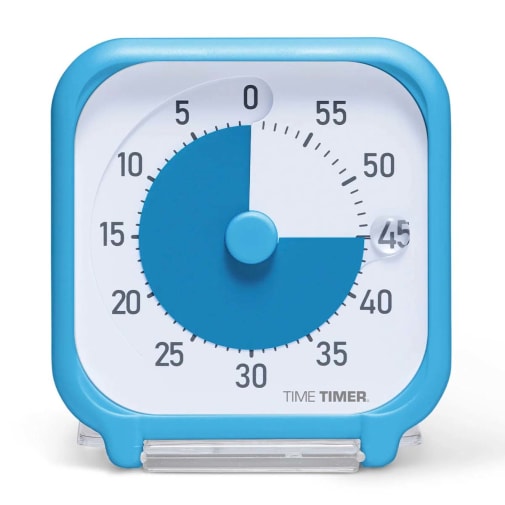
A simple timer turned into a useful tool. The pocket sized 3” Time Timer in blue combines a helpful dry erase card to indicate the task or leave a note for the user and the front-clear face plate folds underneath for a sturdy stand. There is a magnify lens that enlarges the number as the time decreases. A great tool to help students learn time management! Purchase of the physical timer gives you one year of premium access to the Time Timer App. A QR code inside the packaging takes you to the app to set up. Timer needs one (1) AA battery (not included). ~Rebecca
Time Timer Original 3" - Blue Frame with Blue Disk
SKU
043728
Grade K-AD
These icons are designed to help you quickly understand and learn important information about our products.
Teaching Method
Traditional
Teacher-centered curriculum commonly used in classrooms that may include a text, teacher manual, tests, etc.
Charlotte Mason
A methodology based on the work of a 19th century educator who maintained that children learn best from literature (Living Books), not textbooks.
Classical
A methodology based on the Latin Trivium (three stages of learning), including the grammar stage (memorization and facts), logic stage (critical thinking), and rhetoric stage (developing/defending ideas).
Unit Study
A thematic or topical approach centered around one topic that integrates multiple subject areas.
Montessori (Discovery)
A methodology based on the work of a 20th century educator that emphasizes student and sensory-driven discovery learning and real-life applications.
Other
Other methodologies
Religious Content
Secular
Contains content contrary to common Christian beliefs (i.e. evolution).
Neutral
Avoids religious or theoretical topics or presents multiple viewpoints without preference.
Christian/Religious
Faith-based or including instructional religious content.
Learning Modality
Auditory
Learns through listening, talking out loud or reading out loud.
Visual
Learns through seeing, prefers written instructions and visual materials.
Kinesthetic/Tactile (Hands-On)
Learns through moving, doing and touching.
Multi-Sensory
Curriculum that employ a variety of activities/components.
Presentation
Sequential
Curriculum progresses through well-defined learning objectives. Emphasizes mastery before moving to the next topic.
Spiral
Topics and concepts are repeated from level to level, adding more depth at each pass and connecting with review.
Conceptual/Topical
Focus is on the “why,” often with a unifying concept as well as specific skills; coverage may be broader.
Teacher Involvement
Low Teacher Involvement
Student-led materials; parent acts as a facilitator.
Medium Teacher Involvement
A mix of teacher-led time and independent student work.
High Teacher Involvement
Teacher-led lessons; may utilize discussions, hands-on activities and working together.
Additional Materials Required
No other materials needed
Everything you need is included.
Other Materials Required
There are additional required resources that are a separate purchase.
Other Materials Optional
There are additional resources mentioned or recommended but are not absolutely necessary.
Consumable
Consumable
Designed to be written in; not reusable.
Non-Consumable
Not designed to be written in; reusable.
Our Price
$29.95 $29.95 $25.95
Rainbow Savings: $4.00
Product Overview
- Time management doesn’t end when you leave your house—this pocket-sized Time Timer is great for travel and on the go!
- A great way to work on time management skills and introduce the Pomodoro technique
- Blue inner time disk disappears as time passes with no ticking! Optional use of alarm feature
Description
Publisher's Description of Time Timer Original 3" - Blue Frame with Blue Disk
The Time Timer Original 3" is an award-winning 60-minute countdown timer for individuals or small groups. The visual timer has a clear protective cover that flips over to serve as a desktop stand - perfect for a student's workspace in the home or classroom or on your work desk, whether in the office or a work-from-home space. Help keep your child on track with their education plans during homeschool or while on the go by throwing the timer into a purse, luggage, or backpack. Keep yourself focused in meetings or concentrated during big projects.
The Time Timer 3" includes one 3x3 inch Dry Erase Activity card that a teacher, therapist, or student can slot into the top for visual schedules and time-to-task management.
The Time Timer 3" includes one 3x3 inch Dry Erase Activity card that a teacher, therapist, or student can slot into the top for visual schedules and time-to-task management.
Category Description for Time Timer
These timers will have many uses in your classroom. Each timer has a round analog clock face, with black numbers against a white background. Set the timer at any point from 0 to 60 minutes or more (depending on the timer), then watch the time elapse clockwise. A red disk shows the remaining time, gradually diminishing until no red is visible. The clock face has numbers for every five-minute interval (i.e. 55 min, 50 min, etc.), and tick marks designate minutes. The timer is silent (no distracting ticking). It has an on/off switch for an optional "beep beep" sound when the time is up. Of course, these timers are handy for timing tests and homework sessions, but these versatile tools can be used to teach time concepts to students and promote time management as well. ~ Lisa
Details
| Product Format: | Other |
|---|---|
| Grades: | K-AD |
| Brand: | Time Timer |
| EAN/UPC: | 850070055161 |
| Length in Inches: | 3.4375 |
| Width in Inches: | 3.25 |
| Height in Inches: | 1.625 |
| Weight in Pounds: | 0.25 |
Videos
Reviews