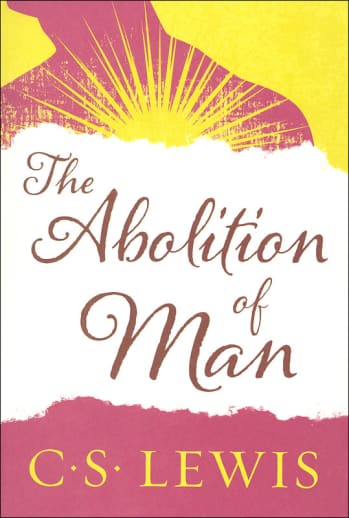
The Abolition of Man C.S. Lewis

SKU
043502
ISBN
9780060652944
Grade 9-AD
Teaching Method
Traditional
Teacher-centered curriculum commonly used in classrooms that may include a text, teacher manual, tests, etc.
Charlotte Mason
A methodology based on the work of a 19th century educator who maintained that children learn best from literature (Living Books), not textbooks.
Classical
A methodology based on the Latin Trivium (three stages of learning), including the grammar stage (memorization and facts), logic stage (critical thinking), and rhetoric stage (developing/defending ideas).
Unit Study
A thematic or topical approach centered around one topic that integrates multiple subject areas.
Montessori (Discovery)
A methodology based on the work of a 20th century educator that emphasizes student and sensory-driven discovery learning and real-life applications.
Other
Other methodologies
Religious Content
Secular
Contains content contrary to common Christian beliefs (i.e. evolution).
Neutral
Avoids religious or theoretical topics or presents multiple viewpoints without preference.
Christian/Religious
Faith-based or including instructional religious content.
Learning Modality
Auditory
Learns through listening, talking out loud or reading out loud.
Visual
Learns through seeing, prefers written instructions and visual materials.
Kinesthetic/Tactile (Hands-On)
Learns through moving, doing and touching.
Multi-Sensory
Curriculum that employ a variety of activities/components.
Presentation
Sequential
Curriculum progresses through well-defined learning objectives. Emphasizes mastery before moving to the next topic.
Spiral
Topics and concepts are repeated from level to level, adding more depth at each pass and connecting with review.
Conceptual/Topical
Focus is on the “why,” often with a unifying concept as well as specific skills; coverage may be broader.
Teacher Involvement
Low Teacher Involvement
Student-led materials; parent acts as a facilitator.
Medium Teacher Involvement
A mix of teacher-led time and independent student work.
High Teacher Involvement
Teacher-led lessons; may utilize discussions, hands-on activities and working together.
Additional Materials Required
No other materials needed
Everything you need is included.
Other Materials Required
There are additional required resources that are a separate purchase.
Other Materials Optional
There are additional resources mentioned or recommended but are not absolutely necessary.
Consumable
Consumable
Designed to be written in; not reusable.
Non-Consumable
Not designed to be written in; reusable.
Our Price
$17.99 $17.99 $13.50
Rainbow Savings: $4.49

Description

This classic by C.S. Lewis shares his views on the education of older students (and how educators of his day were leading students down a dangerous path), and uses that as a starting point to stress the importance of good values, courage, and honor in our society. He warns of the consequences of an education or social thinking that undermines the importance of good values and treats everything as relative. He states that some things are in fact objective (they are without doubt good or evil) and criticizes the way society is trying to rationalize the diminishment of the belief in natural values. Finally he warns of a future in which the values and morals of the majority are controlled by a small group of people who rule by a perfect understanding of psychology. One of most debated of Lewis's work, this book stresses that above all else, people should be taught to love good and hate evil. 114 pages, softcover. ~ Rachel

Publisher's Description of The Abolition of Man C.S. Lewis

In many ways C. S. Lewis predicted the future. “He foresaw the rise of trends we’re currently experiencing: ethical emotivism, the sometimes unquestioned authority of science, and the increasing use of technology by states to control their populations.” –The Gospel Coalition, Joseph A. Kohm Jr.

The Abolition of Man discusses why we shouldn’t always listen to only reason and cut out our emotions. Lewis argues that reason without emotion there is not a reality. He debunks arguments that the purist form of reason is instinct, that benevolent actions will be found through pursuing science, and that science will be the best moral compass for mankind to follow. Lewis proves that moral absolutes do exist and they are universal throughout all of time.

This is a book for C. S. Lewis fans and anyone who wants to better understand traditional moral virtues and how they impact your life. Lewis said, “If nothing is self-evident then nothing can be proved.” There must be self-evident truths that can be applied everywhere. The book brings together a series of lectures on education that Lewis delivered over three nights at the University of Durham.

Details
More Information
Product Format:Softcover Book
Grades:9-AD
Brand:HarperSanFrancisco
Author:C.S. Lewis
ISBN:9780060652944
Length in Inches:8
Width in Inches:5.375
Height in Inches:0.3125
Weight in Pounds:0.2437
Videos
This product doesn't have a video
Reviews
Product Q&A