
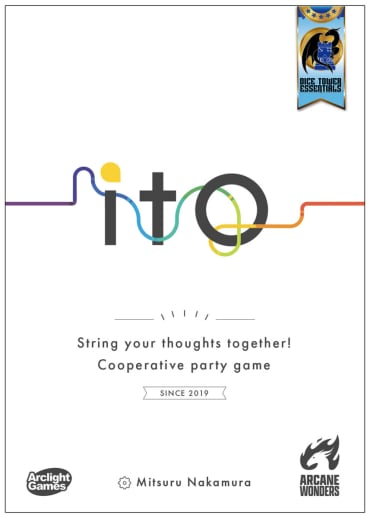

Ito from Arcane Wonders is a cooperative card game for 2-10 people and the perfect choice for family and party groups. The concept is simple but facilitates thought, laughter, and often synchronicity. Best of all, it takes only 10 minutes per round. Here is how it works:
There are two decks of cards that drive this game: One has 50 category cards, and the other has cards numbered from 1-100. Also included is one 0 card. The category cards are two-sided and include three different categories to help customize the game to your group: 1) Everyone cards work for most groups; 2) Family cards play with all ages; and 3) Action cards include physical movement such as singing and sound effects.
The other card component are the player cards. There are ten 3-card sets of different colors, which are used to mark individual players’ “guesses” during gameplay as explained later in this description. Each player chooses one set.
To set up the game, place the 0 card in the middle of the table and shuffle the number and category card decks. Deal each player one number card, which they keep secret from other players. Draw the top card from the category deck and choose one category on either side of the card to use.
To illustrate how gameplay works, imagine that the chosen category card is from the “everyone” group and has the following statement: “Things or actions that take bravery.” Imagine there are three people playing. Player 1 has the number 3 card, Player 2 has 10, and Player 3 has 85. Each player takes turns providing an example best matching their number on a scale to 100 and relative to the category statement. Showing a great amount of bravery would signify a higher number, with little bravery being a lower number. As each player gives their example, they place their number card face down in a line that starts with the 0 card and goes to its right, trying to set its placement relative to zero and to other player’s examples. They also mark their unrevealed number card by placing one of their color-coded cards underneath. Players work together, modifying their hints, but they cannot give any number value–related clues. With the collective goal to put the number cards in the correct order, they may discuss as a group where each number card should be and may make changes to their order.
Begin the resolution phase by revealing each card starting from zero. If all the cards are in the right order, the player group wins! Using the above category of bravery, a win might be 3 (crossing a country road), 10 (rolling down a small hill), and 85 (rescuing people from a burning building). The key to this game is being able to give clues relative to each other and number values. When players happen to have number cards that are closer to each other the game becomes more challenging. Since Ito plays in just 10 minutes per round, it is compelling and fun to play several times! A personal suggestion is to have at least four players, as Ito is at its best in larger groups, both for gameplay and the compelling conversations it elicits! ~ Marsha