
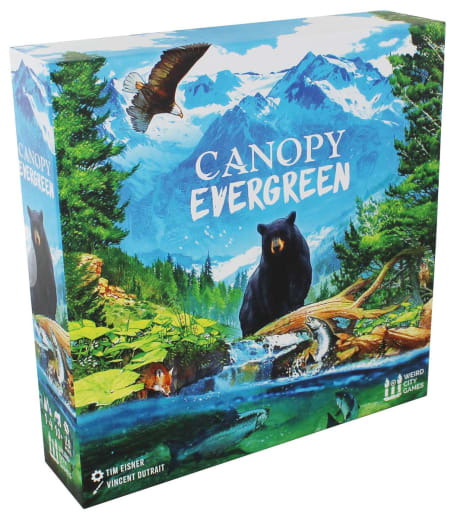
Trees, plants, wildlife, and weather all contribute to the forest in Canopy Evergreen by Weird City Games. What will players experience when they play this game? How can they succeed in creating a balanced environment in their forest to benefit all the living things that inhabit it? How can they win the game?
The experience: Players draft cards over three rounds that consist of tree sections, plants, weather conditions, and wildlife. Different cards provide actions, benefits, and points at the end of each of three rounds and at the end of the game.
Everyone has their own forest map where they will plant and grow 3-dimensional cardboard trees with a root section, trunk sections, and a canopy. The board also tracks food that players earn during the game and all game points. Food points are provided by specific plant species and are used to purchase wildlife cards from a separate display deck.
Creating a balanced environment involves planting enough trees to provide shade, anchor the forest floor to nurture the plants beneath it, and provide food and shelter for the wildlife that inhabit it. The cards used to create your forest work together to support the goals needed to win the game.
The goal for building trees is to try to get as many trunk sections as possible in each tree before completing it with a canopy. Points are awarded when the tree is completed and each round the player with the tallest tree earns additional points.
Plant cards are scored and discarded at the end of each round. Points are given for collecting sets of them, with each card showing how many points are awarded for different numbers of specific cards. Weather cards score points each round for sets of sun and rain icons. The other cards that impact round-end scoring are threat cards, such as droughts and wildfires. Sometimes they require players to discard other cards or subtract points.
Unlike plant cards, Wildlife cards have a separate display and deck to choose from and remain in your forest throughout the game. There are three types of wildlife cards. Some are “active”, which provide ongoing abilities, others are “foraging” which provide points at each round end, and the third type are “point” wildlife, which provide only end-game points. Other end-game points from wildlife cards include 2 points for a pair or 5 points for three of the same wildlife species. Each wildlife card has 2 of 7 species symbols on their lower right and lower left corners. If you place matching symbols next to each other to create a consecutive chain of cards, you gain points that escalate from 0 to 17 based on a range of 1 to 7 cards in a chain.
The person with the most points, after all scoring is complete, wins the game! For 1-4 players with a 45–60-minute game time. Solo instructions are included. To read more about this game and its specific cards, see the link to the game manual above. If you are wondering whether Canopy or Canopy Evergreen is the right choice for you, my recommendation after playing them both follows. - - - Marsha
Comparison between Canopy and Canopy Evergreen:
Canopy: For ages 8+, Card Drafting of all species, lower complexity, plays best at 2 but additional instructions for 3-4 players, smaller box
Canopy Evergreen: For ages 10+, Player Boards used to grow trees, track food, and score, separate card display for wildlife to purchase with food, plays well at 2-4 players, a bit more complexity