
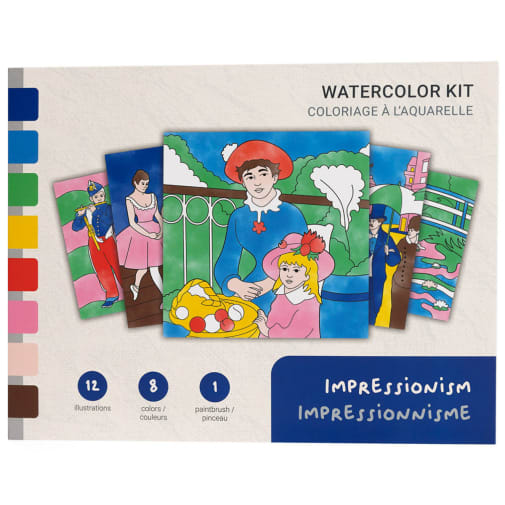
Impressionism Watercolor Kit from Today Is Art Day is a simple way to introduce your students to a survey of artists from the Impressionist movement. Spend time with Monet, Renoir, Cezanne, Degas, Manet, Caillebotte, Cassatt and Morisot. Set includes 12 perforated pages to color, each with a paper palette of 8 colors, and a small brush. Just add water! I would consider adding this affordable set of watercolor brushes with various sizes (12 total) if you want kids to paint at the same time. ~Sara
Impressionism Watercolor Kit
SKU
042768
Grade 5-AD
These icons are designed to help you quickly understand and learn important information about our products.
Teaching Method
Traditional
Teacher-centered curriculum commonly used in classrooms that may include a text, teacher manual, tests, etc.
Charlotte Mason
A methodology based on the work of a 19th century educator who maintained that children learn best from literature (Living Books), not textbooks.
Classical
A methodology based on the Latin Trivium (three stages of learning), including the grammar stage (memorization and facts), logic stage (critical thinking), and rhetoric stage (developing/defending ideas).
Unit Study
A thematic or topical approach centered around one topic that integrates multiple subject areas.
Montessori (Discovery)
A methodology based on the work of a 20th century educator that emphasizes student and sensory-driven discovery learning and real-life applications.
Other
Other methodologies
Religious Content
Secular
Contains content contrary to common Christian beliefs (i.e. evolution).
Neutral
Avoids religious or theoretical topics or presents multiple viewpoints without preference.
Christian/Religious
Faith-based or including instructional religious content.
Learning Modality
Auditory
Learns through listening, talking out loud or reading out loud.
Visual
Learns through seeing, prefers written instructions and visual materials.
Kinesthetic/Tactile (Hands-On)
Learns through moving, doing and touching.
Multi-Sensory
Curriculum that employ a variety of activities/components.
Presentation
Sequential
Curriculum progresses through well-defined learning objectives. Emphasizes mastery before moving to the next topic.
Spiral
Topics and concepts are repeated from level to level, adding more depth at each pass and connecting with review.
Conceptual/Topical
Focus is on the “why,” often with a unifying concept as well as specific skills; coverage may be broader.
Teacher Involvement
Low Teacher Involvement
Student-led materials; parent acts as a facilitator.
Medium Teacher Involvement
A mix of teacher-led time and independent student work.
High Teacher Involvement
Teacher-led lessons; may utilize discussions, hands-on activities and working together.
Additional Materials Required
No other materials needed
Everything you need is included.
Other Materials Required
There are additional required resources that are a separate purchase.
Other Materials Optional
There are additional resources mentioned or recommended but are not absolutely necessary.
Consumable
Consumable
Designed to be written in; not reusable.
Non-Consumable
Not designed to be written in; reusable.
Our Price
$19.95 Product Overview
- Explore the work of several Impressionist artists!
- Set includes 12 pages with paper palettes and a brush
- Add water to the paper palette to activate 8 paint colors
Description
Publisher's Description of Impressionism Watercolor Kit
Let your child enter the magical world of Impressionist art by recreating the works of iconic artists such as Renoir, Monet, and Caillebotte. This kit offers a fun, hands-on way for kids to explore art, culture, and their own creative voice.
Includes 12 masterpieces:
- Dance at Bougival - Pierre-Auguste Renoir
- A King Charles Spaniel - Edouard Manet
- The Basket of Apples - Paul Cézanne
- The Gare Saint-Lazare, Arrival of a Train - Claude Monet
- Two Sisters (On the Terrace) - Pierre-Auguste Renoir
- Dancers in a Studio - Edgar Degas
- Bridge over a Pond of Water Lilies - Claude Monet
- Paris Street; Rainy Day - Gustave Caillebotte
- Woman with a Parasol - Claude Monet
- The Boating Party - Mary Cassatt
- The Fifer - Edouard Manet
- The Cradle - Berthe Morisot
About the Impressionism movement
Impressionism was a 19th-century art movement characterized by visible brush strokes, open composition, emphasis on accurate depiction of light in its changing qualities (often accentuating the effects of the passage of time), ordinary subject matter, unusual visual angles, and inclusion of movement as a crucial element of human perception and experience.
Includes 12 masterpieces:
- Dance at Bougival - Pierre-Auguste Renoir
- A King Charles Spaniel - Edouard Manet
- The Basket of Apples - Paul Cézanne
- The Gare Saint-Lazare, Arrival of a Train - Claude Monet
- Two Sisters (On the Terrace) - Pierre-Auguste Renoir
- Dancers in a Studio - Edgar Degas
- Bridge over a Pond of Water Lilies - Claude Monet
- Paris Street; Rainy Day - Gustave Caillebotte
- Woman with a Parasol - Claude Monet
- The Boating Party - Mary Cassatt
- The Fifer - Edouard Manet
- The Cradle - Berthe Morisot
About the Impressionism movement
Impressionism was a 19th-century art movement characterized by visible brush strokes, open composition, emphasis on accurate depiction of light in its changing qualities (often accentuating the effects of the passage of time), ordinary subject matter, unusual visual angles, and inclusion of movement as a crucial element of human perception and experience.
Category Description for Today is Art Day Watercolor Kits
Watercolor Kits from Today is Art Day are unique in their simplicity. Each book includes 12 (8.5” square) blackline versions of famous artwork to paint with its own palette of 8 colors to use. The paint colors are on the paper in a strip. You wet the brush (included) with water, rub it on the color to pick up paint, and use that to color the image. The paper is heavyweight with a coating on the back. Both the image and the paint color strips are perforated for easy use. Designs are one-sided.
You’ll end up with quite an art gallery! I can see doing a book with several kids around a table having fun making cool art at a party or family event (just get more brushes). Tear out a page and palette for each young artist. The brush that comes with each book is small, but useable. If I were using these books, I would want to incorporate more brush size options like this affordable set of 12 watercolor brushes.
Add these to an art lesson or a unit study! It’s a great way to build familiarity with famous artists and their works. ~Sara
Details
| Product Format: | Other |
|---|---|
| Grades: | 5-AD |
| Brand: | Today is Art Day |
| EAN/UPC: | 753386480446 |
| Length in Inches: | 8.5 |
| Width in Inches: | 11 |
| Height in Inches: | 0.375 |
| Weight in Pounds: | 0.8 |
Videos
Reviews