
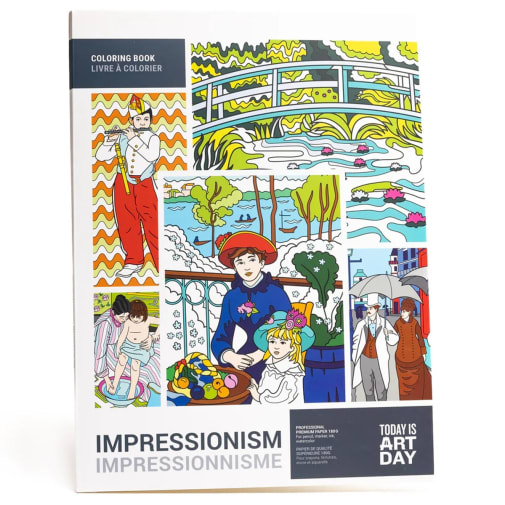
Coloring book featuring special outline versions of famous artworks by Degas, Monet, Renoir, Cassatt and more! Pages are gummed for easy removal. ~Sara
Impressionism Coloring Book
SKU
042753
Grade 5-AD
These icons are designed to help you quickly understand and learn important information about our products.
Teaching Method
Traditional
Teacher-centered curriculum commonly used in classrooms that may include a text, teacher manual, tests, etc.
Charlotte Mason
A methodology based on the work of a 19th century educator who maintained that children learn best from literature (Living Books), not textbooks.
Classical
A methodology based on the Latin Trivium (three stages of learning), including the grammar stage (memorization and facts), logic stage (critical thinking), and rhetoric stage (developing/defending ideas).
Unit Study
A thematic or topical approach centered around one topic that integrates multiple subject areas.
Montessori (Discovery)
A methodology based on the work of a 20th century educator that emphasizes student and sensory-driven discovery learning and real-life applications.
Other
Other methodologies
Religious Content
Secular
Contains content contrary to common Christian beliefs (i.e. evolution).
Neutral
Avoids religious or theoretical topics or presents multiple viewpoints without preference.
Christian/Religious
Faith-based or including instructional religious content.
Learning Modality
Auditory
Learns through listening, talking out loud or reading out loud.
Visual
Learns through seeing, prefers written instructions and visual materials.
Kinesthetic/Tactile (Hands-On)
Learns through moving, doing and touching.
Multi-Sensory
Curriculum that employ a variety of activities/components.
Presentation
Sequential
Curriculum progresses through well-defined learning objectives. Emphasizes mastery before moving to the next topic.
Spiral
Topics and concepts are repeated from level to level, adding more depth at each pass and connecting with review.
Conceptual/Topical
Focus is on the “why,” often with a unifying concept as well as specific skills; coverage may be broader.
Teacher Involvement
Low Teacher Involvement
Student-led materials; parent acts as a facilitator.
Medium Teacher Involvement
A mix of teacher-led time and independent student work.
High Teacher Involvement
Teacher-led lessons; may utilize discussions, hands-on activities and working together.
Additional Materials Required
No other materials needed
Everything you need is included.
Other Materials Required
There are additional required resources that are a separate purchase.
Other Materials Optional
There are additional resources mentioned or recommended but are not absolutely necessary.
Consumable
Consumable
Designed to be written in; not reusable.
Non-Consumable
Not designed to be written in; reusable.
Our Price
$21.95 Product Overview
- Create beautiful works of art with the masters!
- Includes 12 large format coloring pages (10” x14”)
- Use pencil, marker, ink or watercolors on 50# paper
Description
Publisher's Description of Impressionism Coloring Book
Channel your inner Impressionist and recreate timeless masterpieces from the Impressionist period. This coloring book is printed on thick, high-quality paper, allowing you to use any medium you like. Pencils, watercolors, paint, ink, there is no limit to your creativity.
Includes 12 masterpieces:
- Gustave Caillebotte. Paris Street; Rainy Day - 1877
- Mary Cassatt. The Childs Bath - 1893
- Edgar Degas. Dancers in a Studio - 1884
- Édouard Manet. The Fifer - 1866
- Édouard Manet. Luncheon on the Grass - 1863
- Claude Monet. Bridge over a Pond of Water Lilies - 1899
- Claude Monet. Woman with a Parasol - 1875
- Berthe Morisot. The Cradle - 1872
- Camille Pissarro. Rue Saint-Honoré in the Afternoon. Effect of Rain - 1897
- Pierre Auguste-Renoir. Dance at Le Moulin de la Galette - 1881
- Pierre Auguste-Renoir. Two Sisters - 1881
- Alfred Sisley. Boat in the Flood at Port Marly - 1876
Category Description for Today is Art Day Coloring Books
This is not your usual coloring book! The pages are large (10x14”) and heavy (50#) with bold blackline versions of 12 favorite works of art you get to fill in yourself.
Use pencil, marker, ink, even watercolors on these heavy
coloring pages! Designs are on one side only with some in portrait and some in
landscape formats. Pages are gummed and easily removed from the pad.
These would make a fabulous gift with some special art supplies like Prismacolor colored pencils, maybe some brush tip markers, or one of these Royal & Langnickel sets.
Details
| Product Format: | Paperback Book |
|---|---|
| Grades: | 5-AD |
| Brand: | Today is Art Day |
| EAN/UPC: | 717340183453 |
| Length in Inches: | 13.375 |
| Width in Inches: | 10 |
| Height in Inches: | 0.25 |
| Weight in Pounds: | 1.05 |
Videos
Reviews