These icons are designed to help you quickly understand and learn important information about our products.
Teaching Method
Traditional
Teacher-centered curriculum commonly used in classrooms that may include a text, teacher manual, tests, etc.
Charlotte Mason
A methodology based on the work of a 19th century educator who maintained that children learn best from literature (Living Books), not textbooks.
Classical
A methodology based on the Latin Trivium (three stages of learning), including the grammar stage (memorization and facts), logic stage (critical thinking), and rhetoric stage (developing/defending ideas).
Unit Study
A thematic or topical approach centered around one topic that integrates multiple subject areas.
Montessori (Discovery)
A methodology based on the work of a 20th century educator that emphasizes student and sensory-driven discovery learning and real-life applications.
Other
Other methodologies
Religious Content
Secular
Contains content contrary to common Christian beliefs (i.e. evolution).
Neutral
Avoids religious or theoretical topics or presents multiple viewpoints without preference.
Christian/Religious
Faith-based or including instructional religious content.
Learning Modality
Auditory
Learns through listening, talking out loud or reading out loud.
Visual
Learns through seeing, prefers written instructions and visual materials.
Kinesthetic/Tactile (Hands-On)
Learns through moving, doing and touching.
Multi-Sensory
Curriculum that employ a variety of activities/components.
Presentation
Sequential
Curriculum progresses through well-defined learning objectives. Emphasizes mastery before moving to the next topic.
Spiral
Topics and concepts are repeated from level to level, adding more depth at each pass and connecting with review.
Conceptual/Topical
Focus is on the “why,” often with a unifying concept as well as specific skills; coverage may be broader.
Teacher Involvement
Low Teacher Involvement
Student-led materials; parent acts as a facilitator.
Medium Teacher Involvement
A mix of teacher-led time and independent student work.
High Teacher Involvement
Teacher-led lessons; may utilize discussions, hands-on activities and working together.
Additional Materials Required
No other materials needed
Everything you need is included.
Other Materials Required
There are additional required resources that are a separate purchase.
Other Materials Optional
There are additional resources mentioned or recommended but are not absolutely necessary.
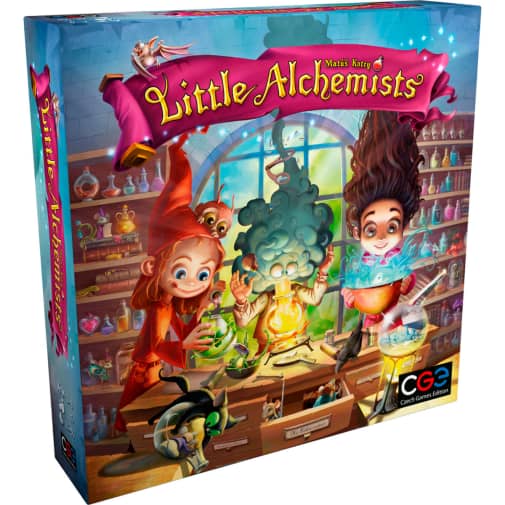
Little Alchemists by
Czech Games will keep kids and adults entertained through several gameplays
because even though the mechanics are simple, there are built-in layers of
accumulating challenges. Players compete to earn the most coins for selling
potions to customers. Six additional game levels can be unlocked with
everyone’s help at the end of each game.
I played through one game at the
beginning level, which was enough for me to learn the following:
This game helps
develop deductive reasoning skills as well as resource management as players test
out different combinations of ingredients to learn what the resulting potion
is. There are 15 possible combinations of six different ingredients with three
different possible potions resulting from them. Each game changes the
ingredient input to potion output for optimal variations between plays. Everyone
tracks the results of their mixtures on a board, which provides a framework to
earn coins and collaborate with others at the end of the game, when players
work together to answer a questionnaire that may allow advancement to the next
game level/challenge for everyone.
Little Alchemists
uses a phone/tablet app, which provides the results of combining ingredients. I
recommend using the manual mode in the app settings, where you enter in each
ingredient manually rather than using the default scanning mode, as it can be
glitchy.
After my first
play, I felt pulled to continue, as I liked the idea of discovering what new
secrets and challenges awaited in the next six levels. This speaks volumes to
the family experiences possible when interest in replay exists across wide age
levels.
Each game lasts 20-40 minutes,
which is a nice opportunity for a quick game and even a replay, which I am sure
will be requested! ~ Marsha
Publisher's Description of Little Alchemists Game
Alchemist apprentices brew potions and work on discovering secrets of alchemy.
Will you surpass your teachers’ knowledge and grow up to become the best alchemists in the land? Let’s find out! It’s time to grab your potion ingredients, sharpen your deduction skills, and get mixing! Little Alchemists is a family-friendly deduction game that’s designed to grow with the curious minds of young players. The game starts with simple concepts and mechanics — you’ll start by gathering and combining ingredients for brewing potions to sell. As you collect keys by achieving your potion-making goals, however, you’ll unlock new chapters that gradually add more components, mechanics, and complexity to the experience. Components