
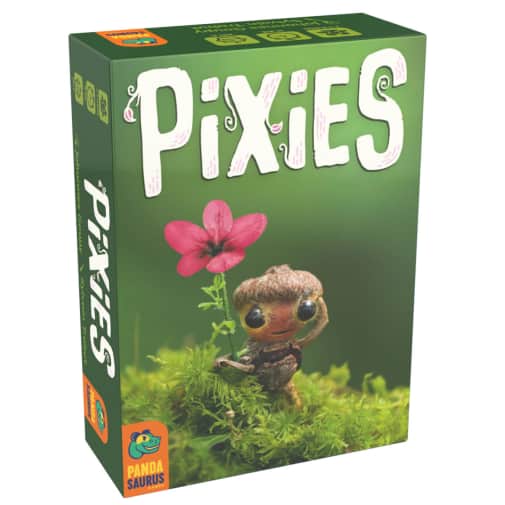
Pixies are small, mischievous mythical beings that grace this lighthearted, easy-to-teach 30-minute card game from Pandasaurus Games. The goal is to gain the most points over three rounds by placing cards, numbered 1-9, in a grid and then optimizing these points each round to win the game!
Setup and play are simple with just 70 shuffled cards and 2-5 eager card players. The first player reveals cards from the deck as follows: For 2 players, reveal 4 cards, and for 3-5 players, reveal the same number of cards as players. Going clockwise, each player takes one of the revealed cards and places it in a personal 3x3 grid in order of the number printed on the card. In a two-player game, there are four cards displayed and each player takes collects a card twice, so that each player has chosen two cards instead of one.
There are 3 rules that must be followed in card placement. 1) If this is the first card of that number in your grid, place it face-up in the grid. 2) If you already have a card of that number in your grid, choose one of them to be the face-up card and the other to place underneath with the back of the card facing up. At that point, the top card is “validated” for benefit of the first of five scoring criteria. 3) If there are already two cards of that number in your grid, place it face down in an empty spot in your grid. After everyone has placed their card(s), a new display is created from the deck and the player who took the last card is first to choose their card(s).
The round-end triggers when someone places a card causing all nine of their grid spaces to contain at least one card. Everyone who has not had a turn that round takes one more, and round-end scoring starts. If there are two players, the round ends after both players have taken at least one card. Look at the scoring criteria below before your first play, then I will describe the setup for rounds 2 and 3.
Five different scoring criteria follow, and understanding them before your first play is important to optimize strategy. Look at some of the cards from the deck for reference, noting that there are four different colored cards (yellow, blue, red, and green) and some wild cards that represent all four colors. The color(s) of each card appears at the bottom, represented by colored symbol(s).
- Validated Cards: Where there are two cards in a grid number spot, add the numbers on the top face-up card.
The remaining four scoring criteria below apply to all face-up cards, even if there is no card underneath it:
- Spirals: Looking at the cards, some have one or more spiral shapes in their upper left-hand corner. Count only the ones that are not “special cards” and score one point each. Special cards have one spiral and one of the four colors next to it.
- Special Cards: Score all face-up cards that match the color of the special card, including wild colored cards.
- Count the cross-X marks on face-up cards. Subtract one point for each one.
- Largest color zone of each player: To qualify, there must be at least two cards of the same color touching along a side (not diagonal) connecting a contiguous number of the same color. Each card in that zone is multiplied by 2 in round 1, 3 in round 2, and 4 in round 3.
Prior to rounds 2 and 3, collect all cards from players, shuffle the entire deck, create a new display and start the next round. After three rounds are completed, total scores for all rounds. The player with the most points wins the game and the Pixies celebrate!
In my experience, there was a bit of pixie dust during the first round, and I made some moves that were not beneficial. I had to remember the special cards and pay attention to x’s as they subtract from scoring. Afterwards, I compulsively played a few more times because it was so much fun! I hope you enjoy Pixies as much as I do! ~ Marsha