
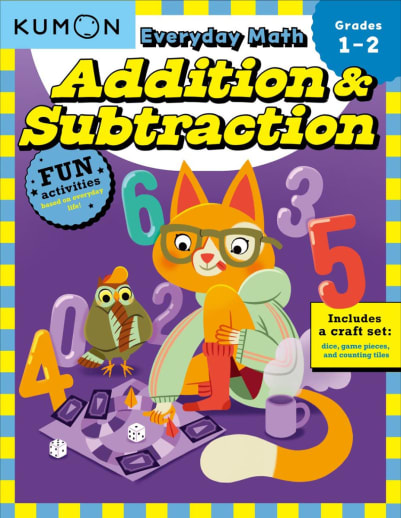
Reinforce math skills your child will use with the Everyday Math: Addition and Subtraction workbook from Kumon. A wide variety of graphics will engage your student as they solve addition and subtraction problems. A cute fox character in the corner offers a few hints to your student before they begin each page. Your student will stay busy matching, reading comic-book style stories, and playing games. The workbook also includes a craft kit to make your own game tokens, dice, and counting tiles.
Math problems work with numbers up to twenty and include carrying and borrowing. Adding and subtracting three one-digit numbers is included as well. Full-color answer key in back. Softcover, 128 pages. ~TaraKumon Everyday Math: Addition & Subtraction
SKU
040334
ISBN
9781953845252
Grade 1-2
These icons are designed to help you quickly understand and learn important information about our products.
Teaching Method
Traditional
Teacher-centered curriculum commonly used in classrooms that may include a text, teacher manual, tests, etc.
Charlotte Mason
A methodology based on the work of a 19th century educator who maintained that children learn best from literature (Living Books), not textbooks.
Classical
A methodology based on the Latin Trivium (three stages of learning), including the grammar stage (memorization and facts), logic stage (critical thinking), and rhetoric stage (developing/defending ideas).
Unit Study
A thematic or topical approach centered around one topic that integrates multiple subject areas.
Montessori (Discovery)
A methodology based on the work of a 20th century educator that emphasizes student and sensory-driven discovery learning and real-life applications.
Other
Other methodologies
Religious Content
Secular
Contains content contrary to common Christian beliefs (i.e. evolution).
Neutral
Avoids religious or theoretical topics or presents multiple viewpoints without preference.
Christian/Religious
Faith-based or including instructional religious content.
Learning Modality
Auditory
Learns through listening, talking out loud or reading out loud.
Visual
Learns through seeing, prefers written instructions and visual materials.
Kinesthetic/Tactile (Hands-On)
Learns through moving, doing and touching.
Multi-Sensory
Curriculum that employ a variety of activities/components.
Presentation
Sequential
Curriculum progresses through well-defined learning objectives. Emphasizes mastery before moving to the next topic.
Spiral
Topics and concepts are repeated from level to level, adding more depth at each pass and connecting with review.
Conceptual/Topical
Focus is on the “why,” often with a unifying concept as well as specific skills; coverage may be broader.
Teacher Involvement
Low Teacher Involvement
Student-led materials; parent acts as a facilitator.
Medium Teacher Involvement
A mix of teacher-led time and independent student work.
High Teacher Involvement
Teacher-led lessons; may utilize discussions, hands-on activities and working together.
Additional Materials Required
No other materials needed
Everything you need is included.
Other Materials Required
There are additional required resources that are a separate purchase.
Other Materials Optional
There are additional resources mentioned or recommended but are not absolutely necessary.
Consumable
Consumable
Designed to be written in; not reusable.
Non-Consumable
Not designed to be written in; reusable.
Our Price
$10.95 $10.95 $7.45
Rainbow Savings: $3.50
Product Overview
- Addition and subtraction problems up to 20, including borrowing and carrying
- A variety of fun math activities
- Includes a craft kit to make your own math manipulatives
Description
Publisher's Description of Kumon Everyday Math: Addition & Subtraction
Learn addition & subtraction with fun activities based on everyday life. Complete with Dice, Game Pieces, and Counting Tiles!
Immerse your child in an enriching learning experience with our comprehensive workbook series. Tailored for young minds capable of reading and writing numbers up to the impressive range of 100, adept at basic addition and subtraction, and equipped with a rough grasp of telling time by observing clock hands. Our meticulously crafted workbooks are meticulously crafted to enhance mathematical prowess while fostering practical application through engaging and interactive activities. Drawing upon relatable scenarios and familiar objects from their daily lives, children will effortlessly refine their existing math skills and unlock the ability to employ them effectively. Prepare your child for a lifelong journey of numerical mastery through enjoyable and game-like learning experiences.
Category Description for Kumon Everyday Math (1-2)
Reviewing “everyday math” can be fun with these bright Kumon workbooks. Books include a variety of activities and cut-out manipulatives to engage your student. All pages are in full color and feature fun drawings, cartoons, and vibrant backgrounds. Easy for a student to use independently with an answer key in the back. ~Tara
Details
| Product Format: | Paperback Book |
|---|---|
| Grades: | 1-2 |
| Brand: | Kumon Publishers |
| ISBN: | 9781953845252 |
| Length in Inches: | 11 |
| Width in Inches: | 8.5 |
| Height in Inches: | 0.375 |
| Weight in Pounds: | 1.1 |
Videos
Reviews