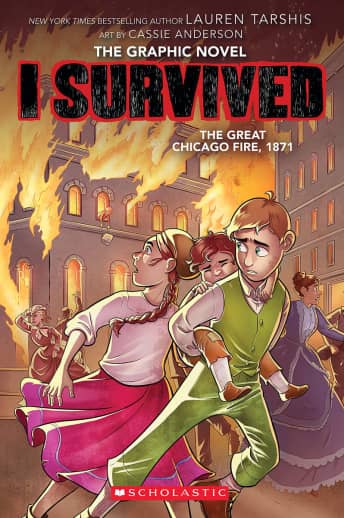
I Survived the Great Chicago Fire, 1871 (Graphic Novel)
SKU
036864
ISBN
9781338825152
Grade 3-7
These icons are designed to help you quickly understand and learn important information about our products.
Teaching Method
Traditional
Teacher-centered curriculum commonly used in classrooms that may include a text, teacher manual, tests, etc.
Charlotte Mason
A methodology based on the work of a 19th century educator who maintained that children learn best from literature (Living Books), not textbooks.
Classical
A methodology based on the Latin Trivium (three stages of learning), including the grammar stage (memorization and facts), logic stage (critical thinking), and rhetoric stage (developing/defending ideas).
Unit Study
A thematic or topical approach centered around one topic that integrates multiple subject areas.
Montessori (Discovery)
A methodology based on the work of a 20th century educator that emphasizes student and sensory-driven discovery learning and real-life applications.
Other
Other methodologies
Religious Content
Secular
Contains content contrary to common Christian beliefs (i.e. evolution).
Neutral
Avoids religious or theoretical topics or presents multiple viewpoints without preference.
Christian/Religious
Faith-based or including instructional religious content.
Learning Modality
Auditory
Learns through listening, talking out loud or reading out loud.
Visual
Learns through seeing, prefers written instructions and visual materials.
Kinesthetic/Tactile (Hands-On)
Learns through moving, doing and touching.
Multi-Sensory
Curriculum that employ a variety of activities/components.
Presentation
Sequential
Curriculum progresses through well-defined learning objectives. Emphasizes mastery before moving to the next topic.
Spiral
Topics and concepts are repeated from level to level, adding more depth at each pass and connecting with review.
Conceptual/Topical
Focus is on the “why,” often with a unifying concept as well as specific skills; coverage may be broader.
Teacher Involvement
Low Teacher Involvement
Student-led materials; parent acts as a facilitator.
Medium Teacher Involvement
A mix of teacher-led time and independent student work.
High Teacher Involvement
Teacher-led lessons; may utilize discussions, hands-on activities and working together.
Additional Materials Required
No other materials needed
Everything you need is included.
Other Materials Required
There are additional required resources that are a separate purchase.
Other Materials Optional
There are additional resources mentioned or recommended but are not absolutely necessary.
Oscar is moving
to Chicago and is not happy about it when he is robbed upon arrival. His
adventure starts when he chases the thief right into the big fire destroying
the city. Join him on his dangerous adventure in I Survived The Great
Chicago Fire, 1871: Graphic Novel by Lauren Tarshis, published by
Scholastic. History comes to life with amazing illustrations by Cassie
Anderson. Will this brave boy find the thief and survive the city that is
ablaze? 148 pages, with additional reference pages in the back including maps,
pictures, photographs, and other facts. Written at a 400 Lexile Level, 2.8
Accelerated Reading Level makes it a great addition to any upper elementary or
junior high school or home library. Could be read for enjoyment or as a
supplement for a Social Studies lesson. Softcover.
Publisher's Description of I Survived the Great Chicago Fire, 1871 (Graphic Novel)
Oscar Starling never wanted to move to Chicago. The smog, the stench, the thieves around every corner -- it"s so different from his old life on the farm. Will the big city ever feel like home? But shortly after Oscar arrives, a huge fire breaks out. All of Chicago is ablaze and one thing is clear: the city is like a powder keg, ready to explode. An army of firemen tries to help, but this fire is a ferocious beast that wants to devour everything in its path. Will Oscar -- and his new city and new friends -- survive one of the most famous and devastating fires in history?
Historical fiction is a popular genre for a variety of ages. Graphic novels appeal to visual learners and reluctant readers, as well as those who just love the comic book look. Combine the two and you have this series based on true events and presented in a visual format for the reader. Kids will read them again and again as they glean something new each time from the illustrations. In the back is a section on the actual event, including books for additional reading. These are a cool addition to a social studies or history course, a unit study, or a home/school library. I liked the size of the series too – not too small or too big. ~Sara