
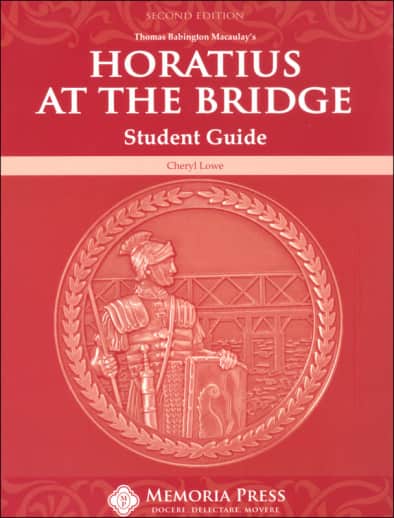

Inspire patriotism and courage with the Horatius at the Bridge Student Guide (2nd Edition) from Memoria Press, designed for grades 6-AD. This consumable softcover accompanies Lord Thomas Babington Macaulay's 70-stanza poem of Roman heroism defending the bridge against invaders, featuring vocabulary (pronunciations/meanings), comprehension questions, quizzes for retention, discussion, memorization of all stanzas (with potential award), worksheets, background info, Roman history review, and appendices with blank/filled maps and ancient/modern place names. Trivium-based (grammar/logic/rhetoric stages), it promotes sequential mastery. Medium teacher involvement encourages memorization challenges—ideal for homeschoolers building literary appreciation, historical context, and values like bravery in a Christian/religious program (book with footnotes required separately).
Horatius at Bridge Student Guide (2nd Edition) | Memoria Press
Description
The Lays of Ancient Rome are five ballads written by the Englishman Thomas Babington Macaulay and published in 1842. These ballads (lays) celebrate events and heroes in ancient Roman history, and Horatius at the Bridge is the most famous of Macaulay's ballads. Ballads are narratives that are composed and sung orally. In more primitive societies, before the development of writing, they were an essential means of remembering and celebrating the past.
There are, however, no existing ballads from the ancient Romans. Macaulay thought these ballads must have existed and probably served as a primary source for Roman historians, such as Livy. And so Macaulay wrote The Lays of Ancient Rome, ballads that celebrate famous events in Roman history, written in a style and meter that would be appropriate for the ancient Romans. The Lays carry messages about values, patriotism, courage, and sacrifice that Macaulay considered relevant to his own time. Horatius at the Bridge is the ballad that "might have been," had it not been lost in time. Macaulay published his Lays in 1842, and considered them a trifle. His trifle was a publishing phenomenon and since its first release, has never been out of print.
A literature study of the "lay" (ballad that might have been) written by Lord Thomas Macaulay. Based on the idea that the Roman histories written by Livy were inspired by ballads that have been lost in time, Macaulay wrote this lay along with several others. The lay depicts the story of the saving of Rome from the Etruscans by the heroic actions of Horatius and two other men. Seventy stanzas tell the story in iambic trimeter. Studied in five sections, students' complete comprehension questions and quizzes for each section. Students in the Highlands Latin School are challenged to memorize all 70 stanzas. Homeschoolers that do so, and send a recording/video to Memoria Press, will receive the same Winston Churchill Award given to those students.
The Horatius Book (5.25"x 8") provides all 70 stanzas of the poem, plus illustration drawings. The right-hand page has the stanzas while the left-hand page provides footnotes (pronunciations, word meanings, and notes). The Student Guide (8.5"x 11") is consumable and provides an introduction, background information, and a Roman history review. Teaching guidelines include lesson plans for the five sections. Each section has a worksheet for the student to complete. The Teacher Guide has the same information as the student guide, plus student pages with answers as well as quizzes (with answers) for each section. Appendices in both books include several maps (blank and filled-in) and Ancient & Modern place names.
| Product Format: | Paperback |
|---|---|
| Grades: | 6-AD |
| Brand: | Memoria Press |
| ISBN: | 9781547703562 |
| Length in Inches: | 11 |
| Width in Inches: | 8.5 |
| Height in Inches: | 0.125 |
| Weight in Pounds: | 0.3 |