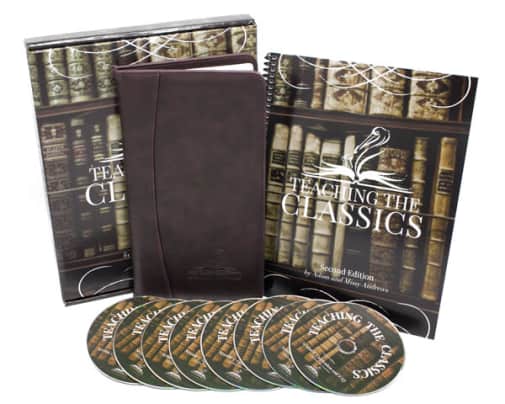
Includes 8 DVD Set and workbook (which includes syllabus).
Teaching the Classics DVD & Syllabus Notebook (Second Edition)
SKU
035998
ISBN
9780988898998
Grade AD
Classical
Neutral
High Teacher Involvement
Visual
These icons are designed to help you quickly understand and learn important information about our products.
Teaching Method
Traditional
Teacher-centered curriculum commonly used in classrooms that may include a text, teacher manual, tests, etc.
Charlotte Mason
A methodology based on the work of a 19th century educator who maintained that children learn best from literature (Living Books), not textbooks.
Classical
A methodology based on the Latin Trivium (three stages of learning), including the grammar stage (memorization and facts), logic stage (critical thinking), and rhetoric stage (developing/defending ideas).
Unit Study
A thematic or topical approach centered around one topic that integrates multiple subject areas.
Montessori (Discovery)
A methodology based on the work of a 20th century educator that emphasizes student and sensory-driven discovery learning and real-life applications.
Other
Other methodologies
Religious Content
Secular
Contains content contrary to common Christian beliefs (i.e. evolution).
Neutral
Avoids religious or theoretical topics or presents multiple viewpoints without preference.
Christian/Religious
Faith-based or including instructional religious content.
Learning Modality
Auditory
Learns through listening, talking out loud or reading out loud.
Visual
Learns through seeing, prefers written instructions and visual materials.
Kinesthetic/Tactile (Hands-On)
Learns through moving, doing and touching.
Multi-Sensory
Curriculum that employ a variety of activities/components.
Presentation
Sequential
Curriculum progresses through well-defined learning objectives. Emphasizes mastery before moving to the next topic.
Spiral
Topics and concepts are repeated from level to level, adding more depth at each pass and connecting with review.
Conceptual/Topical
Focus is on the “why,” often with a unifying concept as well as specific skills; coverage may be broader.
Teacher Involvement
Low Teacher Involvement
Student-led materials; parent acts as a facilitator.
Medium Teacher Involvement
A mix of teacher-led time and independent student work.
High Teacher Involvement
Teacher-led lessons; may utilize discussions, hands-on activities and working together.
Additional Materials Required
No other materials needed
Everything you need is included.
Other Materials Required
There are additional required resources that are a separate purchase.
Other Materials Optional
There are additional resources mentioned or recommended but are not absolutely necessary.
Consumable
Consumable
Designed to be written in; not reusable.
Non-Consumable
Not designed to be written in; reusable.
Our Price
$149.00 $149.00 $128.00
Rainbow Savings: $21.00
Description
Publisher's Description of Teaching the Classics DVD & Syllabus Notebook (Second Edition)
Revolutionize the way you and your students view literature! Learn how to read and discuss works of literature"from children's books to classic novels"and equip students with literary analysis tools that bring literature to life.
Category Description for Teaching the Classics
Teaching the Classics: A Socratic Method for Literary Education is a highly regarded video seminar with accompanying workbook by Adam and Missy Andrews that teaches parents how to lead meaningful, discussion-based literature studies using the Socratic method.
Instead of relying on pre-written study guides, this seminar equips parents with the tools and confidence to ask thoughtful questions that help students deeply analyze any work of literature from picture books to classic novels.
Key Curriculum Features:
- Teaches the Socratic method of literary discussion, focusing on asking questions rather than giving answers
- Focuses on the core elements of literature: Plot & Conflict, Setting, Character, Theme, Literary Devices, and Context
- Uses short stories as teaching tools, then applies the method to longer works including The Iliad, Macbeth, Great Expectations, and To Kill a Mockingbird
- Includes a comprehensive Socratic List of questions organized by classical stages (Grammar, Logic, and Rhetoric)
- Emphasizes critical thinking, worldview analysis, and character development through literature
- Suitable for parents and teachers; children can participate in the discussions
Program Components:
- 8-DVD Seminar: Eight one-hour lectures (revised and expanded with new content)
- 120-page Workbook/Syllabus: Lecture notes, short story texts, graphic organizers, suggested curriculum plans, and daily lesson plan examples
- Socratic List: A powerful appendix with carefully crafted questions for literary analysis
Teaching the Classics stands out as the foundational seminar that gives parents the “big picture” and practical tools for leading rich literature discussions. It is an excellent investment for homeschool families who want to move beyond worksheets and teach their children how to think deeply about what they read.
Browse the Teaching the Classics seminar and workbook below!
Details
| Product Format: | Softcover Book |
|---|---|
| Grade: | AD |
| Brand: | Center for Literary Education |
| ISBN: | 9780988898998 |
| Length in Inches: | 11.875 |
| Width in Inches: | 9.5 |
| Height in Inches: | 1.375 |
| Weight in Pounds: | 2 |
Videos
Reviews