
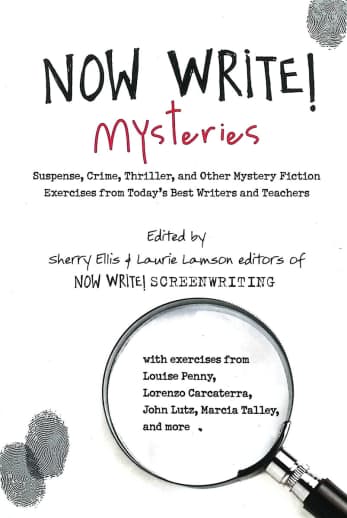
The essential handbook for writers of whodunits, techno- thrillers, cozies, and everything in between-featuring never-before- published personal writing exercises from some of today’s bestselling and award-winning mystery writers.
Now Write! Mysteries, the fourth volume in the acclaimed Now Write! writing guide series, brings together numerous bestselling authors-including winners of and nominees for the Edgar, Hugo, and Shamus awards,-for the definitive guide to writing mysteries, thrillers, and suspense stories. Now Write! Mysteries teaches you everything you’ve ever wanted to know about crafting a page-turning mystery-from creating a believable detective hero (or terrifying villain), to using real-life cutting-edge investigative techniques to bring your story to life-with practical exercises taken directly from the pros:
Discover the best techniques for seamlessly integrating action into your story with John Lutz, New York Times-bestselling author of Urge to Kill, Night Kills, and Serial.
Learn how to fine-tune your sense of place and setting with Louise Penny, New York Times-bestselling author of the Armand Gamache mysteries.
Take advice from Lorenzo Carcaterra, author of Sleepers and writer/producer for Law & Order, on how to compose a scene that lives up to your character’s backstory.
Let Marcia Talley, Agatha- and Anthony-winning author of the Hannah Ives mysteries, show you how to build a memorable, engaging detective. (Hint: It’s not about making him flawless.)
Others included are: Simon Brett, Hallie Ephron, Meg Gardiner, Peter James, Christopher G. Moore, Michael Sears, and many others. No other mystery-writing guide offers the road tested wisdom of so many award-winners and bestselling authors in one place.
Now Write! Mysteries
SKU
035538
ISBN
9781585429035
Grade 10-AD
These icons are designed to help you quickly understand and learn important information about our products.
Teaching Method
Traditional
Teacher-centered curriculum commonly used in classrooms that may include a text, teacher manual, tests, etc.
Charlotte Mason
A methodology based on the work of a 19th century educator who maintained that children learn best from literature (Living Books), not textbooks.
Classical
A methodology based on the Latin Trivium (three stages of learning), including the grammar stage (memorization and facts), logic stage (critical thinking), and rhetoric stage (developing/defending ideas).
Unit Study
A thematic or topical approach centered around one topic that integrates multiple subject areas.
Montessori (Discovery)
A methodology based on the work of a 20th century educator that emphasizes student and sensory-driven discovery learning and real-life applications.
Other
Other methodologies
Religious Content
Secular
Contains content contrary to common Christian beliefs (i.e. evolution).
Neutral
Avoids religious or theoretical topics or presents multiple viewpoints without preference.
Christian/Religious
Faith-based or including instructional religious content.
Learning Modality
Auditory
Learns through listening, talking out loud or reading out loud.
Visual
Learns through seeing, prefers written instructions and visual materials.
Kinesthetic/Tactile (Hands-On)
Learns through moving, doing and touching.
Multi-Sensory
Curriculum that employ a variety of activities/components.
Presentation
Sequential
Curriculum progresses through well-defined learning objectives. Emphasizes mastery before moving to the next topic.
Spiral
Topics and concepts are repeated from level to level, adding more depth at each pass and connecting with review.
Conceptual/Topical
Focus is on the “why,” often with a unifying concept as well as specific skills; coverage may be broader.
Teacher Involvement
Low Teacher Involvement
Student-led materials; parent acts as a facilitator.
Medium Teacher Involvement
A mix of teacher-led time and independent student work.
High Teacher Involvement
Teacher-led lessons; may utilize discussions, hands-on activities and working together.
Additional Materials Required
No other materials needed
Everything you need is included.
Other Materials Required
There are additional required resources that are a separate purchase.
Other Materials Optional
There are additional resources mentioned or recommended but are not absolutely necessary.
Consumable
Consumable
Designed to be written in; not reusable.
Non-Consumable
Not designed to be written in; reusable.
Our Price
$24.00 $24.00 $16.75
Rainbow Savings: $7.25
Description
Publisher's Description of Now Write! Mysteries
Category Description for Now Write! Series
Written for aspiring authors, this series guides students through writing exercises to guide their brainstorming, researching, organizing, and writing of their magnum opus. Focusing on different genres, each book features insights and exercises from acclaimed authors or teachers in that genre. Books are divided into sections, which cover various themes related to the genre. Sections range from understanding the genre, developing characters, story setting, plot development, point of view, and more. Within each section, there are numerous “chapters” that introduce that chapter’s author, and then launch into helpful information and tips, concluding with practice exercises. This unique methodology inspires authors to pursue their passions! While no objectionable information was noted, themes may include material suited for a mature audience.
Details
| Product Format: | Paperback |
|---|---|
| Grades: | 10-AD |
| Brand: | Tarcher |
| Author: | Sherry Ellis & Laurie Lamson |
| ISBN: | 9781585429035 |
| Length in Inches: | 8.1875 |
| Width in Inches: | 5.5 |
| Height in Inches: | 1 |
| Weight in Pounds: | 0.75 |
Videos
Reviews