Investigate cell biology, DNA, genetics, anatomy, and
photosynthesis through microbial culturing, microscopy, sheep heart dissection,
and genetic analysis to understand fundamental biological concepts. 400x+ Microscope
recommended. The Complete Introduction to Biology Lab Kit for grades 6-8
provides 20 hours of learning. Offering a wonderful opportunity for guided,
exploratory based science at the middle school level, the Included Guide offers
numerous suggestions for further study. To create a full semester (or year!)
course, supplement the experiments with related books, online videos, and/or
online research. The opportunities for an immersive learning experience are
endless! Please note, the included suggestions for further study are topical
and not specific titles, which allows parents and children flexibility to add
ones of interest that fit their needs. This would also make an excellent
companion to any middle school course.
Complete Introduction to Biology Lab Kit (Grades 6-8)
SKU
033974
Grade 6-8
These icons are designed to help you quickly understand and learn important information about our products.
Teaching Method
Traditional
Teacher-centered curriculum commonly used in classrooms that may include a text, teacher manual, tests, etc.
Charlotte Mason
A methodology based on the work of a 19th century educator who maintained that children learn best from literature (Living Books), not textbooks.
Classical
A methodology based on the Latin Trivium (three stages of learning), including the grammar stage (memorization and facts), logic stage (critical thinking), and rhetoric stage (developing/defending ideas).
Unit Study
A thematic or topical approach centered around one topic that integrates multiple subject areas.
Montessori (Discovery)
A methodology based on the work of a 20th century educator that emphasizes student and sensory-driven discovery learning and real-life applications.
Other
Other methodologies
Religious Content
Secular
Contains content contrary to common Christian beliefs (i.e. evolution).
Neutral
Avoids religious or theoretical topics or presents multiple viewpoints without preference.
Christian/Religious
Faith-based or including instructional religious content.
Learning Modality
Auditory
Learns through listening, talking out loud or reading out loud.
Visual
Learns through seeing, prefers written instructions and visual materials.
Kinesthetic/Tactile (Hands-On)
Learns through moving, doing and touching.
Multi-Sensory
Curriculum that employ a variety of activities/components.
Presentation
Sequential
Curriculum progresses through well-defined learning objectives. Emphasizes mastery before moving to the next topic.
Spiral
Topics and concepts are repeated from level to level, adding more depth at each pass and connecting with review.
Conceptual/Topical
Focus is on the “why,” often with a unifying concept as well as specific skills; coverage may be broader.
Teacher Involvement
Low Teacher Involvement
Student-led materials; parent acts as a facilitator.
Medium Teacher Involvement
A mix of teacher-led time and independent student work.
High Teacher Involvement
Teacher-led lessons; may utilize discussions, hands-on activities and working together.
Additional Materials Required
No other materials needed
Everything you need is included.
Other Materials Required
There are additional required resources that are a separate purchase.
Other Materials Optional
There are additional resources mentioned or recommended but are not absolutely necessary.
Consumable
Consumable
Designed to be written in; not reusable.
Non-Consumable
Not designed to be written in; reusable.
Our Price
$134.95 Warning
Choking Hazard
- Children under 8 years can choke or suffocate on uninflated or broken balloons. Adult supervision required. Keep uninflated balloons away from children. Discard broken balloons at once.
Description
Publisher's Description of Complete Introduction to Biology Lab Kit (Grades 6-8)
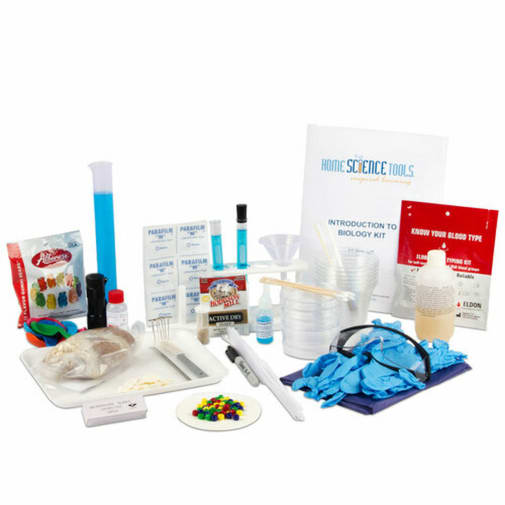
The Complete Introduction to Biology kit for grades 6-8 takes students on an in-depth exploration of life science, from microscopic organisms to complex organ systems. Through 15 hands-on experiments supported by a 58-page full-color manual and over 35 pieces of scientific equipment, students investigate fascinating topics like cell biology, DNA, genetics, anatomy, and photosynthesis. Students engage in authentic scientific practices including microbial culturing, microscopy, sheep heart dissection, and genetic analysis to understand fundamental biological concepts. The comprehensive kit helps young scientists answer essential questions about the nature of life, from understanding how yeast makes bread rise to exploring the diversity of living kingdoms and the intricate workings of the heart.
Contents List: Assorted Gummy Bears; Balloons; Bamboo Skewer; Beads - Red, Blue, Green & Yellow; Blood Type Testing Kit; Chenille Stems; Dish Detergent; Drawing Paper; Dry Protist Culture; Filter Paper; Funnel; Graduated cylinder (10 mL); Isopropyl Alcohol (30 mL); Microscope Slides; Nitrile Gloves (4 pair); Parafilm; Permanent Marker; Petri Dishes; Pipets; Plastic Chips; Plastic Cups; Plastic Stir Rod; Prepared Nutrient Agar (125 mL); Safety Glasses (Adult Size); Sheep Heart Dissection Kit; Sterile Swabs; Stopper; Test Tube Rack; Test Tubes; UV Flashlight; Vinyl Apron; Yeast Packet; Zip Lock Bags
Contents List: Assorted Gummy Bears; Balloons; Bamboo Skewer; Beads - Red, Blue, Green & Yellow; Blood Type Testing Kit; Chenille Stems; Dish Detergent; Drawing Paper; Dry Protist Culture; Filter Paper; Funnel; Graduated cylinder (10 mL); Isopropyl Alcohol (30 mL); Microscope Slides; Nitrile Gloves (4 pair); Parafilm; Permanent Marker; Petri Dishes; Pipets; Plastic Chips; Plastic Cups; Plastic Stir Rod; Prepared Nutrient Agar (125 mL); Safety Glasses (Adult Size); Sheep Heart Dissection Kit; Sterile Swabs; Stopper; Test Tube Rack; Test Tubes; UV Flashlight; Vinyl Apron; Yeast Packet; Zip Lock Bags
Category Description for Complete Introduction to Biology Lab Kits
These impressive kits introduce the basics of biology without a textbook! Guided by the detailed full-color manual (38-58 pgs.) young scientists will discover essential topics through hands-on activities and experiments. These guides are quite helpful as they introduce and explain the topics being studied, provide step-by step instructions to the activities followed by related questions and exercises, and offer a “what happened” explanation after the activity. While there is space to answer questions, Middle school students may benefit from creating a student notebook. Dissections are included. Along with the guide, each kit includes most supplies to complete the activities. A few household items are required.
Details
| Product Format: | Other |
|---|---|
| Grades: | 6-8 |
| Brand: | Home Science Tools |
| Length in Inches: | 10.25 |
| Width in Inches: | 12 |
| Height in Inches: | 6.5 |
| Weight in Pounds: | 3.9 |
Videos
Reviews