
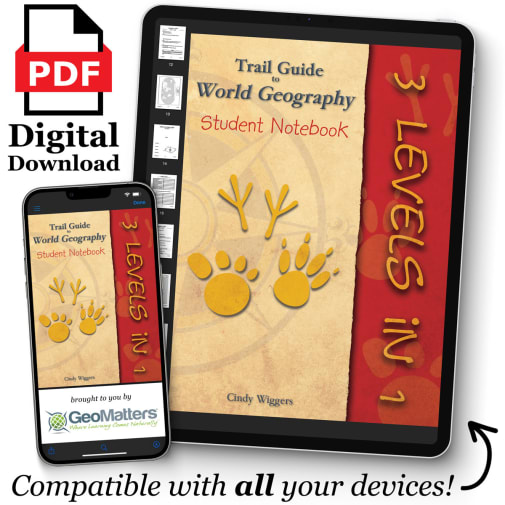
Includes a downloadable set of 500 formatted student notebooking pages for all three levels of Trail Guide to World Geography, to help conveniently put together your student notebooks. These premade pages help both parents and students with guidance and structure in the building of their notebooks. These pages include questions, outline maps, lined paper, room for drawings, crosswords, and much more. These work alongside the Trail Guide to World Geography book as answers to the geography trail questions are only found in the textbook. PDF downloads are available on any device that has Acrobat Reader capabilities. ~Rebecca
Trail Guide to World Geography: Student Notebook All Levels - Digital Download
SKU
033036
Grade 2-12
These icons are designed to help you quickly understand and learn important information about our products.
Teaching Method
Traditional
Teacher-centered curriculum commonly used in classrooms that may include a text, teacher manual, tests, etc.
Charlotte Mason
A methodology based on the work of a 19th century educator who maintained that children learn best from literature (Living Books), not textbooks.
Classical
A methodology based on the Latin Trivium (three stages of learning), including the grammar stage (memorization and facts), logic stage (critical thinking), and rhetoric stage (developing/defending ideas).
Unit Study
A thematic or topical approach centered around one topic that integrates multiple subject areas.
Montessori (Discovery)
A methodology based on the work of a 20th century educator that emphasizes student and sensory-driven discovery learning and real-life applications.
Other
Other methodologies
Religious Content
Secular
Contains content contrary to common Christian beliefs (i.e. evolution).
Neutral
Avoids religious or theoretical topics or presents multiple viewpoints without preference.
Christian/Religious
Faith-based or including instructional religious content.
Learning Modality
Auditory
Learns through listening, talking out loud or reading out loud.
Visual
Learns through seeing, prefers written instructions and visual materials.
Kinesthetic/Tactile (Hands-On)
Learns through moving, doing and touching.
Multi-Sensory
Curriculum that employ a variety of activities/components.
Presentation
Sequential
Curriculum progresses through well-defined learning objectives. Emphasizes mastery before moving to the next topic.
Spiral
Topics and concepts are repeated from level to level, adding more depth at each pass and connecting with review.
Conceptual/Topical
Focus is on the “why,” often with a unifying concept as well as specific skills; coverage may be broader.
Teacher Involvement
Low Teacher Involvement
Student-led materials; parent acts as a facilitator.
Medium Teacher Involvement
A mix of teacher-led time and independent student work.
High Teacher Involvement
Teacher-led lessons; may utilize discussions, hands-on activities and working together.
Additional Materials Required
No other materials needed
Everything you need is included.
Other Materials Required
There are additional required resources that are a separate purchase.
Other Materials Optional
There are additional resources mentioned or recommended but are not absolutely necessary.
Consumable
Consumable
Designed to be written in; not reusable.
Non-Consumable
Not designed to be written in; reusable.
Our Price
$34.95 $34.95 $27.95
Rainbow Savings: $7.00
Digital Product
Product Overview
Important
Non-returnable; this is a digital download.Description
Publisher's Description of Trail Guide to World Geography: Student Notebook All Levels - Digital Download
This Trail Guide to World Geography Student Notebook is a downloadable set of printable pre-formatted templates and outline maps for creating the awesome personal geography student notebooks recommended in the Trail Guide to World Geography.
One of the most common questions we are asked at conventions and by phone regarding our Trail Guides is: "Where is the student book?" Our answer, "No workbook is needed because your students will create their own geography notebooks while they are learning," led to the next question, "How do we create a notebook?"
Although you can build a geography student notebook using the information included in the Trail Guide to World Geography, many folks prefer additional guidance. If you don't know how to create a student notebook, want more structure, or simply don't have time to figure it out for yourself, this is just what you need to catch the vision!
The pages include:
Geography Trails Questions: Separate pages with ALL THREE levels of daily geography trails questions and a place to put the answers.
Outline Maps: Specific outline maps required for each week and the list of mapping assignments.
Notebook Pages: A variety of specifically formatted templates associated with assignment choices for each week. Provides ample room to include written summaries, pictures, and drawings.
Generic Templates: A variety of templates students can use for creating their own crosswords, charts, fact sheets, reports, and more.
Student Levels: The World Trail Guide Student Notebook is available for each of the three trails in Trail Guide to World Geography: Elementary (2nd-4th grades); Middle School (5th-7th grades); and High School (8th grade- high school).
Please Note: You MUST have Trail Guide to World Geography to make use of the Student Notebook. Answers to the daily Geography Trails questions, instructions for using the curriculum, and the literature unit are NOT included in the Student Notebook.
Category Description for Trail Guide to World Geography
Trail Guide to World Geography is a flexible, hands-on world geography curriculum by Cindy Wiggers that makes learning geography engaging and memorable. Using a trail-blazing approach with questions, mapping, timeline work, and activities, it guides students through the world continent by continent while building map skills, geography facts, and research abilities.
The program is designed for 36 weeks and works well for multi-age learning with differentiated questions for Grades 2–4, 5–7, and 8–10.
Key Curriculum Features:
- Weekly "Geography Trails" questions 4 days per week for map skills and facts
- "Points of Interest" activities including mapping, research, art projects, and notebook compilation
- Literature integration with Around the World in 80 Days for the final 9 weeks, along with chapter questions and extensions
- Emphasis on critical thinking, research, and practical geography application
- Flexible pacing suitable for Grades 2–10 with multi-age adaptability
Program Components:
- Trail Guide Book: Core guide with weekly lessons, questions, activities, and instructions
- Required Resources: Age-appropriate atlas, Around the World in 80 Days by Jules Verne for the literature portion, and recommended resources like the Ultimate Geography and Timeline Guide, Uncle Josh's Outline Map Book (or CD-ROM/digital), and Teaching Geography Through Art
- Optional Supplements: Timeline materials, almanac, Geographical Terms chart, and additional atlases or map books
Important Notes:
- The course provides a framework and relies on additional resources for maps, reference, and activities
- Students compile their own geography notebook with maps, research, and projects
- Lessons are adaptable; families can adjust depth based on student ages and interests
Trail Guide to World Geography stands out for its practical, activity-rich approach that makes world geography come alive. It is an excellent choice for homeschool families seeking a flexible, multi-age geography curriculum that builds strong map skills and global awareness.
Shop all Trail Guide to World Geography resources and sets below!
Details
| Product Format: | Other |
|---|---|
| Grades: | 2-12 |
| Brand: | Geography Matters |
| EAN/UPC: | GM-404e |
Videos
Reviews