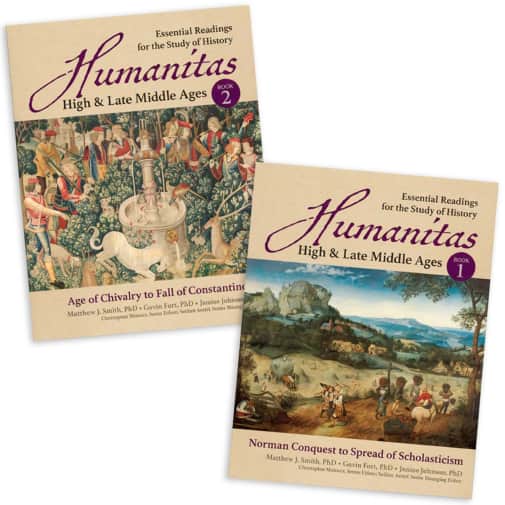
This set of two Student Textbooks (softcover) on the later Middle Ages provides one semester of classical history for high school. Volume 1 begins with the Norman Conquest and unfolds to the spread of Scholasticism. Volume 2 begins with the age of Chivalry and continues through the fall of Constantinople. Both books are beautifully illustrated, with helpful chapter introductions to each document and marginal annotations provided throughout the document to aid understanding. Difficult terms are explained, critical background info given, and historical context, timelines, and maps provided to see how each document fits into the larger picture of history. Each chapter ends with about 8-12 Socratic questions for discussion and writing. The High & Late Middle Ages Teacher E-book will be available soon, providing everything needed to teach this course.
Humanitas High & Late Middle Ages (set of 2 books)
Product Overview
- One semester of classical Medieval history for high school!
- Includes carefully curated primary source documents
- Colorful, engaging, and comprehensive!
- Teacher E-book with lesson plans available separately
Description
Humanitas High & Late Middle Ages Books 1 and 2 begin with the establishment of feudal society following the Norman Conquest and trace the growing tension between Church and state while the Crusades bring Europeans to the Holy Lands. The Black Death ravages Europe, the Peasants’ Revolt and Hundred Years’ War disrupt social stability, and Constantinople eventually falls. Yet the medieval mind and imagination is resilient and fruitful. Scholasticism flourishes, religious life witnesses the advent of mysticism and new forms of lay piety, and the courtly love tradition produces some of the best literature the world has ever known.
The 50 chapters include:
- Accounts of historical events and figures such as the Battle of Hastings, the Crusades, Thomas Becket, and Joan of Arc
- Writings by central figures such as Anselm, Hugh of Saint-Victor, Aquinas, Bonaventure, Julian of Norwich, and Hildegard of Bingen
- Records of early explorers such as Marco Polo, Ibn Battuta, and Felix Fabri
- The writings of literary masters from across Europe: Marie de France, Dante, the authors of the York Mystery Plays, Chaucer, Petrarch, and Shakespeare
Why read about famous people from history when you can read and learn directly from them? Humanitas is a 4-year high school history curriculum based on primary source documents. It is comprehensive and powerful, exposing students first-hand to the greatest minds, ideas, and events of the past. And if you’re thinking that primary source documents are too intimidating, you’ll be pleasantly surprised with these courses! Classical Academic Press has done an amazing job sourcing key documents, extracting core material, and updating archaic language just a bit so students can hear ancient voices like that of Dionysius on the founding of Rome, or Martin Luther on the limitation of government. Just the right amount of secondary information has been added to the primary (original) sources to allow students to digest and engage with the material in a meaningful way.
The Student Textbooks are beautifully illustrated, with helpful chapter introductions for each document and marginal annotations throughout the document to aid in understanding. Difficult terms are explained, critical background info given, and historical context and timelines are provided to see how each document fits into the larger picture in history. Each chapter ends with Socratic questions for discussion and writing.
Each of the 8 titles is designed as a one semester history course (containing 2 books) for .5 credit, but similar titles are paired together for a continuous, full year of history… worth 1 credit. Doing all 8 courses provides 4 years of chronological history (though they can be done in any order), earning 4 credits. These include Level 1 courses – Ancient Greece and Ancient Rome, Level 2 courses – Early Medieval and Late Medieval, Level 3 courses – American Origins and American Republic, and Level 4 courses – Early Modern and Late Modern. Currently only Level 1 (Ancient), Level 3 (American), and the first semester of Level 2 (Medieval) courses have been released, with others coming soon.
The Teacher’s Guide PDF E-books provide everything needed to teach the courses… lesson plans, additional help in understanding each document, and suggestions for facilitating a robust discussion. Because of the emphasis on Socratic discussion, these are perfect for a classroom or homeschool co-op, but a homeschool family can adapt them for discussion around the table with family/friends.
| Product Format: | Other |
|---|---|
| Grades: | 9-12 |
| Brand: | Classical Academic Press |
| ISBN: | 9781600517310 |
| Length in Inches: | 11 |
| Width in Inches: | 8.5 |
| Height in Inches: | 1.875 |
| Weight in Pounds: | 5 |