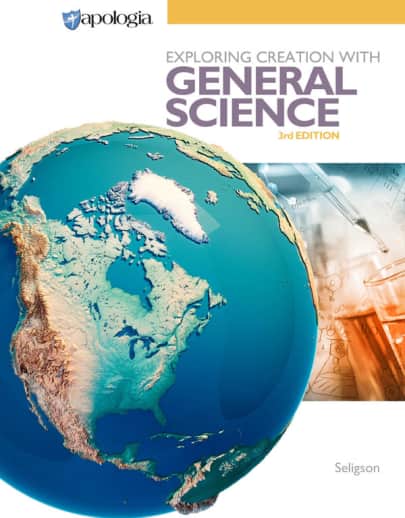
The softcover Exploring Creation with General Science Textbook uses a conversational approach to teach science, designed for homeschool students in their first year of middle school. Along with the student readings, the textbook includes abundant illustrations, hands-on experiments, and “On Your Own” questions (with answers). While students should complete all the activities, only one formal lab report is required per module. It is expected to take one hour per day to complete each science lesson. Lab supplies are easily found items, and a comprehensive list of lab supplies used in each module is found in the Appendix. For your convenience, a Lab Kit is available, as well as a Student Notebook designed to accompany this textbook. Additional student resources are available online through the link and password provided in the textbook.
Exploring Creation with General Science Student Text (3rd Edition Softcover)
Product Overview
- Required student textbook for Apologia’s General Science curriculum
- Topics include the history of science, scientific inquiry, scientific methodology, astronomy, geology, paleontology, meteorology, oceanography, marine science, life science, environmental science, and a basic overview of chemistry, physics, and biology
- Learn about many great historical and modern-day scientists who studied the world out of a desire to better know God as its Creator
Description
NOTE: Students will require both the textbook and a student notebook to complete this course.
This is a true general science course covering a wide range of the branches of science. There is a large component of Earth Science (modules include astronomy, meteorology, oceanography, earth study, geology, paleontology, and environmental science) to give students a great foundation of that broad field of study. The students will learn what science is and, in a detailed and engaging way, how to utilize proper scientific method.
Students are walked through how to record data and report it. Too often, students are not given instruction in how to read and create graphs (a skill that is found on SAT and ACT exams!), however they are taken through the process of creating several graph types, learning how to properly design and read them, too.
The final module is a fun and exciting culmination of the course. It has no exam, rather students are given step-by-step instructions to build a final project of creating a Rube-Goldberg machine, incorporating many of the scientific principles they learned throughout the year (such as combustion, buoyancy, simple machines, and more). Between the project set-up instructions, students will read testimonies from modern-day scientists, sharing how they see God's hand as they work in their respective fields of science. Lesson Plans and Materials: The course is designed to be done 4 days a week (as compared to 2 days a week for our elementary series and 5 days a week for our high school courses). The book is written in a conversational format as the author talks directly to students, walking them through how to complete experiments, how to identify the important parts of the information presented, and where and how to take notes as they progress. The student notebook pairs perfectly with this process, providing easy-to-understand graphics where students fill in the blank spaces as they read. Thus, they are learning how to take information out of a text, identify key points, and critically think through what they are learning. Daily lesson plans are included in the student notebook so students easily understand what is expected of them each day, yet there is still room for flexibility in the schedule to meet the needs of the student and the family.
Experiments: In early modules, specific portions of the text are highlighted so students know where to find important information for lab write-ups, and they are guided through that process. Although the students might complete more than one experiment in a module, they are given the opportunity to choose a single experiment on which they want to complete a formal lab report, thus providing the opportunity to build on interest-driven learning. Lab report samples are provided so the students learn proper formatting and what is expected of them. All of the experiments in this course utilize easy-to-obtain household materials, so no special equipment is necessary, yet complex scientific principles are easy to explore and understand.
Bonus Hands-on Work: Middle school-aged children still greatly benefit from hands-on exploration, so like our elementary series, we include several optional activities (called Explore More) to allow students to further explore the scientific concepts presented in each module.
Tests: There are tests provided for each module, however, students are given many study helps via their student notes within the Student Notebook, and a practice Study Guide they complete once they complete a module. The first two module tests are assigned to be given as open-book tests so that students learn the format of this course and more easily transition to improve the skill of test-taking, thus preparing them for upper grades and even college work.
Character-building: Middle school-aged students are in a transition period between childhood and adulthood, and we believe it is important to emphasize the importance of character. Thus in each module, parents are encouraged (and guided) to incorporate character performance into their student's grade.
Grading: Complete, step-by-step grading rubrics are provided to the parents, showing how to calculate a module grade from the student's module test, lab work, and character displayed throughout the module.
Seeing God's Creative Hand: Throughout the course, students are able to see evidence of God's creation as they learn scientific principles. Additionally, they will be excited to learn about many great scientists in history who were driven to study our world out of a desire to better know God as its creator. The course is sandwiched by this historical information within the first module and a presentation of testimonies by modern-day scientists in the last module to help encourage students to study science to better know God and give him glory!
Exploring Creation with General Science from Apologia is a student’s first middle school science course. This foundational course teaches the three branches of science while helping students develop important independent learning skills, scientific thinking, and a biblical worldview.
Students explore a wide range of topics including astronomy,
geology, paleontology, meteorology, oceanography, marine science, life science,
environmental science, and a basic overview of chemistry, physics, and biology.
The course also covers the history of science, scientific inquiry, the
scientific method, documenting and interpreting experimental results, and
scientific analysis. Anatomy is intentionally not covered to avoid overlap with
the Young Explorer series Anatomy and Physiology course.
Key Curriculum Features:
- 14 chapters with a suggested 4-day per week schedule
- In-depth study of multiple scientific fields with a strong emphasis on the history and process of science
- Biblical worldview woven throughout with scripture references (NIV/NLT), Creation Connections, and stories of faithful scientists
- Hands-on experiments and activities that reinforce learning
- Development of note-taking, lab documentation, and independent study skills
Program Components:
- Student Textbook: Full-color hardcover text with modules, explanations, and activities
- Student Notebook: Consumable notebook with lesson plans, note-taking pages, lab records, and more
- Solutions Book with Test Pages: Answer key and tests for assessment
- Lab Kit (optional): Convenient package from Nature's Workshop with most supplies needed for activities
- MP3 Audio CD (optional): Audio version of the textbook
- Video Instruction Thumb Drive (optional): Video lessons taught by the author
Important Notes:
- A suggested daily schedule is included in the Student Notebook.
- Experiments use numerous household items and science supplies
- Three components are required for a complete course: Student Textbook, Student Notebook, and Solutions Book with Test Pages.
Exploring Creation with General Science stands out for its comprehensive coverage, engaging activities, and consistent biblical worldview that shows students how science declares the glory of God. It is an excellent choice for homeschool families looking for a solid, faith-based introduction to middle school science.
Browse all Exploring Creation with General Science resources and sets below!
| Product Format: | Binder |
|---|---|
| Grades: | 7-8 |
| Brand: | Apologia |
| ISBN: | 9781946506573 |
| Length in Inches: | 11 |
| Width in Inches: | 8.5 |
| Height in Inches: | 0.875 |
| Weight in Pounds: | 2.7187 |