These icons are designed to help you quickly understand and learn important information about our products.
Teaching Method
Traditional
Teacher-centered curriculum commonly used in classrooms that may include a text, teacher manual, tests, etc.
Charlotte Mason
A methodology based on the work of a 19th century educator who maintained that children learn best from literature (Living Books), not textbooks.
Classical
A methodology based on the Latin Trivium (three stages of learning), including the grammar stage (memorization and facts), logic stage (critical thinking), and rhetoric stage (developing/defending ideas).
Unit Study
A thematic or topical approach centered around one topic that integrates multiple subject areas.
Montessori (Discovery)
A methodology based on the work of a 20th century educator that emphasizes student and sensory-driven discovery learning and real-life applications.
Other
Other methodologies
Religious Content
Secular
Contains content contrary to common Christian beliefs (i.e. evolution).
Neutral
Avoids religious or theoretical topics or presents multiple viewpoints without preference.
Christian/Religious
Faith-based or including instructional religious content.
Learning Modality
Auditory
Learns through listening, talking out loud or reading out loud.
Visual
Learns through seeing, prefers written instructions and visual materials.
Kinesthetic/Tactile (Hands-On)
Learns through moving, doing and touching.
Multi-Sensory
Curriculum that employ a variety of activities/components.
Presentation
Sequential
Curriculum progresses through well-defined learning objectives. Emphasizes mastery before moving to the next topic.
Spiral
Topics and concepts are repeated from level to level, adding more depth at each pass and connecting with review.
Conceptual/Topical
Focus is on the “why,” often with a unifying concept as well as specific skills; coverage may be broader.
Teacher Involvement
Low Teacher Involvement
Student-led materials; parent acts as a facilitator.
Medium Teacher Involvement
A mix of teacher-led time and independent student work.
High Teacher Involvement
Teacher-led lessons; may utilize discussions, hands-on activities and working together.
Additional Materials Required
No other materials needed
Everything you need is included.
Other Materials Required
There are additional required resources that are a separate purchase.
Other Materials Optional
There are additional resources mentioned or recommended but are not absolutely necessary.
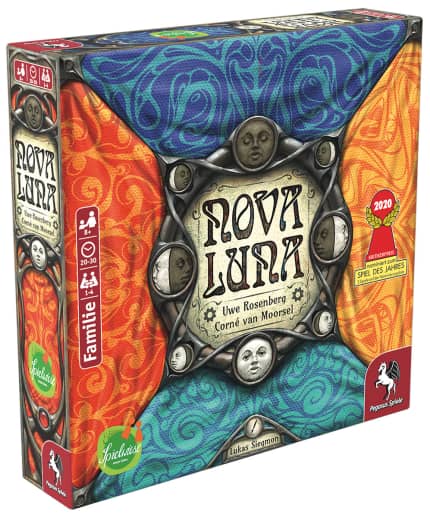
The centerpiece of Nova Luna by
Pegasus Spiele is a moon wheel which serves two purposes. It keeps
track of turn order, and it serves up the beautiful tile choices that players
collect to create a colorful tableau puzzle with goals to achieve as they race
to finish them first. So how do you plan, choose, obtain, and place tiles to
create the challenge and fun that makes this game unique?
It starts with setup: Place the moon wheel in
the center of the table. It has 12 indented spaces around its outer ring.
Included in the game is a “moon meeple,” which is fit into the top space on the
outside of the moon wheel. The 68 tiles in 4 colors are shuffled and stacked in
as many piles as you wish. Moving from the “meeple” in clockwise direction, one
tile is placed in each of the other 11 “indentations” around the outside of the
wheel. Each player obtains 21 tokens in
their player color and starting turn order is determined. Take one colored
player token for each player and stack in turn order at the top of the moon wheel’s
turn order/tile selection track. You are ready to start the game! Now, the game
begins as players race to put their 20 remaining player tokens into the tile
tableau they will create.
Choosing tiles and player movement
on the moon track: In turn order, each player may choose from one of the three
tiles at or ahead of the moon meeple. Each
tile displays three elements that influence its selection. It will be one of
four colors (red, yellow, light blue, or dark blue), have a number in its upper
left corner, and have 1-3 goals depicted on it. After a player selects and
acquires a tile, the moon meeple moves clockwise to the space on the moon ring
that the tile occupied. The player’s token is moved the number of spaces
clockwise matching that of the number on the chosen tile. The tile is
immediately placed in the player’s tile display. Going forward each round, turn
order proceeds with the player’s marker farthest back on the track.
Tile goals and placement: The key
to placing your player tokens is completing tile goals. There are 1-3 goals per
tile, and each goal displays a requirement of specific numbers/colors of horizontally
or vertically adjacent tiles to complete it.
Plan tile acquisitions well to
coordinate with goals, and there will be turns where you complete multiple
goals!
For the Win: The first person to
place all their player tokens on tile goals immediately wins!
If you have played and enjoyed games like Framework
or Cascadia, this game has similar characteristics. I am really enjoying
this one! For 1-4 players, Nova Luna plays in 30-60 minutes and includes solo
instructions. ~ Marsha
Publisher's Description of Nova Luna Game
The moon has had an influence on mankind for many thousands of years.
For example, the new moon stands for a new beginning or the time to
think about the future and taking the first steps.
In Nova Luna,
players must deal effective with the display of the moon clock to
fulfill their orders. Every decision has far-reaching consequences for
the future.
Nova Luna is a family-friendly laying game
that is full of strategic decisions at the same time. A solo rule also
makes the game playable alone.