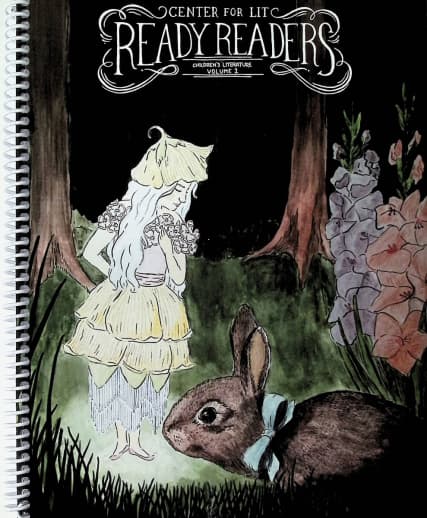
Ready Readers: Children's Literature, Volume 2

SKU
030732
ISBN
9798987337615
Grade K-3
Teaching Method
Traditional
Teacher-centered curriculum commonly used in classrooms that may include a text, teacher manual, tests, etc.
Charlotte Mason
A methodology based on the work of a 19th century educator who maintained that children learn best from literature (Living Books), not textbooks.
Classical
A methodology based on the Latin Trivium (three stages of learning), including the grammar stage (memorization and facts), logic stage (critical thinking), and rhetoric stage (developing/defending ideas).
Unit Study
A thematic or topical approach centered around one topic that integrates multiple subject areas.
Montessori (Discovery)
A methodology based on the work of a 20th century educator that emphasizes student and sensory-driven discovery learning and real-life applications.
Other
Other methodologies
Religious Content
Secular
Contains content contrary to common Christian beliefs (i.e. evolution).
Neutral
Avoids religious or theoretical topics or presents multiple viewpoints without preference.
Christian/Religious
Faith-based or including instructional religious content.
Learning Modality
Auditory
Learns through listening, talking out loud or reading out loud.
Visual
Learns through seeing, prefers written instructions and visual materials.
Kinesthetic/Tactile (Hands-On)
Learns through moving, doing and touching.
Multi-Sensory
Curriculum that employ a variety of activities/components.
Presentation
Sequential
Curriculum progresses through well-defined learning objectives. Emphasizes mastery before moving to the next topic.
Spiral
Topics and concepts are repeated from level to level, adding more depth at each pass and connecting with review.
Conceptual/Topical
Focus is on the “why,” often with a unifying concept as well as specific skills; coverage may be broader.
Teacher Involvement
Low Teacher Involvement
Student-led materials; parent acts as a facilitator.
Medium Teacher Involvement
A mix of teacher-led time and independent student work.
High Teacher Involvement
Teacher-led lessons; may utilize discussions, hands-on activities and working together.
Additional Materials Required
No other materials needed
Everything you need is included.
Other Materials Required
There are additional required resources that are a separate purchase.
Other Materials Optional
There are additional resources mentioned or recommended but are not absolutely necessary.
Consumable
Consumable
Designed to be written in; not reusable.
Non-Consumable
Not designed to be written in; reusable.
Our Price
$35.00 $35.00 $31.95
Rainbow Savings: $3.05

Product Overview

  • Uses the classical Socratic method to discuss and evaluate ten children’s books
  • Includes questions about the author, structure, and style of each story
  • Story charts (graphic organizers) are included as a visual aid to help break down the elements of the story
  • Answers to the questions are included as well as book page numbers to reference

Description

Ready Readers: Children’s Literature Volume 2 was developed to aid parents in having meaningful discussions using ten wonderful children’s books (sold separately). This is not a workbook, but a guide for discussion following the Socratic method outlined in the Teaching the Classics literature seminar. The books are discussed and analyzed as students learn about the structure (conflict, plot, settings, characters, and theme), and style (literary devices used by the author) of each story. The author and historical events at the time the story was written are also talked through.

Each picture book study begins with a page describing the plot, setting, characters, conflict, theme, and literary devices. Next are several pages with questions about the structure and style of the story with the book’s page numbers for a quick reference. Answers are provided after each question. Then a few essay questions for writing assignments are presented. Finally, at the end of the study there are two story charts (one filled in and one blank). These story charts are graphic organizers about the parts of the story. There are also blank lines for notes on several pages in each study.

This volume can be used for younger students (K-3) or for older students to introduce them to literary analysis. Teaching the Classics DVD seminar would be helpful to view for a better understanding of the Socratic pattern the author uses but it is not necessary before using this guide. The children’s books can be purchased in a bundle (SKU #RRV2CL) or separately. Spiral-bound. 187 pgs. ~ Gina

Publisher's Description of Ready Readers: Children's Literature, Volume 2

Many parents and teachers have asked us for a set of example lessons to help them apply the Teaching the Classics model in their classes.

Ready Readers: Children's Literature fills this need with complete discussion notes for 10 classic picture books. Each lesson includes a full set of Socratic discussion questions with comprehensive answers keyed to the text.  Questions cover Conflict, Plot, Setting, Characters, Theme, Literary Devices, and Context. In addition, a completed Story Chart graphically outlines the major structural and thematic elements of each story.

This exciting resource is appropriate for use with students of all ages, depending on their needs:

READING COMPREHENSION

Ready Readers helps develop good reading comprehension in the very youngest students.  It encourages them to ponder well-designed questions about structure, style, context, and theme in every story they read.

LITERARY ANALYSIS

Though the books discussed here were written for children, they provide excellent examples of the structural elements common to all stories.  They are therefore useful even in discussions with older students, who read at a higher level, but may be new to the techniques of literary analysis.

TITLES INCLUDED:

  • The Story of Ferdinand by Munro Leaf

  • The Little House by Virginia Lee Burton

  • The Biggest Bear by Lynd Ward

  • Amos and Boris by William Steig

  • The Velveteen Rabbit by Margery Williams

  • Lentil by Robert McCloskey

  • Thank You, Mr. Falker by Patricia Polacco

  • The Bee Tree by Patricia Polacco

  • I Have an Olive Tree by Eve Bunting

  • All Those Secrets of the World by Jane Yolen


Category Description for Ready Readers

Ready Readers are literature study guides designed to complement the Socratic methodology taught in Teaching the Classics by Adam & Missy Andrews.

These ready-to-use guides provide fleshed-out lesson plans and Socratic discussion questions for whole-book studies, making it easier for parents to lead meaningful literary analysis with their children.

Key Curriculum Features:

  • Discussion-based studies focusing on setting, characters, conflict, plot, theme, literary devices, and context
  • Carefully crafted Socratic questions with talking-point answers for the teacher
  • Story charts and one-page book summaries included for each title
  • Flexible use with students of varying ages (often slightly below the student’s reading level to build confidence)
  • Can be used with any unabridged edition of the selected book
  • Excellent bridge between Teaching the Classics methodology and actual book studies

Program Components:

  • Each Ready Reader volume contains complete studies for multiple books at a specific reading level
  • Includes Socratic discussion questions, teacher talking points, story charts, and summaries
  • Designed to work alongside Teaching the Classics seminar for best results

Ready Readers stand out for their practical, ready-to-go format that helps parents confidently lead rich literature discussions. They are an excellent choice for families who want structured guidance in teaching literary analysis while using quality literature.

Browse all Ready Readers volumes below!

Details
More Information
Product Format:Paperback
Grades:K-3
Brand:Center for Literary Education
ISBN:9798987337615
Length in Inches:11
Width in Inches:8.75
Height in Inches:0.75
Weight in Pounds:1.2
Videos
This product doesn't have a video
Reviews
Product Q&A