
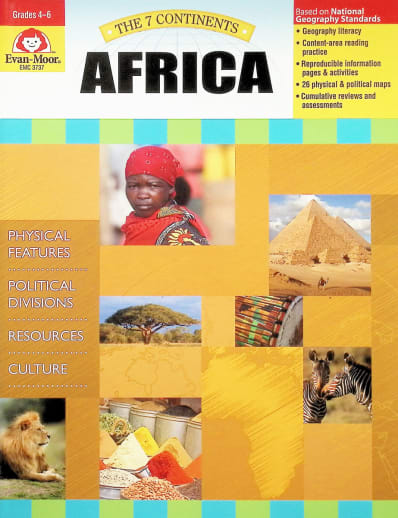
Africa

SKU
030684
ISBN
9781609631321
Grade 3-6
Teaching Method
Traditional
Teacher-centered curriculum commonly used in classrooms that may include a text, teacher manual, tests, etc.
Charlotte Mason
A methodology based on the work of a 19th century educator who maintained that children learn best from literature (Living Books), not textbooks.
Classical
A methodology based on the Latin Trivium (three stages of learning), including the grammar stage (memorization and facts), logic stage (critical thinking), and rhetoric stage (developing/defending ideas).
Unit Study
A thematic or topical approach centered around one topic that integrates multiple subject areas.
Montessori (Discovery)
A methodology based on the work of a 20th century educator that emphasizes student and sensory-driven discovery learning and real-life applications.
Other
Other methodologies
Religious Content
Secular
Contains content contrary to common Christian beliefs (i.e. evolution).
Neutral
Avoids religious or theoretical topics or presents multiple viewpoints without preference.
Christian/Religious
Faith-based or including instructional religious content.
Learning Modality
Auditory
Learns through listening, talking out loud or reading out loud.
Visual
Learns through seeing, prefers written instructions and visual materials.
Kinesthetic/Tactile (Hands-On)
Learns through moving, doing and touching.
Multi-Sensory
Curriculum that employ a variety of activities/components.
Presentation
Sequential
Curriculum progresses through well-defined learning objectives. Emphasizes mastery before moving to the next topic.
Spiral
Topics and concepts are repeated from level to level, adding more depth at each pass and connecting with review.
Conceptual/Topical
Focus is on the “why,” often with a unifying concept as well as specific skills; coverage may be broader.
Teacher Involvement
Low Teacher Involvement
Student-led materials; parent acts as a facilitator.
Medium Teacher Involvement
A mix of teacher-led time and independent student work.
High Teacher Involvement
Teacher-led lessons; may utilize discussions, hands-on activities and working together.
Additional Materials Required
No other materials needed
Everything you need is included.
Other Materials Required
There are additional required resources that are a separate purchase.
Other Materials Optional
There are additional resources mentioned or recommended but are not absolutely necessary.
Consumable
Consumable
Designed to be written in; not reusable.
Non-Consumable
Not designed to be written in; reusable.
Our Price
$21.99 $21.99 $14.75
Rainbow Savings: $7.24

Description

Publisher's Description of Africa

Five geography units cover the following standards-based topics:

Section 1: Africa in the World
Introduces students to the location of Africa in the world.

  • Africa's Relative Location
  • Africa's Hemispheres
  • Africa's Absolute Location
  • Using a Projection Map

Section 2: Political Divisions of Africa
Introduces students to the five regions and 53 countries of Africa.

  • Population of Africa
  • Countries of Africa
  • Largest Countries by Area
  • Smallest Countries by Area
  • Largest Countries by Population
  • Northern Africa
  • Western Africa
  • Central Africa
  • Eastern Africa
  • Southern Africa
  • Largest Cities of Africa

Section 3: Physical Features of Africa
Students learn about the landforms and bodies of water of Africa.

  • Africa's Landscape
  • Mount Kilimanjaro
  • Great Rift Valley
  • Africa's Deserts
  • African Savanna
  • Africa's Rainforests
  • Madagascar
  • Africa's Bodies of Water
  • Africa's Lakes
  • Major Rivers of Africa
  • Amazing Waterfalls of Africa

Section 4: Valuable Resources of Africa
Students learn about the various natural resources of Africa.

  • Oil Production in Africa
  • Mining for Gold and Diamonds
  • Farming in Africa
  • Sharing the Nile River
  • Africa's Cacao and Coffee
  • African Safaris
  • The Great Migration
  • Africa's Desert Animals
  • Rainforest Animals

Section 5: African Culture
Introduces students to the wide variety of traditional African cultures.

  • Tourist Attractions
  • Arts and Crafts
  • Three African Fabrics
  • Music and Dance
  • Languages of Africa
  • Major Religions of Africa
  • African Cuisines

This resource contains teacher support pages, reproducible student pages, and an answer key. This is a reproducible resource (photocopying of lessons is permitted) for single classroom or individual home use only.

Category Description for Seven Continents Series

These activity-packed workbooks explore the geography of the continents, dividing them into water and landforms, geographic regions, political divisions, resources, animals, and people. The five themes of geography play a role in the series also, with all of the exercises and activities falling into one or more of the following themes: location (position on the earth's surface), place (physical and human characteristics), relationships within places (humans and the environment), movement (human interactions on the earth), and regions (how they form and change). Students work through a variety of exercises, map activities, informational pages, graph readings, games, and note takers as they study the continents. Though written for use in a classroom, this series is easy to use at home or with a co-op. Workbook pages are reproducible and consumable. pb. ~ Zach

Details
More Information
Product Format:Softcover Book
Grades:3-6
Brand:Evan-Moor
ISBN:9781609631321
Length in Inches:11
Width in Inches:8.5
Height in Inches:0.5
Weight in Pounds:0.82
Videos
This product doesn't have a video
Reviews
Product Q&A