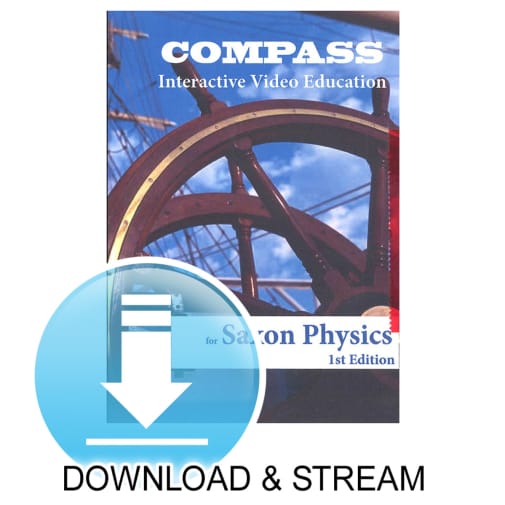

The Compass Digital Download for Saxon Physics is a tutorial for students needing more explanation than what is provided in the Student Workbook. This adds helpful instruction connecting the new concept to previous concepts. Students will see a whiteboard with a teacher voiceover by David Shormann. He will present the new material in his own words with different problems than the textbook uses. The Compass version is the same as the DIVE but does not contain Biblical content. When you place an order, an email will be sent within 1-2 business days with activation instructions to your lifetime access.
Compass Digital Download Saxon Physics
SKU
030285
Grade 11-12
These icons are designed to help you quickly understand and learn important information about our products.
Teaching Method
Traditional
Teacher-centered curriculum commonly used in classrooms that may include a text, teacher manual, tests, etc.
Charlotte Mason
A methodology based on the work of a 19th century educator who maintained that children learn best from literature (Living Books), not textbooks.
Classical
A methodology based on the Latin Trivium (three stages of learning), including the grammar stage (memorization and facts), logic stage (critical thinking), and rhetoric stage (developing/defending ideas).
Unit Study
A thematic or topical approach centered around one topic that integrates multiple subject areas.
Montessori (Discovery)
A methodology based on the work of a 20th century educator that emphasizes student and sensory-driven discovery learning and real-life applications.
Other
Other methodologies
Religious Content
Secular
Contains content contrary to common Christian beliefs (i.e. evolution).
Neutral
Avoids religious or theoretical topics or presents multiple viewpoints without preference.
Christian/Religious
Faith-based or including instructional religious content.
Learning Modality
Auditory
Learns through listening, talking out loud or reading out loud.
Visual
Learns through seeing, prefers written instructions and visual materials.
Kinesthetic/Tactile (Hands-On)
Learns through moving, doing and touching.
Multi-Sensory
Curriculum that employ a variety of activities/components.
Presentation
Sequential
Curriculum progresses through well-defined learning objectives. Emphasizes mastery before moving to the next topic.
Spiral
Topics and concepts are repeated from level to level, adding more depth at each pass and connecting with review.
Conceptual/Topical
Focus is on the “why,” often with a unifying concept as well as specific skills; coverage may be broader.
Teacher Involvement
Low Teacher Involvement
Student-led materials; parent acts as a facilitator.
Medium Teacher Involvement
A mix of teacher-led time and independent student work.
High Teacher Involvement
Teacher-led lessons; may utilize discussions, hands-on activities and working together.
Additional Materials Required
No other materials needed
Everything you need is included.
Other Materials Required
There are additional required resources that are a separate purchase.
Other Materials Optional
There are additional resources mentioned or recommended but are not absolutely necessary.
Consumable
Consumable
Designed to be written in; not reusable.
Non-Consumable
Not designed to be written in; reusable.
Our Price
$74.99 $74.99 $68.25
Rainbow Savings: $6.74
Product Overview
- Video instruction for Saxon Physics
- Video lessons average 10-15 minutes per lesson
- David Shormann voiceover with no Biblical content
- Lifetime access after activation
Important
Non-returnable. Is, or contains, a digital item.Description
Publisher's Description of Compass Digital Download Saxon Physics
VIDEO LECTURES Provide Expert Instruction for every lesson
DIVE Physics teaches every lesson in the Saxon Physics curriculum Typically completed in 11th or 12th grade, DIVE Physics is a full-year course teaching concepts found in a typical high school AP physics course, preparing students for the AP Physics 1 and 2 exams. Topics include but are not limited to Science and Christianity, Newton’s laws, speed and velocity, torque, impulse/momentum, relativity theory, work, gases and thermodynamics, potential and kinetic energy, electricity and magnetism, circuit theory and Ohm’s law, and reflection and refraction. DIVE Physics contains 100 lectures, one for each lesson in the Saxon Physics textbook.
VIDEO LABS WITH REAL WORLD EXAMPLES
Students using DIVE Physics will become skilled at working with the scientific method, become familiar with the use of technology in science, and develop their lab skills above and beyond most of their peers. Most importantly, students will have a better understanding and appreciation for the rich Christian heritage that exists in science, and will better understand the importance of studying His word and His works as they seek to become good rulers of His creation. There are 23 video labs, most of which are taught using the scientific method. Students formulate a hypothesis, perform the experiment, and then use the results to determine whether their hypothesis was correct. The majority of DIVE Physics labs use equipment that is too cost-prohibitive for home use, and therefore a supply list is not currently available for the labs. A printable workbook is included on the DIVE CD containing all lab activities. Scroll down to view a sample.
QUARTERLY EXAMS
Quarterly exams are an integral part of DIVE Physics, as they promote study habits similar to what a student should expect in college, where exams are given infrequently, yet cover several weeks of material. Students prepare for the quarterly exams by studying their weekly Saxon tests. If they understand the material on the Saxon weekly tests, then the quarterly exams are not difficult. A grade calculator is also provided. Parents simply enter homework, lab, Saxon weekly test and DIVE quarterly exam grades into the calculator, and it automatically calculates the student’s overall grade.
EARN UP TO 8 COLLEGE CREDITS
Upon completion of DIVE Physics, students who want to go a step further can also purchase the CLEP Professor course to prepare for the AP Physics 1 and 2 Exams as well as 70% of the AP Physics C Exams (The College Board does not offer a CLEP Physics exam).
DIVE Physics teaches every lesson in the Saxon Physics curriculum Typically completed in 11th or 12th grade, DIVE Physics is a full-year course teaching concepts found in a typical high school AP physics course, preparing students for the AP Physics 1 and 2 exams. Topics include but are not limited to Science and Christianity, Newton’s laws, speed and velocity, torque, impulse/momentum, relativity theory, work, gases and thermodynamics, potential and kinetic energy, electricity and magnetism, circuit theory and Ohm’s law, and reflection and refraction. DIVE Physics contains 100 lectures, one for each lesson in the Saxon Physics textbook.
VIDEO LABS WITH REAL WORLD EXAMPLES
Students using DIVE Physics will become skilled at working with the scientific method, become familiar with the use of technology in science, and develop their lab skills above and beyond most of their peers. Most importantly, students will have a better understanding and appreciation for the rich Christian heritage that exists in science, and will better understand the importance of studying His word and His works as they seek to become good rulers of His creation. There are 23 video labs, most of which are taught using the scientific method. Students formulate a hypothesis, perform the experiment, and then use the results to determine whether their hypothesis was correct. The majority of DIVE Physics labs use equipment that is too cost-prohibitive for home use, and therefore a supply list is not currently available for the labs. A printable workbook is included on the DIVE CD containing all lab activities. Scroll down to view a sample.
QUARTERLY EXAMS
Quarterly exams are an integral part of DIVE Physics, as they promote study habits similar to what a student should expect in college, where exams are given infrequently, yet cover several weeks of material. Students prepare for the quarterly exams by studying their weekly Saxon tests. If they understand the material on the Saxon weekly tests, then the quarterly exams are not difficult. A grade calculator is also provided. Parents simply enter homework, lab, Saxon weekly test and DIVE quarterly exam grades into the calculator, and it automatically calculates the student’s overall grade.
EARN UP TO 8 COLLEGE CREDITS
Upon completion of DIVE Physics, students who want to go a step further can also purchase the CLEP Professor course to prepare for the AP Physics 1 and 2 Exams as well as 70% of the AP Physics C Exams (The College Board does not offer a CLEP Physics exam).
Category Description for Saxon Physics
Rather than an introduction to physics (i.e. basic/general physics), Saxon Physics is an engineering physics course. A scientific calculator is needed for the course. Students will be most successful with this course if they have completed at least the first half of Advanced Mathematics or some other pre-calculus book that includes trigonometry. This text is strong enough to be considered an AP Physics course when paired with the DIVE Physics Lecture and Lab CD-ROM.
Details
| Product Format: | Other |
|---|---|
| Grades: | 11-12 |
| Brand: | DIVE |
Videos
Reviews