
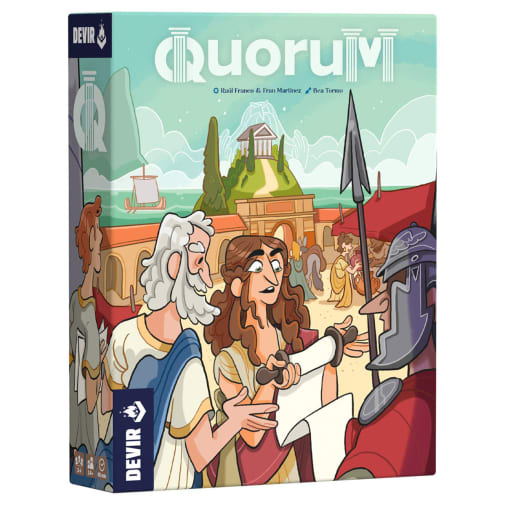
The Roman Empire spans the entire known world. The expansion of civilization is seen in all aspects of life, from commerce to architecture, through the power of the army or political intrigues, and the presence of the gods is evident in the future of human lives. . As senator of this vast empire, will you be able to expand your influence throughout all its provinces?
Designed by Raul Franco and Fran Martínez and illustrated by Bea Tormo, Quorum allows games for 2 to 4 players, ages 14 and up, lasting about 45 minutes. In Quorum, players step into the sandals of Roman senators who live try to gain the greatest possible influence in Rome and its provinces. The objective is to be the most powerful and influential senator through victory points, which are obtained in the different areas of influence of the game at the end of the twelve rounds of the game.
Learning to play Quorum is very easy, but achieving as many points as possible is quite a challenge. Basically, points can be earned in two ways: by influencing the 6 provinces on the central board or by achieving certain combinations of cards in the personal zone.
The cards on one side show a province (and, if played, a player will score points in that province on the central board) and on the other side cards show show 1 of the 4 groups: military, intrigue, architecture and commerce, which will give different bonuses according to the final combination in each player's personal zone. Additionally, there are 14 God cards, which affect the scoring value of the provinces on the central map and can turn the game around at any time.
Each player starts with 4 cards in hand; On your turn, you will draw a card from a common market and then play a card from your hand into the personal area, influencing one of the provinces on the board. Once these two steps have been resolved, the turn passes to the player on your right, and so on until all players have 12 cards in front of them (having played a total of 12 turns each).
And how do you score the cards in the playing area? At the end of the game, the military cards give points for each pair or trio with consecutive values; intrigue cards give as many points as the number of intrigue cards multiplied by the number of cards of value 3 in the player's personal zone; Architecture cards give points for each different card of this type accumulated by the player; and trade cards give points for the size of the set of products present on cards of this type.
With many interesting choices to make at each turn, Quorum is a game that is easy to learn and quick to play, but will test all players' strategic abilities. Is it better to secure leadership in a province or get a specific card to maximize your score? In short, a game worth an empire.
Quorum Game
SKU
030275
Grade 9-AD
These icons are designed to help you quickly understand and learn important information about our products.
Teaching Method
Traditional
Teacher-centered curriculum commonly used in classrooms that may include a text, teacher manual, tests, etc.
Charlotte Mason
A methodology based on the work of a 19th century educator who maintained that children learn best from literature (Living Books), not textbooks.
Classical
A methodology based on the Latin Trivium (three stages of learning), including the grammar stage (memorization and facts), logic stage (critical thinking), and rhetoric stage (developing/defending ideas).
Unit Study
A thematic or topical approach centered around one topic that integrates multiple subject areas.
Montessori (Discovery)
A methodology based on the work of a 20th century educator that emphasizes student and sensory-driven discovery learning and real-life applications.
Other
Other methodologies
Religious Content
Secular
Contains content contrary to common Christian beliefs (i.e. evolution).
Neutral
Avoids religious or theoretical topics or presents multiple viewpoints without preference.
Christian/Religious
Faith-based or including instructional religious content.
Learning Modality
Auditory
Learns through listening, talking out loud or reading out loud.
Visual
Learns through seeing, prefers written instructions and visual materials.
Kinesthetic/Tactile (Hands-On)
Learns through moving, doing and touching.
Multi-Sensory
Curriculum that employ a variety of activities/components.
Presentation
Sequential
Curriculum progresses through well-defined learning objectives. Emphasizes mastery before moving to the next topic.
Spiral
Topics and concepts are repeated from level to level, adding more depth at each pass and connecting with review.
Conceptual/Topical
Focus is on the “why,” often with a unifying concept as well as specific skills; coverage may be broader.
Teacher Involvement
Low Teacher Involvement
Student-led materials; parent acts as a facilitator.
Medium Teacher Involvement
A mix of teacher-led time and independent student work.
High Teacher Involvement
Teacher-led lessons; may utilize discussions, hands-on activities and working together.
Additional Materials Required
No other materials needed
Everything you need is included.
Other Materials Required
There are additional required resources that are a separate purchase.
Other Materials Optional
There are additional resources mentioned or recommended but are not absolutely necessary.
Consumable
Consumable
Designed to be written in; not reusable.
Non-Consumable
Not designed to be written in; reusable.
Our Price
$29.99 $29.99 $25.95
Rainbow Savings: $4.04
Description
Publisher's Description of Quorum Game
Details
| Product Format: | Other |
|---|---|
| Grades: | 9-AD |
| Brand: | Devir Games |
| EAN/UPC: | 8436607946229 |
| Length in Inches: | 9.0625 |
| Width in Inches: | 7.125 |
| Height in Inches: | 2.0625 |
| Weight in Pounds: | 1.5 |
Videos
Reviews