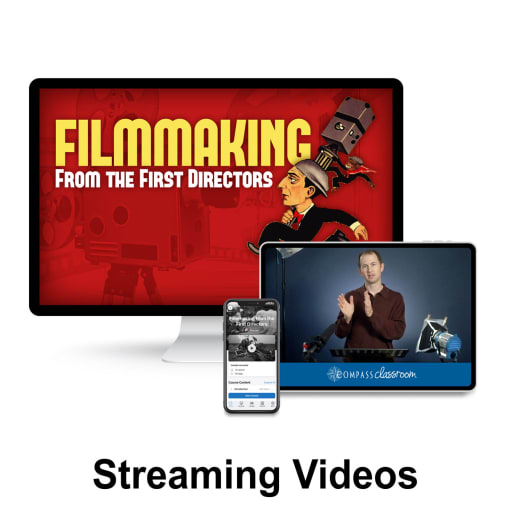
Filmmaking from the First Directors (Digital) - Streaming Videos

SKU
030227
Grade 8-12
Teaching Method
Traditional
Teacher-centered curriculum commonly used in classrooms that may include a text, teacher manual, tests, etc.
Charlotte Mason
A methodology based on the work of a 19th century educator who maintained that children learn best from literature (Living Books), not textbooks.
Classical
A methodology based on the Latin Trivium (three stages of learning), including the grammar stage (memorization and facts), logic stage (critical thinking), and rhetoric stage (developing/defending ideas).
Unit Study
A thematic or topical approach centered around one topic that integrates multiple subject areas.
Montessori (Discovery)
A methodology based on the work of a 20th century educator that emphasizes student and sensory-driven discovery learning and real-life applications.
Other
Other methodologies
Religious Content
Secular
Contains content contrary to common Christian beliefs (i.e. evolution).
Neutral
Avoids religious or theoretical topics or presents multiple viewpoints without preference.
Christian/Religious
Faith-based or including instructional religious content.
Learning Modality
Auditory
Learns through listening, talking out loud or reading out loud.
Visual
Learns through seeing, prefers written instructions and visual materials.
Kinesthetic/Tactile (Hands-On)
Learns through moving, doing and touching.
Multi-Sensory
Curriculum that employ a variety of activities/components.
Presentation
Sequential
Curriculum progresses through well-defined learning objectives. Emphasizes mastery before moving to the next topic.
Spiral
Topics and concepts are repeated from level to level, adding more depth at each pass and connecting with review.
Conceptual/Topical
Focus is on the “why,” often with a unifying concept as well as specific skills; coverage may be broader.
Teacher Involvement
Low Teacher Involvement
Student-led materials; parent acts as a facilitator.
Medium Teacher Involvement
A mix of teacher-led time and independent student work.
High Teacher Involvement
Teacher-led lessons; may utilize discussions, hands-on activities and working together.
Additional Materials Required
No other materials needed
Everything you need is included.
Other Materials Required
There are additional required resources that are a separate purchase.
Other Materials Optional
There are additional resources mentioned or recommended but are not absolutely necessary.
Consumable
Consumable
Designed to be written in; not reusable.
Non-Consumable
Not designed to be written in; reusable.
Our Price
$195.00 $195.00 $153.00
Rainbow Savings: $42.00
Downloadable Product

Product Overview

  • Streamed course can be completed on your schedule
  • Students learn to make a film step-by-step
  • Completion of this course is a full-year elective credit
Downloadable Product

Description

Filmmaking from the First Directors is a series of video lectures on early film history that teaches students how to make a film step-by-step. Students watch original films and complete assignments that involve making a short film and uploading it for the class to comment on and review. This course counts as a full year of high school credit. The class is taught by Thomas Purifoy, Jr.

The format is an online classroom with pre-recorded lectures that can be watched on your schedule. You will receive an email from info@rainbowresource.com with access details within 1-2 business days. Streaming does not expire. This product is for one family’s use. Groups should purchase a different license from Compass Classroom directly.

The course is for serious students. Expect each lesson to take about 3 weeks to complete. There are no grades, only pass/fail based on completion. Students will need a digital video camera or smartphone, tripod, computer with editing software, and internet connection. ~Sara

Here is what you can expect:

  • Introduction
  • Lesson 1 – Documenting Life: Edison & Lumiere
  • Lesson 2 – A Magical Story: George Melies
  • Lesson 3 – Editing Action: Edwin S. Porter
  • Lesson 4 – Multi-Shot Narrative: D.W. Griffith
  • Lesson 5 – Parallel Editing & More: D.W. Griffith
  • Lesson 6 – Mise-en-scene – Framing, Depth, and Setting: D.W. Griffith
  • Lesson 7 – The First Epics – Introduction of the Feature Film
  • Lesson 8 – Feature Films & Auteur Theory: Maurice Tourneur
  • Lesson 9 – The Character of Comedy: Charlie Chaplin
  • Lesson 10 – Comedy as Complex Sequence: Buster Keaton
  • Lesson 11 – Documenting life: Robert Flaherty
  • Lesson 12 – Realism and the Classical Cinema: Douglas Fairbanks and John Ford
  • Lesson 13 – Formalism and Montage: Sergei Eisenstein

Publisher's Description of Filmmaking from the First Directors (Digital) - Streaming Videos

Filmmaking from the First Directors teaches the basics of filmmaking and early film history. It takes students through a unique journey starting in the late 19th century when film was invented, then guides them through the steps first directors took in creating the modern language of film.

Each lesson includes watching a series of lectures on history and production basics then viewing original films. Assignments will include making a variety of short films which will be uploaded for class comments and review. The goal of the class is to teach students how to make films one step at a time.

This class is taught by Thomas Purifoy, Jr., producer, director and writer of Is Genesis History?, Modern Parables, and Economics for Everybody. He has produced a variety of dramatic and documentary shorts, and is a student of film history. He believes merging these two areas is the perfect way to learn how to make films.

Details
More Information
Product Format:Other
Grades:8-12
Brand:Compass Classroom
EAN/UPC:FILMAKDIG
Videos
This product doesn't have a video
Reviews
Product Q&A