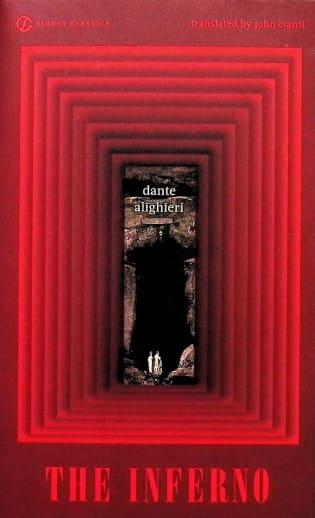
This allegorical work of art written in the 13th century is the first of Dante’s Divine Comedy, each portion designed to represent a part of the Divine Trinity, The Inferno represents the power of the Father. Dante believed that the writing style should match its subject matter. This fact is particularly helpful to remember with this first volume. Inferno is the land of Hell, containing those who have rejected God the Father. Dante’s writing style reflects the land and individuals he is describing. Therefore, be aware that you’ll find a lower level of vocabulary, some immoral behavior, historical individuals deemed worthy of Hell, etc. These elements are identified and elaborated upon in the notes which follow each Canto. Originally written in 1954 (one of the first American translations) is focused on keeping the language more natural, rather than a word-for-word translation that focuses on maintaining rhyme. A few diagrams help elucidate the levels of Hell. Text size is approximately 6 pt font. 296 pgs, pb. ~ Ruth
Inferno
SKU
029842
ISBN
9780451531391
Grade PK-AD
These icons are designed to help you quickly understand and learn important information about our products.
Teaching Method
Traditional
Teacher-centered curriculum commonly used in classrooms that may include a text, teacher manual, tests, etc.
Charlotte Mason
A methodology based on the work of a 19th century educator who maintained that children learn best from literature (Living Books), not textbooks.
Classical
A methodology based on the Latin Trivium (three stages of learning), including the grammar stage (memorization and facts), logic stage (critical thinking), and rhetoric stage (developing/defending ideas).
Unit Study
A thematic or topical approach centered around one topic that integrates multiple subject areas.
Montessori (Discovery)
A methodology based on the work of a 20th century educator that emphasizes student and sensory-driven discovery learning and real-life applications.
Other
Other methodologies
Religious Content
Secular
Contains content contrary to common Christian beliefs (i.e. evolution).
Neutral
Avoids religious or theoretical topics or presents multiple viewpoints without preference.
Christian/Religious
Faith-based or including instructional religious content.
Learning Modality
Auditory
Learns through listening, talking out loud or reading out loud.
Visual
Learns through seeing, prefers written instructions and visual materials.
Kinesthetic/Tactile (Hands-On)
Learns through moving, doing and touching.
Multi-Sensory
Curriculum that employ a variety of activities/components.
Presentation
Sequential
Curriculum progresses through well-defined learning objectives. Emphasizes mastery before moving to the next topic.
Spiral
Topics and concepts are repeated from level to level, adding more depth at each pass and connecting with review.
Conceptual/Topical
Focus is on the “why,” often with a unifying concept as well as specific skills; coverage may be broader.
Teacher Involvement
Low Teacher Involvement
Student-led materials; parent acts as a facilitator.
Medium Teacher Involvement
A mix of teacher-led time and independent student work.
High Teacher Involvement
Teacher-led lessons; may utilize discussions, hands-on activities and working together.
Additional Materials Required
No other materials needed
Everything you need is included.
Other Materials Required
There are additional required resources that are a separate purchase.
Other Materials Optional
There are additional resources mentioned or recommended but are not absolutely necessary.
Consumable
Consumable
Designed to be written in; not reusable.
Non-Consumable
Not designed to be written in; reusable.
Our Price
$7.95 $7.95 $6.25
Rainbow Savings: $1.70
Product Overview
- First American translation, in English only
- General and detailed notes follow each Canto
- Follow the poet through Dante’s 8 levels of Hell
Description
Publisher's Description of Inferno
Belonging in the immortal company of the works of Homer, Virgil, Milton, and Shakespeare, Dante Alighieri’s poetic masterpiece is a visionary journey that takes readers through the torment of Hell.
The first part of Dante’s Divine Comedy is many things: a moving human drama, a supreme expression of the Middle Ages, a glorification of the ways of God, and a magnificent protest against the ways in which men have thwarted the divine plan. One of the few literary works that has enjoyed a fame both immediate and enduring, The Inferno remains powerful after seven centuries. It confronts the most universal values—good and evil, free will and predestination—while remaining intensely personal and ferociously political, for it was born out of the anguish of a man who saw human life blighted by the injustice and corruption of his times.
Translated by John Ciardi
With an Introduction by Archibald T. MacAllister
and an Afterword by Edward M. Cifelli
The first part of Dante’s Divine Comedy is many things: a moving human drama, a supreme expression of the Middle Ages, a glorification of the ways of God, and a magnificent protest against the ways in which men have thwarted the divine plan. One of the few literary works that has enjoyed a fame both immediate and enduring, The Inferno remains powerful after seven centuries. It confronts the most universal values—good and evil, free will and predestination—while remaining intensely personal and ferociously political, for it was born out of the anguish of a man who saw human life blighted by the injustice and corruption of his times.
Translated by John Ciardi
With an Introduction by Archibald T. MacAllister
and an Afterword by Edward M. Cifelli
Details
| Product Format: | Softcover Book |
|---|---|
| Grades: | PK-AD |
| Brand: | Penguin Books |
| Author: | Dante |
| ISBN: | 9780451531391 |
| Length in Inches: | 6.75 |
| Width in Inches: | 4.25 |
| Height in Inches: | 0.75 |
| Weight in Pounds: | 0.35 |
Videos
Reviews