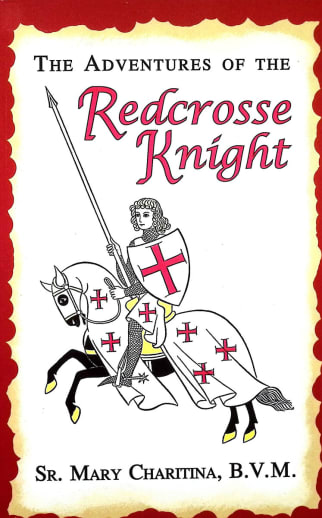
The Adventures of the Redcrosse Knight by Mary Charitina
SKU
029801
ISBN
9781932350920
Grade 3-AD
These icons are designed to help you quickly understand and learn important information about our products.
Teaching Method
Traditional
Teacher-centered curriculum commonly used in classrooms that may include a text, teacher manual, tests, etc.
Charlotte Mason
A methodology based on the work of a 19th century educator who maintained that children learn best from literature (Living Books), not textbooks.
Classical
A methodology based on the Latin Trivium (three stages of learning), including the grammar stage (memorization and facts), logic stage (critical thinking), and rhetoric stage (developing/defending ideas).
Unit Study
A thematic or topical approach centered around one topic that integrates multiple subject areas.
Montessori (Discovery)
A methodology based on the work of a 20th century educator that emphasizes student and sensory-driven discovery learning and real-life applications.
Other
Other methodologies
Religious Content
Secular
Contains content contrary to common Christian beliefs (i.e. evolution).
Neutral
Avoids religious or theoretical topics or presents multiple viewpoints without preference.
Christian/Religious
Faith-based or including instructional religious content.
Learning Modality
Auditory
Learns through listening, talking out loud or reading out loud.
Visual
Learns through seeing, prefers written instructions and visual materials.
Kinesthetic/Tactile (Hands-On)
Learns through moving, doing and touching.
Multi-Sensory
Curriculum that employ a variety of activities/components.
Presentation
Sequential
Curriculum progresses through well-defined learning objectives. Emphasizes mastery before moving to the next topic.
Spiral
Topics and concepts are repeated from level to level, adding more depth at each pass and connecting with review.
Conceptual/Topical
Focus is on the “why,” often with a unifying concept as well as specific skills; coverage may be broader.
Teacher Involvement
Low Teacher Involvement
Student-led materials; parent acts as a facilitator.
Medium Teacher Involvement
A mix of teacher-led time and independent student work.
High Teacher Involvement
Teacher-led lessons; may utilize discussions, hands-on activities and working together.
Additional Materials Required
No other materials needed
Everything you need is included.
Other Materials Required
There are additional required resources that are a separate purchase.
Other Materials Optional
There are additional resources mentioned or recommended but are not absolutely necessary.
Based
on the first book of the epic poem The Faerie Queene by Edmund Spenser,
this thrilling fairytale-like story follows the journey of the Redcrosse
Knight. Who is the Redcrosse Knight? Only a gentle knight on a noble quest to
free the lady Una’s parents from a dangerous dragon! The text is divided into
chapters with a handful of colorful illustrations scattered throughout. Meant
to introduce students to the allegory and message of The Faerie Queene,
this text stays true to the original epic while also narrating events in a way
that students can follow along. Explanations of what different things mean are
incorporated throughout the natural course of the story, helping the reader understand
the allegory without being distracting. 105 pgs, pb.
Publisher's Description of The Adventures of the Redcrosse Knight by Mary Charitina
In sparkling prose, the author retells Book One of Edmund Spenser’s The Faerie Queene
for young readers. Celebrating the lost age of knights and chivalry,
the story follows the young Redcrosse Knight as he faces a series of
trials that will bring him to the final task laid upon him by the Fairy
Queen, Gloriana. As his true guide, the Lady Una shares in the knight’s
sorrows and dangers as she leads him onward to his great battle: the
liberation of her land from a terrible dragon.
Elegant three-color illustrations and excerpts from the original poem
combine with the narrative to capture an authentic sense of Spenser’s
beautiful allegory, thus offering children an appealing entry point into
this classic of English literature.