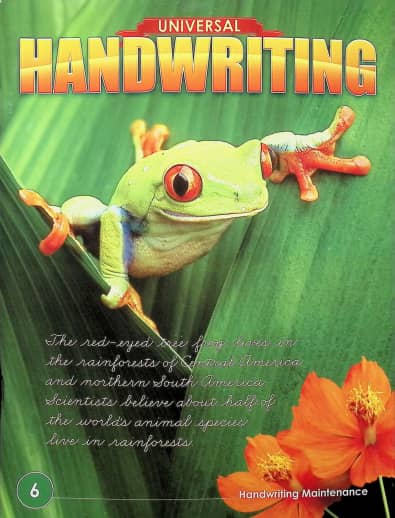
Refresh your cursive skills! We lose what we don’t practice—so true when it comes to our handwriting. This is maintenance made easy with engaging passages to copy. This book uses non-fiction history topics, so you learn a bit as you write. Older students can work on their own, a page a day or once or twice a week. It helps students slow down and think about connecting letters, proper capital and lowercase formation, and being consistent and neat with written communication. Most students are fine using just the student book, but there is a Teacher Edition available. We know you want to know—the capital Q does not look like a 2. Not reproducible, 80pp. ~Sara
Universal Handwriting: Handwriting Maintenance
SKU
029572
ISBN
9781883421304
Grade 6
These icons are designed to help you quickly understand and learn important information about our products.
Teaching Method
Traditional
Teacher-centered curriculum commonly used in classrooms that may include a text, teacher manual, tests, etc.
Charlotte Mason
A methodology based on the work of a 19th century educator who maintained that children learn best from literature (Living Books), not textbooks.
Classical
A methodology based on the Latin Trivium (three stages of learning), including the grammar stage (memorization and facts), logic stage (critical thinking), and rhetoric stage (developing/defending ideas).
Unit Study
A thematic or topical approach centered around one topic that integrates multiple subject areas.
Montessori (Discovery)
A methodology based on the work of a 20th century educator that emphasizes student and sensory-driven discovery learning and real-life applications.
Other
Other methodologies
Religious Content
Secular
Contains content contrary to common Christian beliefs (i.e. evolution).
Neutral
Avoids religious or theoretical topics or presents multiple viewpoints without preference.
Christian/Religious
Faith-based or including instructional religious content.
Learning Modality
Auditory
Learns through listening, talking out loud or reading out loud.
Visual
Learns through seeing, prefers written instructions and visual materials.
Kinesthetic/Tactile (Hands-On)
Learns through moving, doing and touching.
Multi-Sensory
Curriculum that employ a variety of activities/components.
Presentation
Sequential
Curriculum progresses through well-defined learning objectives. Emphasizes mastery before moving to the next topic.
Spiral
Topics and concepts are repeated from level to level, adding more depth at each pass and connecting with review.
Conceptual/Topical
Focus is on the “why,” often with a unifying concept as well as specific skills; coverage may be broader.
Teacher Involvement
Low Teacher Involvement
Student-led materials; parent acts as a facilitator.
Medium Teacher Involvement
A mix of teacher-led time and independent student work.
High Teacher Involvement
Teacher-led lessons; may utilize discussions, hands-on activities and working together.
Additional Materials Required
No other materials needed
Everything you need is included.
Other Materials Required
There are additional required resources that are a separate purchase.
Other Materials Optional
There are additional resources mentioned or recommended but are not absolutely necessary.
Consumable
Consumable
Designed to be written in; not reusable.
Non-Consumable
Not designed to be written in; reusable.
Our Price
$12.50 Product Overview
- Independent practice for older students
- Uses interesting history facts for copywork paragraphs
- Revisit letter connections and upper & lowercase letter formation
Description
Publisher's Description of Universal Handwriting: Handwriting Maintenance
This complete review of cursive writing - from basic strokes and joinings to writing paragraphs - is appropriate for students new to cursive writing as well as those with previous writing experience.
Category Description for Universal Handwriting (2022 Edition)
Expanded, revised, and updated, this effective handwriting series continues to get better. Full-color student worktexts offer fun illustrations, colorful instruction boxes, and writing lines with a red baseline and light blue dotted midline in the early grades. Parents will appreciate the "how to use" information that is now included that makes the course more user-friendly. The helpful teacher edition provides detailed, step-by-step instructions for every lesson, reduced student pages and teaching tips – including common problems and corrective techniques. At most levels, the updates are primarily in the words/sentences used, and images. The teaching methodology and sequence is the same except for Writing Readiness. Notable changes impact the books at the PK and K levels. Writing Readiness now focuses on the needs of early childhood and include foundational skill building exercises, and coloring/writing letters with a focus only on upper case letters. Basic Strokes and Letters targets PK skills and covers basic strokes through upper- and lower-case letters. Pretests have been added to Beginning Manuscript and Reinforcing Manuscript.
Details
| Product Format: | Paperback Book |
|---|---|
| Grade: | 6 |
| Brand: | Universal Publishing |
| ISBN: | 9781883421304 |
| Length in Inches: | 11 |
| Width in Inches: | 8.5 |
| Height in Inches: | 0.25 |
| Weight in Pounds: | 0.5 |
Videos
Reviews