
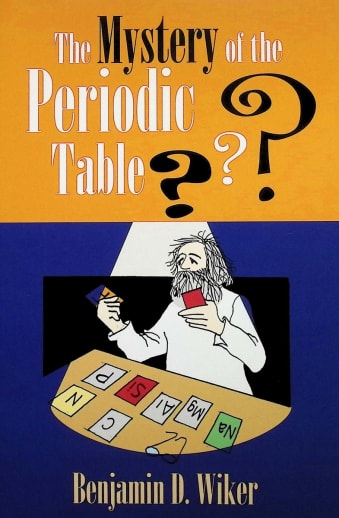
Digging back much further than the development of the Periodic Table, this extremely readable (and entertaining!) book tells the whole story of chemistry, from the first pure elements ever found and used in ancient times (gold and silver) to Mendeleev's development of the Periodic Table, and beyond to the discovery of protons, neutrons and electrons. Along the way, we are introduced to the great thinkers of Greece, Medieval alchemists, Robert Boyle, Joseph Priestly, Lavoisier, John Dalton, Humphrey Davy, Ernest Rutherford, and many other colorful characters from chemistry's history. Believe me - they are definitely colorful! Avoiding dry facts and scientific language, author Benjamin D. Wiker has written this readable history of chemistry with an excellent blend of fact, anecdote and interactive writing. - Jess
Mystery of the Periodic Table
SKU
029477
ISBN
9781883937713
Grade 5-AD
Neutral
Non-Consumable
These icons are designed to help you quickly understand and learn important information about our products.
Teaching Method
Traditional
Teacher-centered curriculum commonly used in classrooms that may include a text, teacher manual, tests, etc.
Charlotte Mason
A methodology based on the work of a 19th century educator who maintained that children learn best from literature (Living Books), not textbooks.
Classical
A methodology based on the Latin Trivium (three stages of learning), including the grammar stage (memorization and facts), logic stage (critical thinking), and rhetoric stage (developing/defending ideas).
Unit Study
A thematic or topical approach centered around one topic that integrates multiple subject areas.
Montessori (Discovery)
A methodology based on the work of a 20th century educator that emphasizes student and sensory-driven discovery learning and real-life applications.
Other
Other methodologies
Religious Content
Secular
Contains content contrary to common Christian beliefs (i.e. evolution).
Neutral
Avoids religious or theoretical topics or presents multiple viewpoints without preference.
Christian/Religious
Faith-based or including instructional religious content.
Learning Modality
Auditory
Learns through listening, talking out loud or reading out loud.
Visual
Learns through seeing, prefers written instructions and visual materials.
Kinesthetic/Tactile (Hands-On)
Learns through moving, doing and touching.
Multi-Sensory
Curriculum that employ a variety of activities/components.
Presentation
Sequential
Curriculum progresses through well-defined learning objectives. Emphasizes mastery before moving to the next topic.
Spiral
Topics and concepts are repeated from level to level, adding more depth at each pass and connecting with review.
Conceptual/Topical
Focus is on the “why,” often with a unifying concept as well as specific skills; coverage may be broader.
Teacher Involvement
Low Teacher Involvement
Student-led materials; parent acts as a facilitator.
Medium Teacher Involvement
A mix of teacher-led time and independent student work.
High Teacher Involvement
Teacher-led lessons; may utilize discussions, hands-on activities and working together.
Additional Materials Required
No other materials needed
Everything you need is included.
Other Materials Required
There are additional required resources that are a separate purchase.
Other Materials Optional
There are additional resources mentioned or recommended but are not absolutely necessary.
Consumable
Consumable
Designed to be written in; not reusable.
Non-Consumable
Not designed to be written in; reusable.
Our Price
$15.95 $15.95 $11.40
Rainbow Savings: $4.55
Description
Publisher's Description of Mystery of the Periodic Table
Benjamin Wiker leads the reader on a delightful and absorbing journey through the ages, on the trail of the elements of the Periodic Table as we know them today. He introduces the young reader to people like Von Helmont, Boyle, Stahl, Priestly, Cavendish, Lavoisier, and many others, all incredibly diverse in personality and approach, who have laid the groundwork for a search that is still unfolding to this day. The first part of Wiker's witty and solidly instructive presentation is most suitable to middle school age, while the later chapters are designed for ages 12-13 and up, with a final chapter somewhat more advanced.
Includes:
Includes:
- Illustrations
- Periodic Table of elements (2003)
- Glossary
- List of elements by date of discovery
- About the author
- Back cover flap for easy reference of Periodic Table
Category Description for Chemistry
Homeschool Chemistry Curriculum, Workbooks, Lab Materials, Kits, Games, and Chemistry Lab Supplies
Details
| Product Format: | Binder |
|---|---|
| Grades: | 5-AD |
| Brand: | Bethlehem Books |
| Author: | Benjamin D. Wiker |
| ISBN: | 9781883937713 |
| Length in Inches: | 8.5 |
| Width in Inches: | 5.5 |
| Height in Inches: | 0.5 |
| Weight in Pounds: | 0.55 |
| Ages: | 10+ |
| Edition: | Illustrated |
| Illustrated by: | Jeanne Bendick |
| Pages: | 170 |
| Publication Date: | 5/3/2013 |
Videos
Reviews