
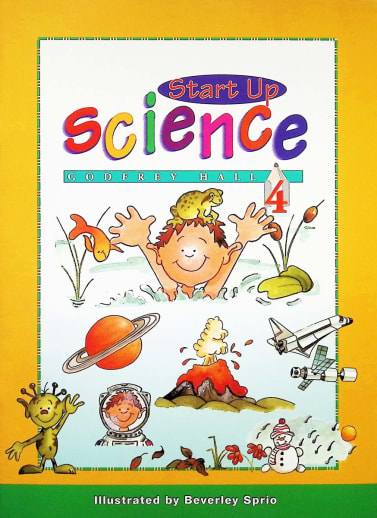
Earlybird Start-Up Science 4 teaches young children simple yet foundational concepts in earth science through short readings and activities. Colorful and consumable, there are 29 one-page lessons that introduce day and night, the seasons, land and sea, earth and planets, solar system, life in space, meteors, studying the sky, food chains, survival, and more. Activities vary from easy-to-do written exercises to hands-on experiments. You will need to provide sand or flour, marbles or stones, a sausage-shaped balloon, bull-dog clip, straws, cord, a map, and household items. Personally, I would also add a volcano kit or making a baking soda volcano to accompany the lesson on volcanoes! Answers included.
Earlybird Start Up Science 4
SKU
029392
ISBN
9789810106638
Grade 1-2
These icons are designed to help you quickly understand and learn important information about our products.
Teaching Method
Traditional
Teacher-centered curriculum commonly used in classrooms that may include a text, teacher manual, tests, etc.
Charlotte Mason
A methodology based on the work of a 19th century educator who maintained that children learn best from literature (Living Books), not textbooks.
Classical
A methodology based on the Latin Trivium (three stages of learning), including the grammar stage (memorization and facts), logic stage (critical thinking), and rhetoric stage (developing/defending ideas).
Unit Study
A thematic or topical approach centered around one topic that integrates multiple subject areas.
Montessori (Discovery)
A methodology based on the work of a 20th century educator that emphasizes student and sensory-driven discovery learning and real-life applications.
Other
Other methodologies
Religious Content
Secular
Contains content contrary to common Christian beliefs (i.e. evolution).
Neutral
Avoids religious or theoretical topics or presents multiple viewpoints without preference.
Christian/Religious
Faith-based or including instructional religious content.
Learning Modality
Auditory
Learns through listening, talking out loud or reading out loud.
Visual
Learns through seeing, prefers written instructions and visual materials.
Kinesthetic/Tactile (Hands-On)
Learns through moving, doing and touching.
Multi-Sensory
Curriculum that employ a variety of activities/components.
Presentation
Sequential
Curriculum progresses through well-defined learning objectives. Emphasizes mastery before moving to the next topic.
Spiral
Topics and concepts are repeated from level to level, adding more depth at each pass and connecting with review.
Conceptual/Topical
Focus is on the “why,” often with a unifying concept as well as specific skills; coverage may be broader.
Teacher Involvement
Low Teacher Involvement
Student-led materials; parent acts as a facilitator.
Medium Teacher Involvement
A mix of teacher-led time and independent student work.
High Teacher Involvement
Teacher-led lessons; may utilize discussions, hands-on activities and working together.
Additional Materials Required
No other materials needed
Everything you need is included.
Other Materials Required
There are additional required resources that are a separate purchase.
Other Materials Optional
There are additional resources mentioned or recommended but are not absolutely necessary.
Consumable
Consumable
Designed to be written in; not reusable.
Non-Consumable
Not designed to be written in; reusable.
Our Price
$7.05 Product Overview
- 29 lessons introduce basic earth science concepts to young children
- Each lesson is one page with a short reading and simple activity
- Activities vary, including fill-in-the-blank, matching, word scrambles, coloring, and hands-on experiments
Description
Publisher's Description of Earlybird Start Up Science 4
This series opens the door to the challenging world of scientific discovery and introduces young learners to scientific concepts. Simple explanations of concepts are charmingly illustrated and reinforced in the interesting activities and experiments that follow. The books, each with 29 exercises, are filled with stimulating facts and activities covering everything from daily life to satellites and dinosaurs.
There are no teacher’s guides for this series. Answers are provided at the back of each book. Earlybird Start Up Science is ideal for both classroom and home use.
Category Description for Earlybird Start Up Science
Brought to us from the same publisher as Primary Mathematics, the colorful Earlybird Start Up Science series introduces early concepts in life science, physical science, chemistry, and earth science to the very young. Each book focuses on one of these sciences and contains 29 lessons and an answer key. Each page of the book focuses on a different topic and presents a short informational segment, followed by questions or a hands-on activity. The material is presented in its simplest form, and most often the questions repeated at the end simply ask the student what was discussed at the top of the page, although in some cases, it might be helpful to have read a little more material on the subject as well. The range of subjects is pretty impressive, including animal habitats, parts of the ear and eye, how seeds sprout, electromagnets, conductors, circuits, mixing colors, evaporation, how sound is made, sinking or floating, seasons, the solar system, the Milky Way, constellations, meteors, food chains, and more. As an example of a lesson, one lesson in Book 3 features a short paragraph on the properties of some common materials, followed by a blank chart. The students must decide whether some other common materials such as wood, glass, plastic, rubber, and more, are hard, if they can be bent, if they last a long time, and if they are attracted to a magnet. After that activity, several common materials are listed, and the student must match these to the item or construction it can be used to make. All activities are generously illustrated with friendly, cartoon-like animals and objects, and altogether the books have a “fun” and relaxed look about them, even though the concepts are well-presented and a little more serious than I’ve seen in other early elementary science programs. Answers are included. Please note, some supplies may be hard to find in the U.S., although it would be fairly easy to swap out the supply or activity. Inexpensive and easy-to-use, these books could easily make up a complete science curriculum for the early grades, although you may want to supplement with a little more reading, especially with interesting, related library books to broaden their horizons a little more. Evolutionary dating. Available individually or in a convenient set.- Jess
Details
| Product Format: | Paperback Book |
|---|---|
| Grades: | 1-2 |
| Brand: | Marshall Cavendish |
| ISBN: | 9789810106638 |
| Length in Inches: | 10.25 |
| Width in Inches: | 7.5 |
| Height in Inches: | 0.125 |
| Weight in Pounds: | 0.25 |
Videos
Reviews