
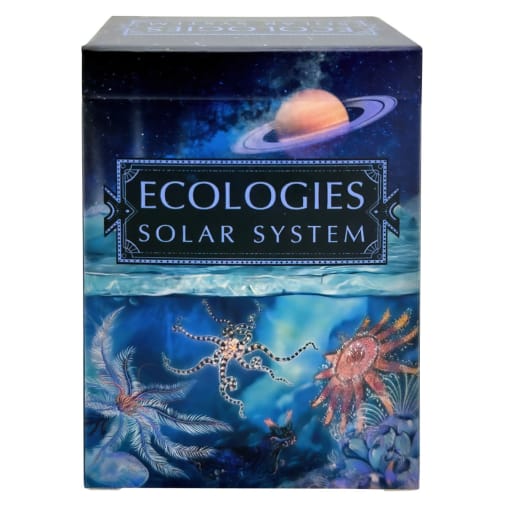
Play a science-based card game in the home or classroom that focuses on food chains and the circle of life. The playing cards feature beautiful artwork of animals, plants, and celestial bodies. Unlike the original Ecologies game, this version focuses on “What kind of life may have existed, or what might someday exist.” Includes 78 unique organism cards, 7 celestial bodies, and beautiful art cards (108 cards total). Also included is a 24-page instruction manual with some scientific information. For 1-6 players, ages 12+. Offers 60-90 minutes of playing time. Can be played in standard, simple, or single-player modes. ~ Brianna
Ecologies Solar System Card Game
SKU
028274
Grade 7-AD
These icons are designed to help you quickly understand and learn important information about our products.
Teaching Method
Traditional
Teacher-centered curriculum commonly used in classrooms that may include a text, teacher manual, tests, etc.
Charlotte Mason
A methodology based on the work of a 19th century educator who maintained that children learn best from literature (Living Books), not textbooks.
Classical
A methodology based on the Latin Trivium (three stages of learning), including the grammar stage (memorization and facts), logic stage (critical thinking), and rhetoric stage (developing/defending ideas).
Unit Study
A thematic or topical approach centered around one topic that integrates multiple subject areas.
Montessori (Discovery)
A methodology based on the work of a 20th century educator that emphasizes student and sensory-driven discovery learning and real-life applications.
Other
Other methodologies
Religious Content
Secular
Contains content contrary to common Christian beliefs (i.e. evolution).
Neutral
Avoids religious or theoretical topics or presents multiple viewpoints without preference.
Christian/Religious
Faith-based or including instructional religious content.
Learning Modality
Auditory
Learns through listening, talking out loud or reading out loud.
Visual
Learns through seeing, prefers written instructions and visual materials.
Kinesthetic/Tactile (Hands-On)
Learns through moving, doing and touching.
Multi-Sensory
Curriculum that employ a variety of activities/components.
Presentation
Sequential
Curriculum progresses through well-defined learning objectives. Emphasizes mastery before moving to the next topic.
Spiral
Topics and concepts are repeated from level to level, adding more depth at each pass and connecting with review.
Conceptual/Topical
Focus is on the “why,” often with a unifying concept as well as specific skills; coverage may be broader.
Teacher Involvement
Low Teacher Involvement
Student-led materials; parent acts as a facilitator.
Medium Teacher Involvement
A mix of teacher-led time and independent student work.
High Teacher Involvement
Teacher-led lessons; may utilize discussions, hands-on activities and working together.
Additional Materials Required
No other materials needed
Everything you need is included.
Other Materials Required
There are additional required resources that are a separate purchase.
Other Materials Optional
There are additional resources mentioned or recommended but are not absolutely necessary.
Consumable
Consumable
Designed to be written in; not reusable.
Non-Consumable
Not designed to be written in; reusable.
Our Price
$30.00 $30.00 $23.95
Rainbow Savings: $6.05
Description
Publisher's Description of Ecologies Solar System Card Game
ECOLOGIES, this game speculates about what kind of life may have existed, or might someday exist, in our own solar system. Using real science, and in collaboration with a NASA JPL educator, we imagine what life might need to survive on 7 unique celestial bodies.
Designed by a biology teacher, the game includes 78 unique organism and "life requirement" cards, 7 celestial bodies, and beautiful scientific art. (108 cards total)
Players: 1-6
Ages: 12+ (8+ with included simplified rules)
Time: 60-90 minutes
Game Modes: Standard, Simplified, Single Player
The goal is to build healthy food webs on different celestial bodies. If you create a healthy ecology you are rewarded with the perks and powers of that celestial body. Each organism card lists what it eats and what it’s eaten by. Cards are arranged with producers on the bottom, predators on top. This deck also includes new "life requirement cards" that need to be in place before you can add a producer. There is a trade mechanic similar to Catan where players trade with others based on what their individual needs are. It is a race to get 12 victory points and different organisms give different points. There are terrestrial/cosmic factor cards that can affect opponents and different strategies such as focusing on one celestial body, going for perks and bonuses, or disrupting other ecologies.
The game takes inspiration from titles like Settlers of Catan, Agricola, and Dominion. The gameplay is rooted in authentic science, as it is used in the classroom to teach real concepts to science students. While it is scientific enough for the classroom, it is also strategic enough for any game night.
The points system is based on ecological trophic levels. The producers (plants) are worth less and as you make your way up the pyramid organisms are worth more as it takes a lot of energy to sustain them. In real life only roughly 10% of the energy makes it from one level to the next, meaning you have to have acres of land and hundreds of animals just to sustain one apex predator. There is a 24 page rulebook included with the card game that also gives an overview of the science.
Category Description for Ecologies Game
It's a dog-eat-dog world in Ecologies – well, actually, it's a dog-eat-rat world, ecologically speaking! The goal of this delightfully educational game is to create sustainable ecosystems across environments such as Desert, Grassland, and Ocean. Beautifully illustrated cards serve as these Biomes, as well as the Plants and Animals within them. Players take turns drawing and playing cards to create balanced ecologies. For instance, a healthy temperate forest ecology contains blackberries (producing plant), bees (to feed on the blackberries), frogs (to eat the bees), hawks (to eat the frogs), and earthworms (to decompose everything). Once a biome is complete, it offers bonuses ranging from points, to extra cards, to sabotaging another player's ecosystem. The trick is that players can only play cards "up" the food chain, and players are limited to a small handful of cards, often leaving half-finished ecosystems worth very few points. To alleviate this danger, players are encouraged to make trades – sometimes asymmetrical – with their competitors. It's not uncommon for players to offer up a fistful of unusable animals in exchange for the one missing link they need to complete their ecosystem! Adding another element of unpredictability are powerful Biotic and Abiotic Factor cards, providing bonuses to oneself or inflicting setbacks upon opponents. With gorgeous John James Audubon-style artwork, open gameplay, and vocabulary and animal diet information galore, this game is equally at home as a science supplement or a family game. For 1-6 players, with a playing time of 30-60 minutes. Each edition contains all-new biomes, animals, and Biotic and Abiotic factor cards, and can be played standalone or mixed with the original game.
Details
| Product Format: | Other |
|---|---|
| Grades: | 7-AD |
| Brand: | Montrose Biology |
| EAN/UPC: | 860003217764 |
| Length in Inches: | 3.5625 |
| Width in Inches: | 2.5625 |
| Height in Inches: | 1.6875 |
| Weight in Pounds: | 0.5 |
Videos
Reviews