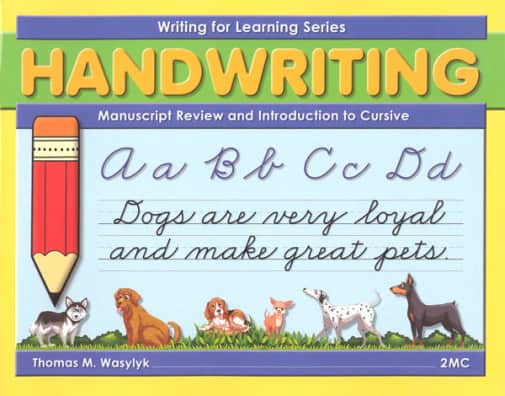

The first part of this book reviews manuscript. Students then learn the additional strokes for cursive and the cursive alphabet, practicing individual letters and short sentences. This straightforward, no-nonsense handwriting workbook is 8.5" x 11" with the first seven in landscape format. Books feature color covers, but are black-and-white inside.
Manuscript Review / Introduction to Cursive Writing Gr 2 (WFL Series)
SKU
027066
ISBN
9781934732601
Grade 2
Traditional
Neutral
Low Teacher Involvement
These icons are designed to help you quickly understand and learn important information about our products.
Teaching Method
Traditional
Teacher-centered curriculum commonly used in classrooms that may include a text, teacher manual, tests, etc.
Charlotte Mason
A methodology based on the work of a 19th century educator who maintained that children learn best from literature (Living Books), not textbooks.
Classical
A methodology based on the Latin Trivium (three stages of learning), including the grammar stage (memorization and facts), logic stage (critical thinking), and rhetoric stage (developing/defending ideas).
Unit Study
A thematic or topical approach centered around one topic that integrates multiple subject areas.
Montessori (Discovery)
A methodology based on the work of a 20th century educator that emphasizes student and sensory-driven discovery learning and real-life applications.
Other
Other methodologies
Religious Content
Secular
Contains content contrary to common Christian beliefs (i.e. evolution).
Neutral
Avoids religious or theoretical topics or presents multiple viewpoints without preference.
Christian/Religious
Faith-based or including instructional religious content.
Learning Modality
Auditory
Learns through listening, talking out loud or reading out loud.
Visual
Learns through seeing, prefers written instructions and visual materials.
Kinesthetic/Tactile (Hands-On)
Learns through moving, doing and touching.
Multi-Sensory
Curriculum that employ a variety of activities/components.
Presentation
Sequential
Curriculum progresses through well-defined learning objectives. Emphasizes mastery before moving to the next topic.
Spiral
Topics and concepts are repeated from level to level, adding more depth at each pass and connecting with review.
Conceptual/Topical
Focus is on the “why,” often with a unifying concept as well as specific skills; coverage may be broader.
Teacher Involvement
Low Teacher Involvement
Student-led materials; parent acts as a facilitator.
Medium Teacher Involvement
A mix of teacher-led time and independent student work.
High Teacher Involvement
Teacher-led lessons; may utilize discussions, hands-on activities and working together.
Additional Materials Required
No other materials needed
Everything you need is included.
Other Materials Required
There are additional required resources that are a separate purchase.
Other Materials Optional
There are additional resources mentioned or recommended but are not absolutely necessary.
Consumable
Consumable
Designed to be written in; not reusable.
Non-Consumable
Not designed to be written in; reusable.
Our Price
$8.75 Description
Publisher's Description of Manuscript Review / Introduction to Cursive Writing Gr 2 (WFL Series)
Writing for Learning: Manuscript Review and Introduction to Cursive for second grade prepares students to make the transition from manuscript handwriting to cursive handwriting.
- Students write manuscript and cursive basic strokes, letters, words, and sentences.
- Every lowercase cursive letter page includes joining models to help students learn how to properly connect letters.
- Check-ups encourage students to self-evaluate their work so they can recognize and immediately correct errors.
Category Description for Writing for Learning Series (formerly Universal Handwriting 2nd Edition)
The Writing for Learning series (formerly Universal Publishing Handwriting) is a straightforward, traditional handwriting program that guides students from basic pre-writing skills through manuscript mastery and into fluent cursive. With consistent models and meaningful copywork, it helps students develop neat, legible handwriting while reinforcing educational content.
Key Curriculum Features:
- Progressive skill development from pre-writing strokes and shapes to full cursive writing
- Traditional manuscript instruction followed by a smooth transition to cursive
- Educationally rich sentences and paragraphs focused on science, geography, history, and interesting facts
- Real-life writing practice such as addresses, forms, and messages
- Ample writing space with appropriate line sizes for each grade level
- Clean, uncluttered black-and-white interior pages
Program Components:
- Reading/Writing Readiness & PK/K books: Pre-writing activities, shapes, and beginning manuscript letter formation
- Grades 1–2 books: Manuscript mastery and introduction to cursive
- Grades 3+ books: Continued cursive practice with increasing sentence and paragraph work (portrait format with smaller lines in later books)
Writing for Learning stands out for its traditional style, educational copywork, and clear progression that builds confident, legible handwriting. It is an excellent choice for homeschool families seeking a practical, no-nonsense handwriting program with meaningful content.
Browse all Writing for Learning levels and sets below!
Details
| Product Format: | Softcover Book |
|---|---|
| Grade: | 2 |
| Brand: | Universal Publishing |
| ISBN: | 9781934732601 |
| Length in Inches: | 8.5 |
| Width in Inches: | 11 |
| Height in Inches: | 0.25 |
| Weight in Pounds: | 0.45 |
Videos
Reviews