These icons are designed to help you quickly understand and learn important information about our products.
Teaching Method
Traditional
Teacher-centered curriculum commonly used in classrooms that may include a text, teacher manual, tests, etc.
Charlotte Mason
A methodology based on the work of a 19th century educator who maintained that children learn best from literature (Living Books), not textbooks.
Classical
A methodology based on the Latin Trivium (three stages of learning), including the grammar stage (memorization and facts), logic stage (critical thinking), and rhetoric stage (developing/defending ideas).
Unit Study
A thematic or topical approach centered around one topic that integrates multiple subject areas.
Montessori (Discovery)
A methodology based on the work of a 20th century educator that emphasizes student and sensory-driven discovery learning and real-life applications.
Other
Other methodologies
Religious Content
Secular
Contains content contrary to common Christian beliefs (i.e. evolution).
Neutral
Avoids religious or theoretical topics or presents multiple viewpoints without preference.
Christian/Religious
Faith-based or including instructional religious content.
Learning Modality
Auditory
Learns through listening, talking out loud or reading out loud.
Visual
Learns through seeing, prefers written instructions and visual materials.
Kinesthetic/Tactile (Hands-On)
Learns through moving, doing and touching.
Multi-Sensory
Curriculum that employ a variety of activities/components.
Presentation
Sequential
Curriculum progresses through well-defined learning objectives. Emphasizes mastery before moving to the next topic.
Spiral
Topics and concepts are repeated from level to level, adding more depth at each pass and connecting with review.
Conceptual/Topical
Focus is on the “why,” often with a unifying concept as well as specific skills; coverage may be broader.
Teacher Involvement
Low Teacher Involvement
Student-led materials; parent acts as a facilitator.
Medium Teacher Involvement
A mix of teacher-led time and independent student work.
High Teacher Involvement
Teacher-led lessons; may utilize discussions, hands-on activities and working together.
Additional Materials Required
No other materials needed
Everything you need is included.
Other Materials Required
There are additional required resources that are a separate purchase.
Other Materials Optional
There are additional resources mentioned or recommended but are not absolutely necessary.
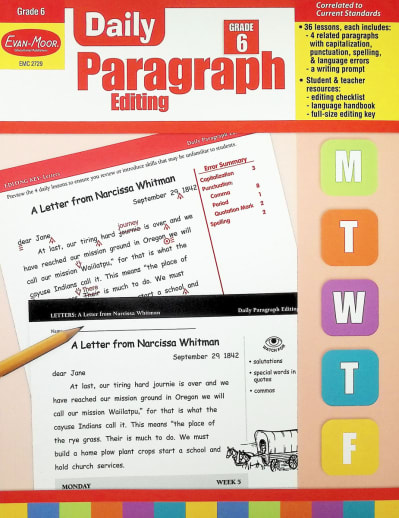
Each two-page spread in the Grade Level Teacher Books contains two of the student's daily editing paragraphs on the right-hand side and the corresponding corrected teacher's editing key on the left. Student pages are reproducible and include a "Watch For" icon in the margin which clues them in to some specific types of errors to watch for. Each error is corrected in red in the key, and a helpful error summary is also included with a total for each type of error found in the paragraph. The error summary allows you to inform your student how many errors of each type there are, if desired, to help them find each one. A short "Language Handbook" is found in the back, and makes referencing capitalization, punctuation and language usage easy and accessible through the use of charts and examples.
Publisher's Description of Daily Paragraph Editing, Grade 6
Daily Paragraph Editing, Grade 6 Teacher Resource Book includes 36 weeks of targeted lessons that will immediately become your favorite supplement to your language arts curriculum. The 176 page focused language arts activities provide the practice students need to produce error-free writing assignments and include easy-to-use teacher support to deliver the lessons.
How it works:
Students apply grade-level language skills to correct a paragraph on Monday through Thursday; when read together, the four paragraphs form a cohesive composition. A writing prompt on Friday relates to the week's four-paragraph composition and gives students the chance to apply the targeted language conventions.
The weekly compositions cover a broad range of expository and narrative writing forms, including:
nonfiction texts on grade-level social studies and science topics
biographies, book reviews, instructions, interviews, journal entries, and letters
fables, fantasy and science fiction, historical fiction, personal narratives, and realistic fiction
Daily Paragraph Editing Grade 6 covers grade-level skills such as:
Capitalization
quotations, salutations, and closings
incorrect use of capitals
names of people, places, and organizations
titles of books, magazines, movies, and songs
Language Usage
singular and plural forms
verb tenses
correct use of pronouns and adjectival and adverbial forms
Punctuation
apostrophes
commas
periods
quotation marks
colons, semicolons, and more!
Spelling
identifying errors in spelling and in multiple-meaning words
Additional resources include:
a reproducible student language handbook that provides simple, clear rules and examples of their application to guide students in correct use of the mechanics, grammar, and spelling skills covered in the daily paragraphs.
a page of reproducible proofreading marks that models the standard markings used to correct and edit text.
an editing checklist to guide students in reviewing and revising their own writing or that of a peer.
an assessment rubric to guide teachers in conducting a holistic evaluation of student writing.
This series gives students a manageable paragraph of editing practice each day. Each book consists of 36 weekly lessons. Monday - Thursday daily editing worksheets are four paragraphs (one each day) on related subject material filled with capitalization, punctuation, spelling, and language usage errors. A writing prompt related to that week's topic is given on Friday so the student may compose their own paragraph.
An easy-to-use way to include a little bit of editing into the little bit of time you have each day. ~ Jess