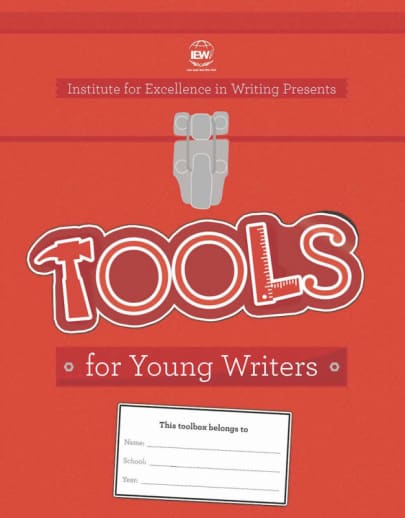
Tools for Young Writers

SKU
024725
ISBN
9781623411701
Grade K-3
Teaching Method
Traditional
Teacher-centered curriculum commonly used in classrooms that may include a text, teacher manual, tests, etc.
Charlotte Mason
A methodology based on the work of a 19th century educator who maintained that children learn best from literature (Living Books), not textbooks.
Classical
A methodology based on the Latin Trivium (three stages of learning), including the grammar stage (memorization and facts), logic stage (critical thinking), and rhetoric stage (developing/defending ideas).
Unit Study
A thematic or topical approach centered around one topic that integrates multiple subject areas.
Montessori (Discovery)
A methodology based on the work of a 20th century educator that emphasizes student and sensory-driven discovery learning and real-life applications.
Other
Other methodologies
Religious Content
Secular
Contains content contrary to common Christian beliefs (i.e. evolution).
Neutral
Avoids religious or theoretical topics or presents multiple viewpoints without preference.
Christian/Religious
Faith-based or including instructional religious content.
Learning Modality
Auditory
Learns through listening, talking out loud or reading out loud.
Visual
Learns through seeing, prefers written instructions and visual materials.
Kinesthetic/Tactile (Hands-On)
Learns through moving, doing and touching.
Multi-Sensory
Curriculum that employ a variety of activities/components.
Presentation
Sequential
Curriculum progresses through well-defined learning objectives. Emphasizes mastery before moving to the next topic.
Spiral
Topics and concepts are repeated from level to level, adding more depth at each pass and connecting with review.
Conceptual/Topical
Focus is on the “why,” often with a unifying concept as well as specific skills; coverage may be broader.
Teacher Involvement
Low Teacher Involvement
Student-led materials; parent acts as a facilitator.
Medium Teacher Involvement
A mix of teacher-led time and independent student work.
High Teacher Involvement
Teacher-led lessons; may utilize discussions, hands-on activities and working together.
Additional Materials Required
No other materials needed
Everything you need is included.
Other Materials Required
There are additional required resources that are a separate purchase.
Other Materials Optional
There are additional resources mentioned or recommended but are not absolutely necessary.
Consumable
Consumable
Designed to be written in; not reusable.
Non-Consumable
Not designed to be written in; reusable.
Our Price
$19.00

Description

Here's a set of writing "tools" just for emerging IEW writers, providing a visual representation of all the elements of the first five Structure and Style units, but simplified for beginning and young writers. The Tool Kit (looking like a tool box) is a tri-fold folder with a pocket on one leaf. Cardstock cut-apart graphics that are to be positioned on the folder are provided. Designed to be added to as the student is introduced to the concepts, the folder serves as a ready reminder of what has been learned (and what the student is to be incorporating into his daily writing.) Notes from the first five units plus dress-ups, parts of speech, and word lists even a basic (traditional) handwriting chart are provided. This toolbox like all useful toolboxes can be kept close at hand and opened whenever a student needs a particular tool. ~ Janice
Publisher's Description of Tools for Young Writers

Here's a "portable wall" for your primary students! Your students apply stickers to their folders as they build on their experience and understanding of writing with Structure and Style.

Category Description for Teaching Writing Structure and Style®

Teaching Writing Structure and Style® (TWSS) is a distinct method used to teach the Institute for Excellence in Writing Structure and Style® student programs and the Theme-Based writing levels. This course equips you to be a writing coach for students who are using these programs, improve your own writing skills, and also offers an accreditation for teachers’ option (on publisher’s website). Structure covers the type of writing and the method of organizing the writing. Style, on the other hand, is taught throughout the units, one technique at a time. Style includes such things as varying sentence openings, using similes and metaphors, or repeating certain words for effect. The idea is to help students develop a creative flow of well-conceived thoughts. Some students will master a lot of the material quickly, while other students will master only a portion of the material, but all will achieve variety and competence in expression.

The newly updated 3rd edition TWSS course seminar trains you to teach students from early elementary age on up. The student materials are provided in the Structure and Style® for Students programs, levels A (3rd-5th grades), B (6th-8th grades, and C (9th-12th grades). Previous editions of the TWSS course videos and materials will not correlate with this new third edition.

This 3rd edition seminar training is only available with the training as a Forever Streaming option. The full kit includes a sturdy, long-lasting binder with preprinted tabs that holds the included looseleaf seminar workbook. The full kit also includes the spiral-bound Strengthening Structure (which is also available separately) and the portable walls (like mini posters) for Structure and Style®. This seminar features over 11 hours of training by Andrew Pudewa – with some teaching by Jeff Nease. The writing seminar covers two basic components of composition structure and style– and is divided into units: Note Making and Outlines; Writing from Notes, Retelling Narrative Stories; Summarizing a Reference; Writing from Pictures; Summarizing Multiple References; Inventive Writing; Formal Essay Models; and Formal Critique. This new edition includes additional resources on Writing about Literature, a Literature Thesaurus, Literary Analysis, Classical Arrangement (a Socratic discussion tool) and resources on developing stylistic techniques (like “dress ups” and “triple extensions”). The program also addresses common problems among writing teachers: overcorrecting, not giving enough help when needed, unclear assignments, and over-expectation. It is designed to help you bring the best out in your student. Additional Seminar binder, Strengthening Structure, Portable Walls (mini posters) and a younger writers’ version of the Portable Wall content are sold separately. ~ Ruth

Details
More Information
Product Format:Other
Grades:K-3
Brand:Institute for Excellence in Writing
Author:Carla Perez
ISBN:9781623411701
Length in Inches:12
Width in Inches:9
Height in Inches:0.0625
Weight in Pounds:0.3
Videos
This product doesn't have a video
Reviews
Product Q&A