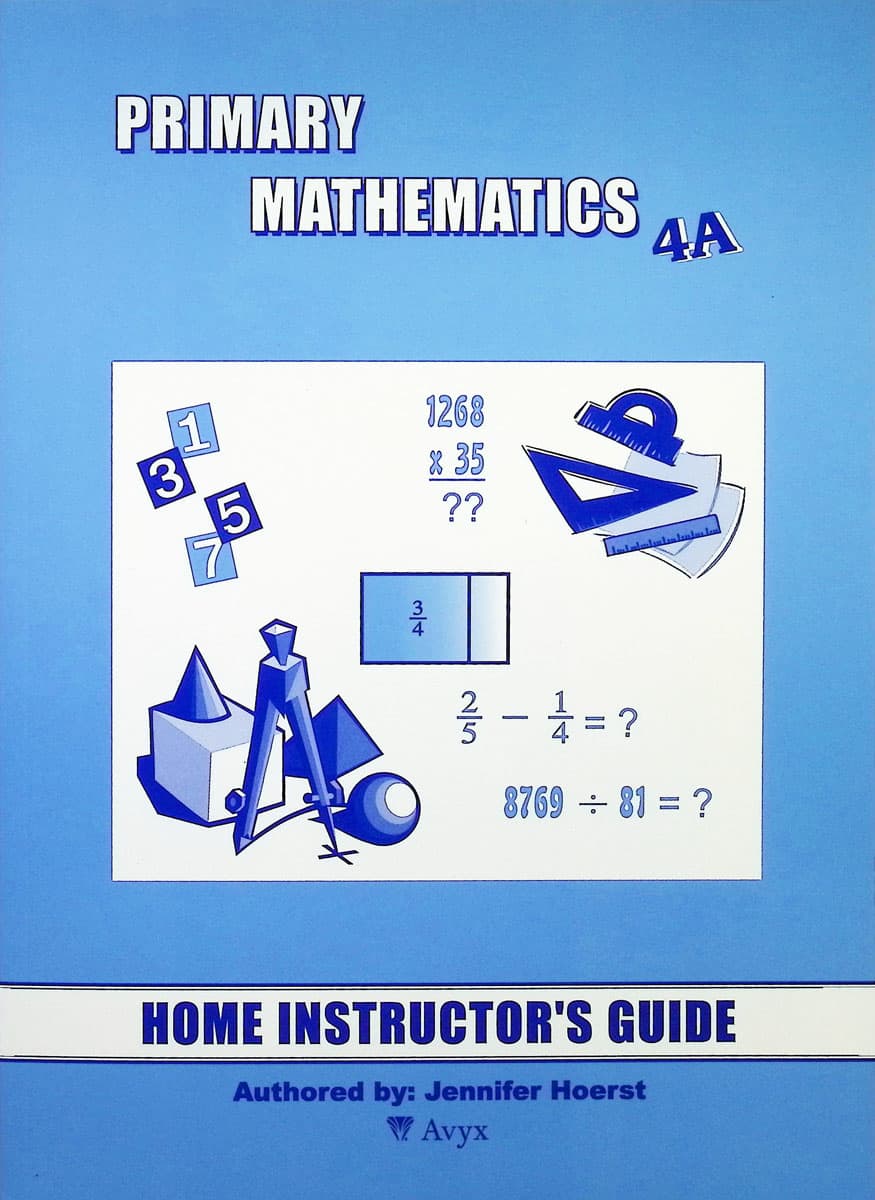
Primary Math US 4A Home Instructor Guide

SKU
024006
ISBN
9781887840934
Grade 4
Neutral
Medium Teacher Involvement
Multi-Sensory
Other Materials Optional
Sequential
Teaching Method
Traditional
Teacher-centered curriculum commonly used in classrooms that may include a text, teacher manual, tests, etc.
Charlotte Mason
A methodology based on the work of a 19th century educator who maintained that children learn best from literature (Living Books), not textbooks.
Classical
A methodology based on the Latin Trivium (three stages of learning), including the grammar stage (memorization and facts), logic stage (critical thinking), and rhetoric stage (developing/defending ideas).
Unit Study
A thematic or topical approach centered around one topic that integrates multiple subject areas.
Montessori (Discovery)
A methodology based on the work of a 20th century educator that emphasizes student and sensory-driven discovery learning and real-life applications.
Other
Other methodologies
Religious Content
Secular
Contains content contrary to common Christian beliefs (i.e. evolution).
Neutral
Avoids religious or theoretical topics or presents multiple viewpoints without preference.
Christian/Religious
Faith-based or including instructional religious content.
Learning Modality
Auditory
Learns through listening, talking out loud or reading out loud.
Visual
Learns through seeing, prefers written instructions and visual materials.
Kinesthetic/Tactile (Hands-On)
Learns through moving, doing and touching.
Multi-Sensory
Curriculum that employ a variety of activities/components.
Presentation
Sequential
Curriculum progresses through well-defined learning objectives. Emphasizes mastery before moving to the next topic.
Spiral
Topics and concepts are repeated from level to level, adding more depth at each pass and connecting with review.
Conceptual/Topical
Focus is on the “why,” often with a unifying concept as well as specific skills; coverage may be broader.
Teacher Involvement
Low Teacher Involvement
Student-led materials; parent acts as a facilitator.
Medium Teacher Involvement
A mix of teacher-led time and independent student work.
High Teacher Involvement
Teacher-led lessons; may utilize discussions, hands-on activities and working together.
Additional Materials Required
No other materials needed
Everything you need is included.
Other Materials Required
There are additional required resources that are a separate purchase.
Other Materials Optional
There are additional resources mentioned or recommended but are not absolutely necessary.
Consumable
Consumable
Designed to be written in; not reusable.
Non-Consumable
Not designed to be written in; reusable.
Our Price
$20.00

Description

If you're looking for a little more help on how to teach Primary Math, these support guides are just what you need. Each guide provides a suggested teaching schedule, detailed notes to the instructor referencing specific course book pages, games and activities, complete textbook and workbook answers, step-by-step solutions for all word problems, and mental math pages. Suggested games and activities may require additional materials, such as a base-10 set, multilink cubes, hundred chart, etc. Currency replacement pages (depicting U.S. money) are also included. Guides for all levels can be used with both the Singapore and U.S. editions, although you may need to make minor adjustments for level 2B. ~ Anh

Publisher's Description of Primary Math US 4A Home Instructor Guide

This guide is meant to help instructors using Primary Mathematics 4A when teaching one student or a small group of students. It should be used as a guide and adapted as needed.

It contains:

  • Objectives
  • Notes to the instructor, providing added explanation of concepts
  • Instructional ideas and suggested activities
  • Game ideas to reinforce concepts from the corresponding textbook pages and learning tasks
  • Homework assignments
  • Answers and solutions to all the learning tasks, workbook exercises and reviews and textbook practices and reviews

Included is a suggested weekly schedule and pages for mental math (in the appendix). Practices and reviews in the text can, for the most part, be done independently by the student. Some can be used as part of the lesson. Since some of the practice questions are challenging, they provide good opportunities for discussion . The mental math pages can be used as worksheets, but they are not meant to be done orally. Students should be able to see the problems. They can be used any time after they are referenced in this guide and can be used more than once.

This guide can be used with both the U.S. edition and the third edition of Primary Mathematics. Items specific to either edition, such as different answers, different page numbers, and different exercise numbers, are clearly indicated. U.S. spellings are used in this guide, and answers involving number words use the current U.S. convention of reserving the word "and" for the decimal and not using it in number words for whole numbers.

Category Description for Primary Math U.S. Edition (Gr. 1-6)

Primary Math U.S. Edition uses the Singapore meth­odology (based on the Singapore’s Ministry of Education Syllabus) that employs a con­crete-to-pictorial-to-abstract approach to teaching. Concrete illustrations are incorporat­ed heavily in the early grades, gradually giving way to more abstract representations so that math is learned meaningfully. The program builds strong problem solving, critical thinking, and computational skills through well-chosen practice problems. Primary Math focuses on topics such as using whole numbers, fractions, and decimals, perimeter, area, volume, angles, quadrilaterals, symmetry, time, length, weight, money, graphs, and algebraic expressions. American money and U.S. measurements are included in the U.S. edition of this curriculum. 

Each grade consists of two semester sets to be completed in one year. The ‘A’ textbook and workbook would be first semester, and the ‘B’ textbook and workbook would be second semester. Although the pace of the course really depends on the individual student, 2-3 pages in the text is usually enough for one day's lesson. Brief teacher instructions are pro­vided in the textbook’s preface, but the Home Instructor Guide offers answers and more in-depth instruction and how to use optional manipulatives for the parent. Sets include text, workbook, and Home Instructor’s Guide.

We also offer supplemental Primary Math U.S. Extra Practice Books for each grade level. Optional, these helpful Extra Practice books provide additional practice problems organized by grade level topics.  Convenient math manipulative kits are also available. Compared to Saxon Math, Primary Math encompasses a narrower scope. While Saxon Math covers coordinate graphing, negative numbers, square roots, and probability, these topics are omitted from Primary Math and are not covered until New Elementary Math. The smaller scope, however, allows the program to emphasize the basics. Primary Math focuses on the four arithmetic operations (using whole numbers, fractions, and decimals), perimeter, area, volume, angles, quadrilaterals, symmetry, time, length, weight, money, graphs, and algebraic expressions (introduced in 6th grade). Saxon Math moves a bit slower introducing Algebra in Math 87. 


Details
More Information
Product Format:Softcover Book
Grade:4
Brand:Avyx
ISBN:9781887840934
Length in Inches:10
Width in Inches:7.5
Height in Inches:0.5
Weight in Pounds:0.894
Videos
This product doesn't have a video
Reviews
Product Q&A