Focus On Middle School Physics Laboratory Notebook (3rd Edition)

SKU
023026
ISBN
9781941181744
Grade 5-8
Neutral
Medium Teacher Involvement
Multi-Sensory
Other Materials Required
Conceptual/Topical
Teaching Method
Traditional
Teacher-centered curriculum commonly used in classrooms that may include a text, teacher manual, tests, etc.
Charlotte Mason
A methodology based on the work of a 19th century educator who maintained that children learn best from literature (Living Books), not textbooks.
Classical
A methodology based on the Latin Trivium (three stages of learning), including the grammar stage (memorization and facts), logic stage (critical thinking), and rhetoric stage (developing/defending ideas).
Unit Study
A thematic or topical approach centered around one topic that integrates multiple subject areas.
Montessori (Discovery)
A methodology based on the work of a 20th century educator that emphasizes student and sensory-driven discovery learning and real-life applications.
Other
Other methodologies
Religious Content
Secular
Contains content contrary to common Christian beliefs (i.e. evolution).
Neutral
Avoids religious or theoretical topics or presents multiple viewpoints without preference.
Christian/Religious
Faith-based or including instructional religious content.
Learning Modality
Auditory
Learns through listening, talking out loud or reading out loud.
Visual
Learns through seeing, prefers written instructions and visual materials.
Kinesthetic/Tactile (Hands-On)
Learns through moving, doing and touching.
Multi-Sensory
Curriculum that employ a variety of activities/components.
Presentation
Sequential
Curriculum progresses through well-defined learning objectives. Emphasizes mastery before moving to the next topic.
Spiral
Topics and concepts are repeated from level to level, adding more depth at each pass and connecting with review.
Conceptual/Topical
Focus is on the “why,” often with a unifying concept as well as specific skills; coverage may be broader.
Teacher Involvement
Low Teacher Involvement
Student-led materials; parent acts as a facilitator.
Medium Teacher Involvement
A mix of teacher-led time and independent student work.
High Teacher Involvement
Teacher-led lessons; may utilize discussions, hands-on activities and working together.
Additional Materials Required
No other materials needed
Everything you need is included.
Other Materials Required
There are additional required resources that are a separate purchase.
Other Materials Optional
There are additional resources mentioned or recommended but are not absolutely necessary.
Consumable
Consumable
Designed to be written in; not reusable.
Non-Consumable
Not designed to be written in; reusable.
Our Price
$34.00 $34.00 $24.25
Rainbow Savings: $9.75

Description

Twelve chapters covering the basic laws of physics, force, energy and work, potential and kinetic energy, energy conservation, motion, friction, momentum, speed, velocity, acceleration, projectile and circular motion, gas laws, chemical energy, electric charge, electric fields, Van de Graaff Generator, electrodynamics, Ohm's Law, magnetic fields, electromagnets and biomagnetism. The consumable Laboratory Notebook is a very important part of the program. For each text chapter there are two lab activities: a main experiment and a second "Just For Fun Experiment" which is less formal and provides further exploration of concepts presented. Experiments are divided into sections: "Observe it" which focuses on making observations; "Think About It" questions; "What Did You Discover?" where students write down or draw what they observed from the experiment; and, "Why?" where they learn the reasons why they observed certain things during the experiment. Single lines are provided for answering questions, along with space for drawing observations. With a few black and white illustrations, the softcover lab notebook helps children develop their observation and analytic skills, which are vital to understanding the scientific process. Experiments take approximately one hour to complete.
Publisher's Description of Focus On Middle School Physics Laboratory Notebook (3rd Edition)
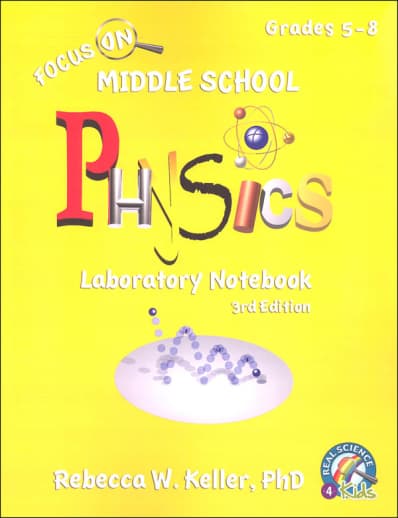
The Focus On Middle School Physics Laboratory Notebook, 3rd Edition accompanies the Focus On Middle School Physics Student Textbook, 3rd Edition. The Laboratory Notebook includes (12) hands-on physics experiments that coincide with the chapters in the Student Textbook. Students will explore physics concepts such as: using the scientific method; building electric circuits; work as defined by physics; potential, kinetic, and gravitational energy; the conversion of energy from one form to another; mass, momentum, friction, and inertia; velocity and acceleration; tangential speed; chemical energy; electric charge; electromagnets, and more.

The Focus On Middle School Physics Laboratory Notebook, 3rd Edition contains 12 black and white chapters. Grades 5-8.

142 pages.

Category Description for Middle School Physics

Twelve chapters covering the basic laws of physics, force, energy and work, potential and kinetic energy, energy conservation, motion, friction, momentum, speed, velocity, acceleration, projectile and circular motion, gas laws, chemical energy, electric charge, electric fields, Van de Graaff Generator, electrodynamics, Ohm's Law, magnetic fields, electromagnets and biomagnetism. Recommended lab supplies include Snap Circuits Jr. 100 Kit, 6v Battery, D cell battery, Slinky and other easily found items. Contact us for full listing.

Details
More Information
Product Format:Paperback
Grades:5-8
Brand:Gravitas Publications
Author:Rebecca Keller
ISBN:9781941181744
Length in Inches:11
Width in Inches:8.5
Height in Inches:0.375
Weight in Pounds:0.8125
Videos
This product doesn't have a video
Reviews
Product Q&A