Discover!
ELA is designed to
encourage and develop independent and critical thinking while also ensuring
mastery of foundational skills. As a full English Language Arts option, it is
framed within wholesome content that incorporates exploration, direct
instruction, skill-building, and lesson review. To meet the needs of auditory,
visual, and kinesthetic learners, each worktext includes activities,
instruction, and extensions. Discover! ELA curriculum covers all essential
English Language Arts components for each grade, including spelling and
handwriting. Students will learn and practice printing in the younger grades,
and cursive handwriting in the upper grades (4th and above).
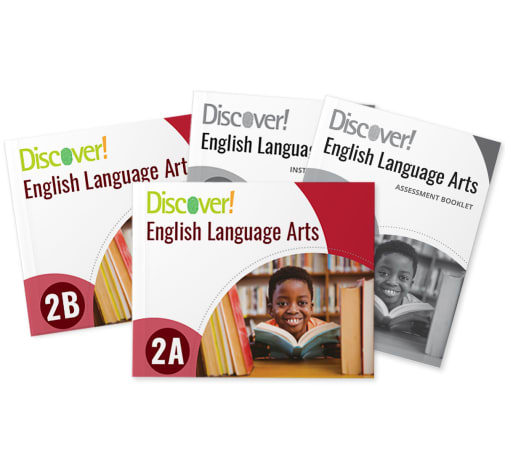
Each
grade set includes a Student Semester A Worktext, Semester B Worktext, a full
Instructor’s Guide, and the Assessment Booklet. Currently, these are only
available as a set and not sold individually. Decodable readers for grades 1
and 2 are sold separately and contain short stories written with specific
letter-sound patterns.
Students
are set up for success with the lesson goals and objectives in the
consumable Student Worktexts A & B. Learning is also
facilitated by identifying lessons students may need to review, relevant
academic vocabulary, and the provision of optional extension activities. Each
course is designed to cover approximately 150 days of instruction. There are
approximately 72–75 lessons, with each lesson taking roughly 2–3 days to
complete. The curriculum suggests using Day 1 to cover the Explore and Read
pages, where students will be given a lesson overview and instructions to read
the text, write responses, and practice what they learned using graphic
organizers, matching, drawing experiments, and hands-on activities. Day 2
covers the Skill Builder and Show What You Know sections,
where students will have the opportunity to review and complete assessments
aligned with the lesson’s objectives. Extension activities are included
throughout each lesson and provide opportunities to create, make observations,
and connect to real-world situations. There are seven chapters, and each
chapter ends with review and assessment. Grade 7 has 10 units and Grade 8 has
11 units.
Assessments
are found in the Instructor’s Guide as well as the separate Assessment
Booklet. Chapter assessments at all grade levels cover 5–10 lessons.
In grades 1–2, students are asked to complete a project or a task to assess
their understanding, with an alternative assessment that includes true/false,
multiple choice, and short-answer questions. Assessments in grades 3–8 provide
a more traditional evaluation of mastery with true/false, multiple choice, and
short answer questions, with an alternative assessment that asks students to
complete a project or task to assess their understanding of material.
Answers to the Assessments and Grading Rubrics are found in the Instructor’s
Guide.
The Instructor’s
Guides take the guesswork out of lesson planning. They are designed to
complement the worktext with suggestions to facilitate, support, and extend
students’ learning. There are approximately 72–75 lessons in each instructor’s
guide. Each lesson guide lays out the lesson objective, provides answers to the
student worktext, and suggests ways to support your student with activities.
Learning style options are offered to adapt lessons to auditory, visual, and
kinesthetic learners. Assessments in the Instructor’s Guide are reproducible
for family use. Weekly spelling lists are also provided in the back for grades
1–6.