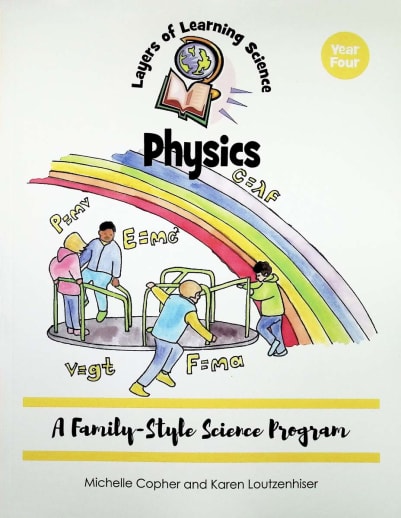

Layers of Learning Physics is a one-year family-style science curriculum. This unique approach to science is a great option for families who want to study science together. Offering nine units that cover the basic topics in a high school course, each unit contains a variety of activities that are divided into 3 age groups: ages 6-9 years, 10-13 years, and 14-18 years. Parents are encouraged to select topical library books that are readily available, as well as the experiments that are best for their family from the abundance of options listed. There are also free resources and You-Tube videos on the publisher’s website that can be used to supplement the topics. Parents will appreciate that the authors have done a lot of research compiling some of the best books and resources for the Physics topics. Included with your purchase are free printable activity sheets for each unit. The activity sheets include experiment recording sheets for younger students, experiment report templates for older children, coloring pages, narration pages, fill-in-the-blank and labeling activities, momentum practice math problems, wave velocity calculations, and more. Answers are included as necessary. What I love about this program is that parents are in control of choosing the books, activities, and experiments that are best for their family from the abundance of options provided! The Usborne Science Encyclopedia, Kingfisher Science Encyclopedia, and DK Encyclopedia of Science (out of print) are recommended and scheduled in the course. Used throughout Layers of Learning’s four cycles, the optional Writer’s Workshop is also periodically scheduled in the course. If you are homeschooling a high school student who needs science with lab credit, additional lab equipment will be required. Otherwise, the activities will require various household items. A pdf list of supplies is available on our website for your convenience; please note that you will not need all of these items, only the ones required for the activities you choose to complete! Also available, the optional Layers of Learning Science Notebook is a spiral-bound, blank notebook with gridded pages for documenting scientific discoveries and more. This Notebook is used in all four years of the Layers of Learning curriculum cycles.
Physics for Layers of Learning (Year Four)
Product Overview
- Pick and Choose curriculum that offers lessons and activities for ages 6 through high school
- Purchase includes printable activity sheets for each unit
- Free resources and You-Tube® Play on Publisher’s Website
- High school lectures and labs meet high school Physics requirements
Description
Physics is a science course about the most fundamental rules of the universe and the way it works. Physics includes the study of things like motion, machines, magnetism, heat, energy, sound, and light. All other branches of science rely on the understanding of the physical laws of the universe that physicists have discovered.
This course covers all the basics that would be found in a high school physics course including things like force diagrams, Newton’s Laws of Motion, Einstein’s ideas about gravity, work and energy in the scientific sense, simple machines, fluids and Bernoulli’s principle, wave interference, the relationship between temperature and pressure, electricity and circuits, magnetic fields, and the nature of light including quantum physics. In this course we focus on classical mechanics but touch briefly on special relativity and quantum mechanics.
Most of the concepts in physics can be taught to any age student and Layers of Learning specializes in family-style learning where the whole family learns together.
Physics includes nine individual units, one for each month of your school year.
- Forces – Things move, stop, or change directions because of a push or a pull from contact, electromagnetic, gravity, or the strong and weak nuclear forces.
- Motion – Motion can be described through simple mathematical equations including Newton’s three laws of motion.
- Gravity – Bodies with mass are attracted one another and bog bodies like stars and planets pull on each other and on smaller bodies.
- Work & Energy – Calculate joules and potential and kinetic energy. Experiment with pendulums and simple machines. Learn how complex machines like gas engines are made of simple machines.
- Fluids – Properties of water including density, buoyancy, specific gravity, surface tension, and hydraulics. Properties of air including pressure and Bernoulli’s Principle. Waves motion and energy including water, and sound waves.
- Thermodynamics – The study of heat and temperature and their effect on volume, pressure, and work.
- Electricity – Static and current electricity, circuits, and electric fields plus batteries.
- Magnetism – Magnets are charged particles all lined up in one direction creating a field of energy that is capable of doing work. Learn about magnets, electromagnets, and motors.
- Light – Learn about the electromagnetic spectrum, the double slit wave experiment, the speed of light, optics and lenses, color, and quantum mechanics and the standard model.
YouTube playlists and links to helpful websites are all assembled and ready for you to access on the Physics Resources page.
Physics also includes printables for every unit. These are worksheets or paper crafts for the students. The Printable Packs are available as a digital PDF download and come with your purchase on your receipt.Layers of Learning Science is a flexible, multi-age science curriculum designed for families learning together across grades 1–12. Each one-year course is organized into 9 units and provides shared teaching with age-appropriate activities for elementary, middle, and high school students.
The program emphasizes hands-on exploration, discussion, and
independent record-keeping while meeting traditional high school lab
requirements.
Key Curriculum Features:
- Multi-age design that allows families to learn together with differentiated activities
- 9 units per year covering core science topics with shared teaching and grade-level adaptations
- Suggested pacing of one unit per month
- Age-appropriate activities for grades 1–4, 5–8, and 9–12
- High school lab instructions that fulfill traditional high school science requirements
- Vocabulary lists, conversation starters, library/supply lists, and enrichment suggestions
- Evolutionary timeline is utilized throughout the program
Program Components:
- Core Unit Guides: Teaching notes, overviews, activity suggestions, and guidance for each unit
- Digital Printable Activity Sheets: Coloring pages, labeling exercises, journal/log pages, experiment templates, and more
- Science Notebook (optional): Student-created record of learning with space for sketches, tables, graphs, and calculations
Important Notes:
- Lab supply lists and recommended resources vary by unit—see individual product pages for details.
- The program is designed for flexible family use; much of the teaching can be done together while activities are differentiated by age.
Layers of Learning Science stands out for its organized yet adaptable approach that keeps the whole family learning science side by side. It is an excellent choice for multi-age homeschool families seeking a structured, hands-on science program that grows with students from elementary through high school.
Find all Layers of Learning Science units and sets below!
| Product Format: | Paperback Book |
|---|---|
| Grades: | 1-AD |
| Brand: | Layers of Learning |
| ISBN: | 9798993601311 |
| Length in Inches: | 11 |
| Width in Inches: | 8.625 |
| Height in Inches: | 0.6875 |
| Weight in Pounds: | 1.75 |