
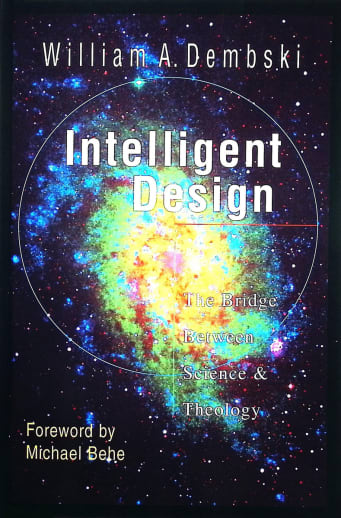
What is the link between the intricate design we see in nature and the truth we know about God? Dembski explains the fast-growing Intelligent Design movement with rigor and thoughtfulness. Synthesizing science and theology, this book addresses the drawbacks of naturalism and argues for divine intervention. Great read for anyone interested in the creation and evolution discussion. ~Tara
Intelligent Design
SKU
020680
ISBN
9780830823147
Grade AD
These icons are designed to help you quickly understand and learn important information about our products.
Teaching Method
Traditional
Teacher-centered curriculum commonly used in classrooms that may include a text, teacher manual, tests, etc.
Charlotte Mason
A methodology based on the work of a 19th century educator who maintained that children learn best from literature (Living Books), not textbooks.
Classical
A methodology based on the Latin Trivium (three stages of learning), including the grammar stage (memorization and facts), logic stage (critical thinking), and rhetoric stage (developing/defending ideas).
Unit Study
A thematic or topical approach centered around one topic that integrates multiple subject areas.
Montessori (Discovery)
A methodology based on the work of a 20th century educator that emphasizes student and sensory-driven discovery learning and real-life applications.
Other
Other methodologies
Religious Content
Secular
Contains content contrary to common Christian beliefs (i.e. evolution).
Neutral
Avoids religious or theoretical topics or presents multiple viewpoints without preference.
Christian/Religious
Faith-based or including instructional religious content.
Learning Modality
Auditory
Learns through listening, talking out loud or reading out loud.
Visual
Learns through seeing, prefers written instructions and visual materials.
Kinesthetic/Tactile (Hands-On)
Learns through moving, doing and touching.
Multi-Sensory
Curriculum that employ a variety of activities/components.
Presentation
Sequential
Curriculum progresses through well-defined learning objectives. Emphasizes mastery before moving to the next topic.
Spiral
Topics and concepts are repeated from level to level, adding more depth at each pass and connecting with review.
Conceptual/Topical
Focus is on the “why,” often with a unifying concept as well as specific skills; coverage may be broader.
Teacher Involvement
Low Teacher Involvement
Student-led materials; parent acts as a facilitator.
Medium Teacher Involvement
A mix of teacher-led time and independent student work.
High Teacher Involvement
Teacher-led lessons; may utilize discussions, hands-on activities and working together.
Additional Materials Required
No other materials needed
Everything you need is included.
Other Materials Required
There are additional required resources that are a separate purchase.
Other Materials Optional
There are additional resources mentioned or recommended but are not absolutely necessary.
Consumable
Consumable
Designed to be written in; not reusable.
Non-Consumable
Not designed to be written in; reusable.
Our Price
$35.99 $35.99 $27.95
Rainbow Savings: $8.04
Product Overview
- Explains the merits of the Intelligent Design movement
- Challenges naturalistic theories
- Synthesis of science and theology
Description
Publisher's Description of Intelligent Design
The Intelligent Design movement is three things:
Although the fast-growing movement has gained considerable grassroots support, many scientists and theologians remain skeptical about its merits. Scientists worry that it's bad science (merely creationism in disguise) and theologians worry that it's bad theology (misunderstanding divine action). In this book William Dembski addresses these concerns and brilliantly argues that intelligent design provides a crucial link between science and theology.
Various chapters creatively and powerfully address intelligent discernment of divine action in nature, why the significance of miracles should be reconsidered, and the demise and unanswered questions of British natural theology. Effectively challenging the hegemony of naturalism and reinstating design within science, Dembski shows how intelligent design can be unpacked as a theory of information.
Intelligent Design is a pivotal, synthesizing work from a thinker whom Phillip Johnson calls "one of the most important of the design theorists who are sparking a scientific revolution by legitimating the concept of intelligent design in science."
- a scientific research program for investigating intelligent causes
- an intellectual movement that challenges naturalistic evolutionary theories
- a way of understanding divine action
Although the fast-growing movement has gained considerable grassroots support, many scientists and theologians remain skeptical about its merits. Scientists worry that it's bad science (merely creationism in disguise) and theologians worry that it's bad theology (misunderstanding divine action). In this book William Dembski addresses these concerns and brilliantly argues that intelligent design provides a crucial link between science and theology.
Various chapters creatively and powerfully address intelligent discernment of divine action in nature, why the significance of miracles should be reconsidered, and the demise and unanswered questions of British natural theology. Effectively challenging the hegemony of naturalism and reinstating design within science, Dembski shows how intelligent design can be unpacked as a theory of information.
Intelligent Design is a pivotal, synthesizing work from a thinker whom Phillip Johnson calls "one of the most important of the design theorists who are sparking a scientific revolution by legitimating the concept of intelligent design in science."
Details
| Product Format: | Paperback Book |
|---|---|
| Grade: | AD |
| Brand: | IVP Academic |
| Author: | William A Dembski |
| ISBN: | 9780830823147 |
| Length in Inches: | 9.125 |
| Width in Inches: | 6 |
| Height in Inches: | 0.875 |
| Weight in Pounds: | 1 |
Videos
Reviews