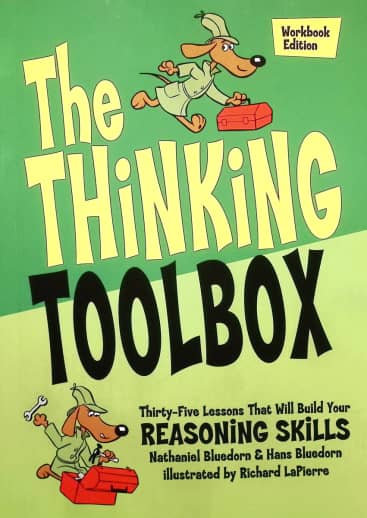
Recently expanded into a Workbook Edition, this sequel to The Fallacy Detective offers thirty-five lessons for strengthening your reasoning skills. The chapters retain their easy-to-understand explanations that provide students with the tools necessary for thinking, opposing viewpoints, and for science study. Within these chapters, you'll find lessons on when not to argue, finding the premises and conclusion, determining primary or secondary sources, circumstantial evidence, keen observation, brainstorming, analyzing data, and much more. Added content includes “How to Take A STOP Moment”, “How to Make SMART Goals”, and “How to Mind Map.” A few of the examples and exercises have been updated to include more current applications. Scripture references and the occasional biblically focused question from the previous edition have been removed. Answers are in the back of the book. 292 pages. ~ Melissa/Deanne
Thinking Toolbox, Version 2
SKU
019773
ISBN
9780974531588
Grade 7-AD
Neutral
Consumable
These icons are designed to help you quickly understand and learn important information about our products.
Teaching Method
Traditional
Teacher-centered curriculum commonly used in classrooms that may include a text, teacher manual, tests, etc.
Charlotte Mason
A methodology based on the work of a 19th century educator who maintained that children learn best from literature (Living Books), not textbooks.
Classical
A methodology based on the Latin Trivium (three stages of learning), including the grammar stage (memorization and facts), logic stage (critical thinking), and rhetoric stage (developing/defending ideas).
Unit Study
A thematic or topical approach centered around one topic that integrates multiple subject areas.
Montessori (Discovery)
A methodology based on the work of a 20th century educator that emphasizes student and sensory-driven discovery learning and real-life applications.
Other
Other methodologies
Religious Content
Secular
Contains content contrary to common Christian beliefs (i.e. evolution).
Neutral
Avoids religious or theoretical topics or presents multiple viewpoints without preference.
Christian/Religious
Faith-based or including instructional religious content.
Learning Modality
Auditory
Learns through listening, talking out loud or reading out loud.
Visual
Learns through seeing, prefers written instructions and visual materials.
Kinesthetic/Tactile (Hands-On)
Learns through moving, doing and touching.
Multi-Sensory
Curriculum that employ a variety of activities/components.
Presentation
Sequential
Curriculum progresses through well-defined learning objectives. Emphasizes mastery before moving to the next topic.
Spiral
Topics and concepts are repeated from level to level, adding more depth at each pass and connecting with review.
Conceptual/Topical
Focus is on the “why,” often with a unifying concept as well as specific skills; coverage may be broader.
Teacher Involvement
Low Teacher Involvement
Student-led materials; parent acts as a facilitator.
Medium Teacher Involvement
A mix of teacher-led time and independent student work.
High Teacher Involvement
Teacher-led lessons; may utilize discussions, hands-on activities and working together.
Additional Materials Required
No other materials needed
Everything you need is included.
Other Materials Required
There are additional required resources that are a separate purchase.
Other Materials Optional
There are additional resources mentioned or recommended but are not absolutely necessary.
Consumable
Consumable
Designed to be written in; not reusable.
Non-Consumable
Not designed to be written in; reusable.
Our Price
$32.00 $32.00 $24.65
Rainbow Savings: $7.35
Description
Publisher's Description of Thinking Toolbox, Version 2
This book is like a toolbox, full of different kinds of tools you can use for different thinking tasks. Just as you use the wrench in a regular tool box to fix the sink, so you can use the tools we give you in this book to solve thinking problems.
- When it is dumb to argue
- Using the scientific method
- Five rules of brainstorming
- Who has a reason to lie?
- How to analyze opposing viewpoints
- How to analyze evidence and sources
- How to list reasons why you believe something
- And much more
We wrote this book for children and adults who want to learn logic and critical thinking skills. The Thinking Toolbox follows the same style as The Fallacy Detective with lessons and exercises and an answer key in the back. Parents and teachers, as well as anybody who wants to learn logic, will find The Thinking Toolbox easy to use and practical.
Features:
- Fun to use – not dry like a math textbook
- Can be used after The Fallacy Detective
- Introductory – teaches skills you can use right away
- Self-teaching format
- For ages thirteen and older
- Over 60 cartoon illustrations by Richard LaPierre
Details
| Product Format: | Softcover Book |
|---|---|
| Grades: | 7-AD |
| Brand: | Christian Logic |
| Author: | Nathaniel & Hans Bluedorn |
| ISBN: | 9780974531588 |
| Length in Inches: | 9 |
| Width in Inches: | 6.5 |
| Height in Inches: | 0.625 |
| Weight in Pounds: | 1 |
Videos
Reviews