
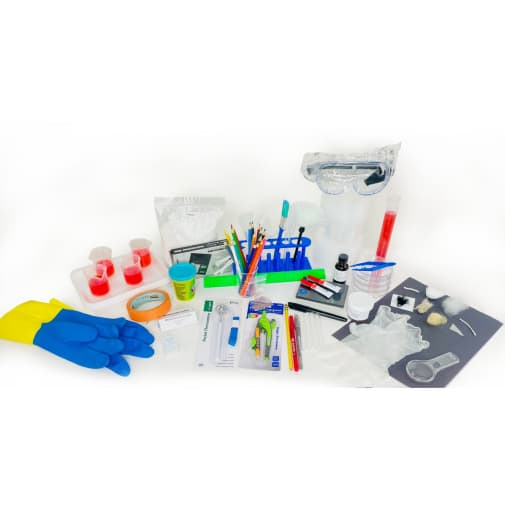
The Master’s Forensics Lab Kit offers a convenient package of general supplies, labware, fabric and simulated blood samples, and the chemicals used in the Intro to Forensics course from Master Books. This is a great way for students to really get “hands-on” as they cast tire tracks, analyze fingerprints, fibers, blood, and so much more! While the kit is designed for one student, it is possible for students to work together and share the supplies. You would want to add protective eyewear and safety gloves/nitrile gloves for each additional student. Additional household supplies are required. A 40-400x microscope is required. Affordable microscope options are available, for example, the Advanced Student Microscope, the Home LED Microscope, or the Walter Microscope Model 3000F.
Master's Forensics Lab Kit
Product Overview
- Convenient kit helps students develop their crime solving skills
- Kit includes general supplies, labware, samples, and chemicals required for the labs and activities
- Microscope required; sold separately
Description
Grab your gear and get ready to crack the case! With this supply kit you'll be outfitted to get out to the crime scene and learn how to collect and analyze the data following the instructions from Intro to Forensic Science. This lab kit contains general supplies, labware, samples, and chemicals required to perform the curriculum's many experiments and activities. (NOTE: The curriculum requires some household items not included in this kit).
Some activities include the use of a microscope, such as our Advanced Student Microscope (sold separately).
General Supplies and Quanties
- Pencil 1
- Red pen 1
- Black pen 1
- Black permanent marker
- Cloth tape measure (metric) 1
- Ruler (metric) 1
- Masking tape 1
- Small paintbrush 1
- Can of modeling dough 1
- Foam trays 2
- Pipe cleaners (blue, white, yellow, pink, and brown) 5
- Cooking Thermometer 1
- Ink pad 1
- Super glue 1
- Drawing compass 1
- Colored pencils 1
- Transparency plates (4" x 6") 4
Labware
- Safety goggles 1 pair
- Safety gloves 1
- Nitrile gloves 1 pair
- Electronic balance 1
- 50ml graduated cylinder 4
- Pipette / water dropper 3
- Test tubes 4
- Test tube rack 1
- 100-ml beaker (borosilicate glass) 1
- 50-mL beaker (plastic) 4
- Microscope slides (pack of 12) 2
- Cover slips (pack of 100) 1
- Funnel 1
- Magnifying glass (3X / 6X acrylic) 1
- Lidded plastic containers 10
- Forceps 1
- 4 small petri (glass/plastic) dishes 4
- Fingerprint black powder or magnetic powder (or ground pencil lead or eyeshadow) 1
- Fingerprint dusting brush or magnetic wand (or makeup or soft artist brush) 1
Samples and Chemicals
- Three animal fur samples 1
- Three natural fiber samples (wool, cotton, flax) 1
- Three synthetic fiber samples (nylon, polyester, acrylic) 1
- simulated human blood 1
- Iodine 1
- 2 lbs Plaster of Paris 1
Laying a foundational understanding of forensics and the criminal justice system through a biblical worldview, this upper-level science course provides an engaging real-life elective for science minded students. Beginning with an introduction to forensic science and the two types of science (historical and observational), the course covers evaluating the crime science, evidence collection and documentation, types of evidence (physical, biological, and transitory), forensic tools and specialties, and the judicial system. Throughout the course, students examine forensic science through a biblical worldview and learn how DNA compliments Biblical truth, what the Bible says about alcohol and drug use, weapons and murder, and much more. Through their study of forensics, students are introduced to case studies that outline a related crime or event. Parents are encouraged to preview the case study prior to students as the cases may be disturbing to young minds. A sampling of case studies includes Jon Benet Ramsey, Ted Bundy, the death of Michael Jackson, Rev. Jim Jones and Jonestown, and the OK City Bombing.
The Student Text is engagingly written, with age-appropriate explanations, and colorful photographs, illustrations, and diagrams. While the topics are challenging or difficult, discretion is used to present the information to students. Student Text does not contain any student worksheets or activities. The Teacher Guide includes a 36-week daily schedule, reproducible student pages, tests, labs activities, and answer keys. Please note, families with additional students taking the course will need to copy the student pages, which is a few hundred pages. You may wish to purchase a second Teacher Guide if you prefer not to make copious copies. The course contains 34 lessons, divided into 8 units. Each lesson covers a specific forensic topic or discipline. Each unit concludes with a test. There are also two cumulative tests– one for each semester. A hands-on activity or lab experiment accompanies most lessons. These vary from building DNA from marshmallows and licorice, to fingerprinting and fiber examinations using a microscope. Numerous household items are required. You will also need a high school level microscope (400x), safety googles, blank microscope slides and cover slips, iodine, ink pad, fingerprint powder and brush, petri dishes, stirring rods, pH strips, test tubes (up to 4), test tube racks, exam gloves (Nitrile), safety gloves, water dropper, acetone, and an electronic balance. A full list is available in the Teacher Guide and in a PDF on our website. Both books are required for the course and available individually or in a convenient package.
This is a well-done course that introduces teens to the fascinating world of forensics, which may prepare them for a future career or provide knowledge to better understand the world. As a homeschool mom who created my own forensics course for my curious teens, I found this course to be well-organized and comprehensive. Highly recommended for science-minded teens and parents!
| Product Format: | Other |
|---|---|
| Grades: | 11-12 |
| Brand: | Cornerstone Educational Supply |
| Length in Inches: | 18.125 |
| Width in Inches: | 12.375 |
| Height in Inches: | 6.625 |
| Weight in Pounds: | 7.05 |