
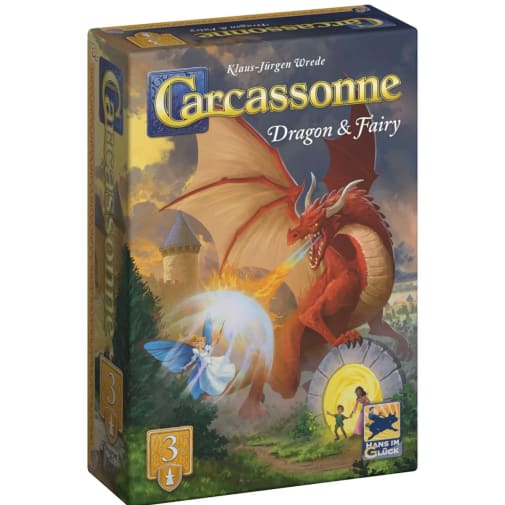

A dragon has invaded the peaceful land of Carcassonne, sending followers fleeing in its wake! This expansion adds a dragon who roams the map and removes followers from the board. Additional features include a Fairy (who scores points and protects followers from the dragon), Magic Gates (place a follower on an unclaimed feature), and a Princess (remove followers from features).
Carcassonne: Dragon & Fairy Expansion #3
SKU
017323
Grade 2-AD
These icons are designed to help you quickly understand and learn important information about our products.
Teaching Method
Traditional
Teacher-centered curriculum commonly used in classrooms that may include a text, teacher manual, tests, etc.
Charlotte Mason
A methodology based on the work of a 19th century educator who maintained that children learn best from literature (Living Books), not textbooks.
Classical
A methodology based on the Latin Trivium (three stages of learning), including the grammar stage (memorization and facts), logic stage (critical thinking), and rhetoric stage (developing/defending ideas).
Unit Study
A thematic or topical approach centered around one topic that integrates multiple subject areas.
Montessori (Discovery)
A methodology based on the work of a 20th century educator that emphasizes student and sensory-driven discovery learning and real-life applications.
Other
Other methodologies
Religious Content
Secular
Contains content contrary to common Christian beliefs (i.e. evolution).
Neutral
Avoids religious or theoretical topics or presents multiple viewpoints without preference.
Christian/Religious
Faith-based or including instructional religious content.
Learning Modality
Auditory
Learns through listening, talking out loud or reading out loud.
Visual
Learns through seeing, prefers written instructions and visual materials.
Kinesthetic/Tactile (Hands-On)
Learns through moving, doing and touching.
Multi-Sensory
Curriculum that employ a variety of activities/components.
Presentation
Sequential
Curriculum progresses through well-defined learning objectives. Emphasizes mastery before moving to the next topic.
Spiral
Topics and concepts are repeated from level to level, adding more depth at each pass and connecting with review.
Conceptual/Topical
Focus is on the “why,” often with a unifying concept as well as specific skills; coverage may be broader.
Teacher Involvement
Low Teacher Involvement
Student-led materials; parent acts as a facilitator.
Medium Teacher Involvement
A mix of teacher-led time and independent student work.
High Teacher Involvement
Teacher-led lessons; may utilize discussions, hands-on activities and working together.
Additional Materials Required
No other materials needed
Everything you need is included.
Other Materials Required
There are additional required resources that are a separate purchase.
Other Materials Optional
There are additional resources mentioned or recommended but are not absolutely necessary.
Consumable
Consumable
Designed to be written in; not reusable.
Non-Consumable
Not designed to be written in; reusable.
Our Price
$18.99 $18.99 $16.95
Rainbow Savings: $2.04
Warning
Choking Hazard
- Small parts. Not for children under 3 years.
Description
Publisher's Description of Carcassonne: Dragon & Fairy Expansion #3
In this expansion for Carcassonne, a hungry dragon roams the countryside. Plan ahead to stay clear of the dragon’s path, summon the fairy for protection or use magic portals to regain lost features.
- BRING MAGIC TO CARCASSONNE: Introduces a hungry dragon, magical fairy, and mystical portals for new challenges and strategies.
- FACE THE DRAGON’S WRATH: The dragon roams the land, devouring followers in its path—forcing players to adapt their plans carefully.
- GAIN PROTECTION WITH THE FAIRY: Summon the fairy to shield your meeples or earn bonus points, adding tactical depth to every turn.
- NEW LAND & SPECIAL TILES: Includes 26 land tiles plus unique Source and Lake tiles, expanding the board and gameplay possibilities.
- EXPANSION FOR THE BASE GAME: Carcassonne base game required to play. Perfect for fans who want to add magical creatures and unpredictable twists.
Contains:
- 26 Land Tiles
- 1 Source and 1 Lake tile
- 1 Dragon and 1 Fairy Meeple
Category Description for Carcassonne
Revisit the medieval city of Carcassonne, France in this strategic tile-laying land development game. In the base Carcassonne game, players attempt to strategically place a randomly drawn land tiles to build cities, roads, cloisters, or fields. Each player has 7 followers that can act as knight, thief, monk, or farmer, depending on their placement. Larger roads and cities score more points when completed, and multiple players can share in the scoring of a multi-tile completed project. Many expansions are available to supplement the base game. Games take about 45 minutes. For 2-5 players.
Details
| Product Format: | Other |
|---|---|
| Grades: | 2-AD |
| Brand: | Hans im Gluck |
| EAN/UPC: | 3558380131694 |
| Length in Inches: | 6.875 |
| Width in Inches: | 4.875 |
| Height in Inches: | 1.875 |
| Weight in Pounds: | 0.5 |
Videos
Reviews