
The Art of Problem Solving: Intermediate Counting & Probability Set

SKU
016729
Grade 9-12
Neutral
Low Teacher Involvement
Multi-Sensory
No other materials needed
Sequential
Teaching Method
Traditional
Teacher-centered curriculum commonly used in classrooms that may include a text, teacher manual, tests, etc.
Charlotte Mason
A methodology based on the work of a 19th century educator who maintained that children learn best from literature (Living Books), not textbooks.
Classical
A methodology based on the Latin Trivium (three stages of learning), including the grammar stage (memorization and facts), logic stage (critical thinking), and rhetoric stage (developing/defending ideas).
Unit Study
A thematic or topical approach centered around one topic that integrates multiple subject areas.
Montessori (Discovery)
A methodology based on the work of a 20th century educator that emphasizes student and sensory-driven discovery learning and real-life applications.
Other
Other methodologies
Religious Content
Secular
Contains content contrary to common Christian beliefs (i.e. evolution).
Neutral
Avoids religious or theoretical topics or presents multiple viewpoints without preference.
Christian/Religious
Faith-based or including instructional religious content.
Learning Modality
Auditory
Learns through listening, talking out loud or reading out loud.
Visual
Learns through seeing, prefers written instructions and visual materials.
Kinesthetic/Tactile (Hands-On)
Learns through moving, doing and touching.
Multi-Sensory
Curriculum that employ a variety of activities/components.
Presentation
Sequential
Curriculum progresses through well-defined learning objectives. Emphasizes mastery before moving to the next topic.
Spiral
Topics and concepts are repeated from level to level, adding more depth at each pass and connecting with review.
Conceptual/Topical
Focus is on the “why,” often with a unifying concept as well as specific skills; coverage may be broader.
Teacher Involvement
Low Teacher Involvement
Student-led materials; parent acts as a facilitator.
Medium Teacher Involvement
A mix of teacher-led time and independent student work.
High Teacher Involvement
Teacher-led lessons; may utilize discussions, hands-on activities and working together.
Additional Materials Required
No other materials needed
Everything you need is included.
Other Materials Required
There are additional required resources that are a separate purchase.
Other Materials Optional
There are additional resources mentioned or recommended but are not absolutely necessary.
Consumable
Consumable
Designed to be written in; not reusable.
Non-Consumable
Not designed to be written in; reusable.
Our Price
$56.00

Description

Includes the Student Text and Solutions Manual for the Intermediate Counting & Probability Level.
Publisher's Description of The Art of Problem Solving: Intermediate Counting & Probability Set
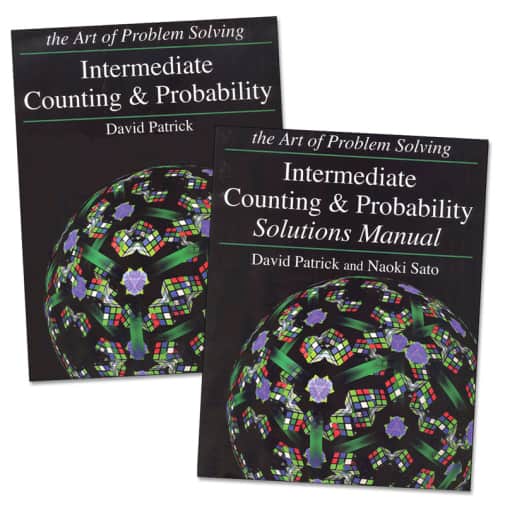
An intermediate textbook in counting and probability for students in grades 9-12, containing topics such as inclusion-exclusion, recursion, conditional probability, generating functions, graph theory, and more.

Continue your exploration of more advanced counting and probability topics from former USA Mathematical Olympiad winner David Patrick. This book is the follow-up to the acclaimed Introduction to Counting & Probability textbook.

Topics covered in this book include inclusion-exclusion, 1-1 correspondences, the Pigeonhole Principle, constructive expectation, Fibonacci and Catalan numbers, recursion, conditional probability, generating functions, graph theory, and much more.

As with all of the books in Art of Problem Solving's Introduction and Intermediate series, the text is structured to inspire the reader to explore and develop new ideas. Each section starts with problems, so the student has a chance to solve them without help before proceeding. The text then includes solutions to these problems, through which counting and probability techniques are taught. Important facts and powerful problem solving approaches are highlighted throughout the text. In addition to the instructional material, the book contains over 650 problems. The solutions manual contains full solutions to all of the problems, not just answers.

Paperback. Text: 400 pages. Solutions: 208 pages.

Continues discrete math topics begun in Introductory Counting & Probability including topics of interest to future computer scientists.

Details
More Information
Product Format:Other
Grades:9-12
Brand:Art of Problem Solving
Videos
This product doesn't have a video
Reviews
Product Q&A