Discover! 7th Grade Medieval Culture & History Kit

SKU
015572
Grade 7
Teaching Method
Traditional
Teacher-centered curriculum commonly used in classrooms that may include a text, teacher manual, tests, etc.
Charlotte Mason
A methodology based on the work of a 19th century educator who maintained that children learn best from literature (Living Books), not textbooks.
Classical
A methodology based on the Latin Trivium (three stages of learning), including the grammar stage (memorization and facts), logic stage (critical thinking), and rhetoric stage (developing/defending ideas).
Unit Study
A thematic or topical approach centered around one topic that integrates multiple subject areas.
Montessori (Discovery)
A methodology based on the work of a 20th century educator that emphasizes student and sensory-driven discovery learning and real-life applications.
Other
Other methodologies
Religious Content
Secular
Contains content contrary to common Christian beliefs (i.e. evolution).
Neutral
Avoids religious or theoretical topics or presents multiple viewpoints without preference.
Christian/Religious
Faith-based or including instructional religious content.
Learning Modality
Auditory
Learns through listening, talking out loud or reading out loud.
Visual
Learns through seeing, prefers written instructions and visual materials.
Kinesthetic/Tactile (Hands-On)
Learns through moving, doing and touching.
Multi-Sensory
Curriculum that employ a variety of activities/components.
Presentation
Sequential
Curriculum progresses through well-defined learning objectives. Emphasizes mastery before moving to the next topic.
Spiral
Topics and concepts are repeated from level to level, adding more depth at each pass and connecting with review.
Conceptual/Topical
Focus is on the “why,” often with a unifying concept as well as specific skills; coverage may be broader.
Teacher Involvement
Low Teacher Involvement
Student-led materials; parent acts as a facilitator.
Medium Teacher Involvement
A mix of teacher-led time and independent student work.
High Teacher Involvement
Teacher-led lessons; may utilize discussions, hands-on activities and working together.
Additional Materials Required
No other materials needed
Everything you need is included.
Other Materials Required
There are additional required resources that are a separate purchase.
Other Materials Optional
There are additional resources mentioned or recommended but are not absolutely necessary.
Consumable
Consumable
Designed to be written in; not reusable.
Non-Consumable
Not designed to be written in; reusable.
Our Price
$159.50

Product Overview

  • Flexible curriculum to meet the needs of different learning styles and abilities
  • Meets the National Council of Social Studies C3 framework that focuses on critical thinking and the development of active, informed citizens
  • Topically, the course covers why medieval studies are important, Medieval Europe, the Medieval Middle East, Medieval Asia, Medieval India, Medieval Africa, Medieval Life in the Americas, and concludes with a look at the Renaissance. Religion is covered for its historical and cultural significance
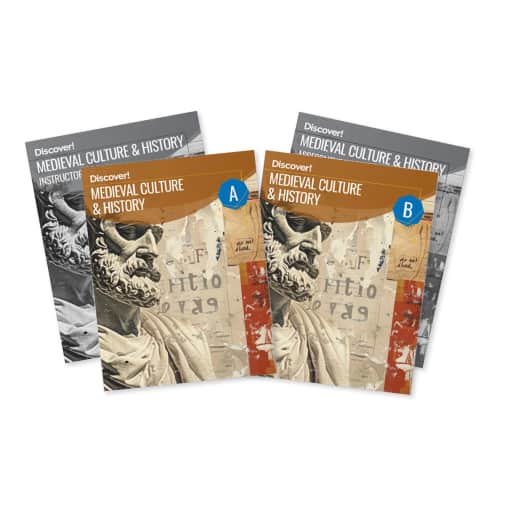
  • Kit includes the Instructor Guide, Student Worktext A, Student Worktext B, and the Test Book.

Description

Discover! Medieval Culture and History is a self-directed curriculum that is flexible for different learning styles and abilities. The Kit includes two Student Worktexts (Semester A and Semester B), the Instructor Guide, and the Assessments Book. Currently, these are only sold in a set–they are not available individually.

The consumable and colorfully illustrated Student Worktexts are organized into eight units with roughly 8 chapters per unit. Students are expected to complete one chapter in two days. Lessons follow a similar format. On the first day, explore through short real-life narratives and read the informational text, and the second day practice and show what you know through various types of questions and activities.  Two types of assessments are included to provide options for student success: a traditional test with short answer and multiple-choice questions, or a project-based performance assessment. Assessments are found in the Test Book and the Instructor Guide. The Instructor Guide is a parent’s dream! Beginning with an easy-to-follow overview, the Instructor Guide provides parents with helpful ways to support your student through the lessons, ideas to meet (and challenge) the different learning styles, optional co-op activities, suggested extension or enrichment activities, and answers to all the student activities. It also includes the student assessments and answers. There are two types of assessments: a traditional test with short answer and multiple-choice questions, or a project-based performance assessment. The consumable Test Book includes all the unit tests/assessments as well as the performance assessment projects and grading rubric.  Not reproducible.

Publisher's Description of Discover! 7th Grade Medieval Culture & History Kit
Worktext

  • Scope and sequence integrates an engaging storyline with direct instruction, practice, application, and extension activities
  • Curriculum provides direct instruction and assessment opportunities that allow the student to gain knowledge, reflect on it, and apply it
  • Curriculum is guided by the College, Career, and Civic Life (C3) framework that integrates arts and humanities to build deep and enduring understandings essential for informed and active participation in civic life.
  • Curriculum meets a variety of learning preferences (styles) to meet the unique needs of the student

Instructor Guide
  • Specifically structured to complement the worktext and lab book
  • Provides suggestions for the instructor to facilitate, support, and extend their student's learning
  • Instruction and curriculum are differentiated with remediation, enrichment, assessment, and supporting activities suitable for a variety of learning styles
  • Answer keys for all activities are provided

Assessment Booklet
  • Each unit assessment has two assessment options
  • Traditional unit assessment: A multiple choice assessment with an answer key
  • Performance assessment: A performance-based option with a rubric
  • A copy of each traditional and performance assessment is also provided in the instructor guide along with the answer key and rubric
Category Description for Discover! Social Studies Grades 7-8

Written for self-directed learning, Discover! Social Studies for grades 7 and 8 is designed to promote critical thinking and integrate arts and humanities to prepare students to be informed and active citizens. Along with the focus on meeting the National Council of Social Studies C3 framework, the curriculum includes varied learning activities to meet the different learners.

The grade level kits include two Student Worktexts (Semester A and Semester B), the Instructor Guide, and the Assessments Book. Currently, these are only sold in a set–they are not available individually.

Each grade level courses include 160 days of instruction with each chapter taking about 2 days to complete the base lesson, with optional enrichment activities provided for students needing an extra layer of challenge. Chapters are organized into ten units (6-8 chapters per unit) and each unit concludes with a review and assessment. Assessments are found in the separate Assessment Book, and in the Instructor Guide. Parents have flexibility to have their student take a traditional assessment with short answer and multiple-choice questions or a performance assessment. The performance assessment is project based and includes the steps/requirements. An assessment rubric to grade the project is also included.

The daily lessons and related activities are found the Student Worktexts. Lessons follow a similar format. Day 1 complete the Explore and Read sections. Day 2 complete the Practice and Show What You Know pages. The Explore section is designed to engage the student through a short, applicable story and introduces the new concept to be learned. Day 1, the Read pages provide the informational text and concludes with a short answer, application or reflection questions, or other learning activity. These are varied and may include graphic organizers, matching exercises, drawing activities, etc. On the Day 2, the Practice and Show What You Know lessons help students prepare for the assessment through open ended questions and careful readings of documents and responsive questions. Along with these activities, students also may answer reflective questions, true and false questions, and complete graphic organizers. The Student Worktexts are designed to be written in and will become a valuable study tool for students. The Instructor Guide is a parent’s dream! Beginning with an easy-to-follow overview of the guide and suggested planning, the Instructor Guide provides parents with helpful ways to support your student through the lessons, ideas to meet (and challenge) the different learning styles, co-op activities for families using the course in a large group setting, suggested extension or enrichment activities, and answers to all the student activities. It also includes the student tests and answers. Helpful graphic organizers with examples are found in the back of the Instructor Guide. The consumable Test Book includes all ten unit’s traditional assessments as well as the performance assessment project and grading rubric.  Not reproducible.

Details
More Information
Product Format:Other
Grade:7
Brand:Discover!
Videos
This product doesn't have a video
Reviews
Product Q&A