
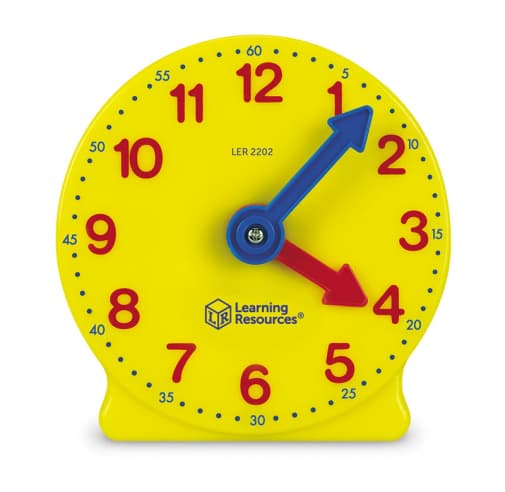
This little (4" diameter) clock is geared like the larger Judy clocks. While smaller than our 5" clock, it's still large enough for close-up demonstration and student use AND so inexpensive, we don't know why you'd even consider a non-geared substitute.
Learning Resources Student Geared Clock
SKU
015339
Grade PK-AD
Neutral
Non-Consumable
These icons are designed to help you quickly understand and learn important information about our products.
Teaching Method
Traditional
Teacher-centered curriculum commonly used in classrooms that may include a text, teacher manual, tests, etc.
Charlotte Mason
A methodology based on the work of a 19th century educator who maintained that children learn best from literature (Living Books), not textbooks.
Classical
A methodology based on the Latin Trivium (three stages of learning), including the grammar stage (memorization and facts), logic stage (critical thinking), and rhetoric stage (developing/defending ideas).
Unit Study
A thematic or topical approach centered around one topic that integrates multiple subject areas.
Montessori (Discovery)
A methodology based on the work of a 20th century educator that emphasizes student and sensory-driven discovery learning and real-life applications.
Other
Other methodologies
Religious Content
Secular
Contains content contrary to common Christian beliefs (i.e. evolution).
Neutral
Avoids religious or theoretical topics or presents multiple viewpoints without preference.
Christian/Religious
Faith-based or including instructional religious content.
Learning Modality
Auditory
Learns through listening, talking out loud or reading out loud.
Visual
Learns through seeing, prefers written instructions and visual materials.
Kinesthetic/Tactile (Hands-On)
Learns through moving, doing and touching.
Multi-Sensory
Curriculum that employ a variety of activities/components.
Presentation
Sequential
Curriculum progresses through well-defined learning objectives. Emphasizes mastery before moving to the next topic.
Spiral
Topics and concepts are repeated from level to level, adding more depth at each pass and connecting with review.
Conceptual/Topical
Focus is on the “why,” often with a unifying concept as well as specific skills; coverage may be broader.
Teacher Involvement
Low Teacher Involvement
Student-led materials; parent acts as a facilitator.
Medium Teacher Involvement
A mix of teacher-led time and independent student work.
High Teacher Involvement
Teacher-led lessons; may utilize discussions, hands-on activities and working together.
Additional Materials Required
No other materials needed
Everything you need is included.
Other Materials Required
There are additional required resources that are a separate purchase.
Other Materials Optional
There are additional resources mentioned or recommended but are not absolutely necessary.
Consumable
Consumable
Designed to be written in; not reusable.
Non-Consumable
Not designed to be written in; reusable.
Our Price
$2.95 Description
Publisher's Description of Learning Resources Student Geared Clock
Engage small groups or individual students in time-telling activities with this student clock with mechanisms. Color-coded hour and minute functions.
Category Description for RightStart Mathematics
RightStart Mathematics is a proven, hands-on homeschool math curriculum designed to help children truly understand, apply, and enjoy math. Created by Dr. Joan A. Cotter, RightStart Math replaces traditional counting with powerful visualization strategies and the innovative AL abacus, building deep number sense from the very beginning.
Unlike rote-memorization programs, RightStart emphasizes conceptual understanding through multi-sensory activities, engaging math card games, early place value work, and non-counting strategies inspired by Asian approaches. Students learn to see quantities in groups of fives and tens and use the unique “math-way” of number naming (such as “ten-one” for eleven) to develop stronger mental math and place value skills.
RightStart uses flexible lettered levels rather than strict grade levels. Use the free downloadable placement test below to find the best starting point for your child. The program is especially helpful for children who learn differently, struggle with math anxiety, or need to catch up or move ahead quickly.
Key Features of RightStart Math
- The AL abacus as the primary tool for visualizing numbers in groups of 5 and 10
- Fun math card games turn practice into an enjoyable activity
- Spiral yet mastery-oriented progression that prevents gaps
- Guided lessons with high teacher involvement and minimal busywork
- Clear two-column lesson pages: activities on the left and helpful teacher background on the right
- 30–40 minute lessons that are easy to teach
Levels A–F build core elementary skills (roughly K–5/6), while Levels G and H extend into middle school topics including pre-algebra, geometry, and some trigonometry.
Second Edition Note: The Second Edition of RightStart Math incorporates recent research and uses one comprehensive Manipulative Set that works for all levels. When starting, most families purchase the RS2 Manipulative Set along with the Book Bundle for their starting level (which includes the spiral-bound lesson book, worksheets, and appendix). Level G requires an additional Geometry Set.
Whether your child struggles with math or thrives on hands-on discovery, RightStart Mathematics fosters lasting confidence and true mathematical thinking.
Browse all RightStart Math levels, bundles, the AL abacus, and manipulatives below, or download the free placement test to find the perfect starting point for your homeschool math journey.
Details
| Product Format: | Other |
|---|---|
| Grades: | PK-AD |
Videos
Reviews