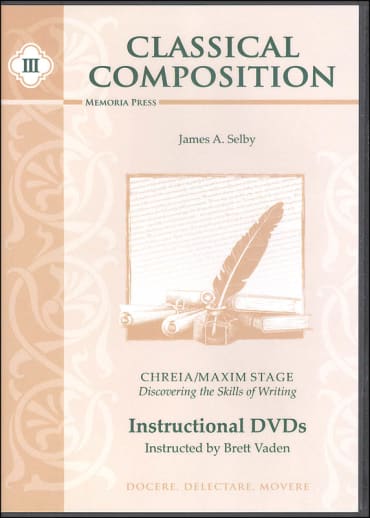
Memoria Press Classical Composition 3: Chreia/Maxim Instructional DVD
SKU
014923
ISBN
9781615384037
Grade 6-AD
These icons are designed to help you quickly understand and learn important information about our products.
Teaching Method
Traditional
Teacher-centered curriculum commonly used in classrooms that may include a text, teacher manual, tests, etc.
Charlotte Mason
A methodology based on the work of a 19th century educator who maintained that children learn best from literature (Living Books), not textbooks.
Classical
A methodology based on the Latin Trivium (three stages of learning), including the grammar stage (memorization and facts), logic stage (critical thinking), and rhetoric stage (developing/defending ideas).
Unit Study
A thematic or topical approach centered around one topic that integrates multiple subject areas.
Montessori (Discovery)
A methodology based on the work of a 20th century educator that emphasizes student and sensory-driven discovery learning and real-life applications.
Other
Other methodologies
Religious Content
Secular
Contains content contrary to common Christian beliefs (i.e. evolution).
Neutral
Avoids religious or theoretical topics or presents multiple viewpoints without preference.
Christian/Religious
Faith-based or including instructional religious content.
Learning Modality
Auditory
Learns through listening, talking out loud or reading out loud.
Visual
Learns through seeing, prefers written instructions and visual materials.
Kinesthetic/Tactile (Hands-On)
Learns through moving, doing and touching.
Multi-Sensory
Curriculum that employ a variety of activities/components.
Presentation
Sequential
Curriculum progresses through well-defined learning objectives. Emphasizes mastery before moving to the next topic.
Spiral
Topics and concepts are repeated from level to level, adding more depth at each pass and connecting with review.
Conceptual/Topical
Focus is on the “why,” often with a unifying concept as well as specific skills; coverage may be broader.
Teacher Involvement
Low Teacher Involvement
Student-led materials; parent acts as a facilitator.
Medium Teacher Involvement
A mix of teacher-led time and independent student work.
High Teacher Involvement
Teacher-led lessons; may utilize discussions, hands-on activities and working together.
Additional Materials Required
No other materials needed
Everything you need is included.
Other Materials Required
There are additional required resources that are a separate purchase.
Other Materials Optional
There are additional resources mentioned or recommended but are not absolutely necessary.
Chreia & Maxim instructional videos begin with a 29-minute course introduction. Eighteen lessons, ranging from 21 minutes to just over 1 hour, explain to the student the writing concepts for each lesson in the student book. Students will focus on story, apply paraphrase, and learn what the Greek writers called the “eight heads of development." This level takes lines of wisdom and incorporates various techniques such as analogy, paraphrase, anecdote, and restatement to explain the main thoughts. Video instructors will explain the writing model themes, draw out concepts modeled in the lessons, discuss vocabulary, ask students rhetorical questions, and more. They will also direct the students to complete tasks which might require stopping the video occasionally to write responses.
Publisher's Description of Memoria Press Classical Composition 3: Chreia/Maxim Instructional DVD
In the third stage of the Classical Composition program, Creia/Maxim students gain the ability to create a story through the use of the narrative categories and variation through paraphrase. Students learn to demonstrate the truth of the Commonplace through what the ancient Greek writer Aphthonius calls "eight heads of development, and students deal more explicitly and thoroughly with what in modern composition theory are referred to as "support points. The ability to invent four specific types of narrative through these "heads of development and to paraphrase in two specific ways are the foundational skills to be learned in this stage.
Classical Composition III: The Chreia/Maxim Stage focuses on
the crafting a story through the use of the narrative categories and variation
through paraphrase. Students learn to demonstrate the truth of the Commonplace
through what the ancient Greek writer Aphthonius calls "eight heads of
development, and students deal more explicitly and thoroughly with what in
modern composition theory are referred to as "support points.