
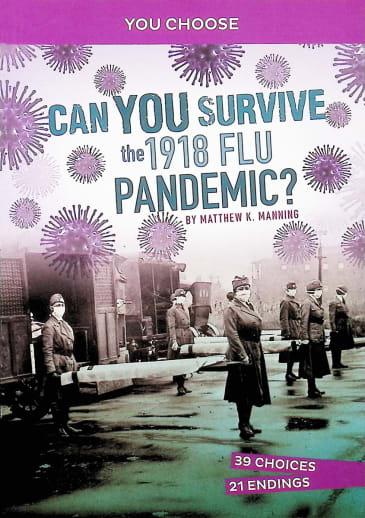
A deadly flu outbreak is spreading, and you must make day-to-day decisions, any of which will alter the course of your life. There are 39 choices and 21 possible endings to this historical adventure. 112 pgs, pb.
Can You Survive the 1918 Flu Pandemic? An Interactive History Adventure
SKU
014857
ISBN
9781666390827
Grade 3-7
These icons are designed to help you quickly understand and learn important information about our products.
Teaching Method
Traditional
Teacher-centered curriculum commonly used in classrooms that may include a text, teacher manual, tests, etc.
Charlotte Mason
A methodology based on the work of a 19th century educator who maintained that children learn best from literature (Living Books), not textbooks.
Classical
A methodology based on the Latin Trivium (three stages of learning), including the grammar stage (memorization and facts), logic stage (critical thinking), and rhetoric stage (developing/defending ideas).
Unit Study
A thematic or topical approach centered around one topic that integrates multiple subject areas.
Montessori (Discovery)
A methodology based on the work of a 20th century educator that emphasizes student and sensory-driven discovery learning and real-life applications.
Other
Other methodologies
Religious Content
Secular
Contains content contrary to common Christian beliefs (i.e. evolution).
Neutral
Avoids religious or theoretical topics or presents multiple viewpoints without preference.
Christian/Religious
Faith-based or including instructional religious content.
Learning Modality
Auditory
Learns through listening, talking out loud or reading out loud.
Visual
Learns through seeing, prefers written instructions and visual materials.
Kinesthetic/Tactile (Hands-On)
Learns through moving, doing and touching.
Multi-Sensory
Curriculum that employ a variety of activities/components.
Presentation
Sequential
Curriculum progresses through well-defined learning objectives. Emphasizes mastery before moving to the next topic.
Spiral
Topics and concepts are repeated from level to level, adding more depth at each pass and connecting with review.
Conceptual/Topical
Focus is on the “why,” often with a unifying concept as well as specific skills; coverage may be broader.
Teacher Involvement
Low Teacher Involvement
Student-led materials; parent acts as a facilitator.
Medium Teacher Involvement
A mix of teacher-led time and independent student work.
High Teacher Involvement
Teacher-led lessons; may utilize discussions, hands-on activities and working together.
Additional Materials Required
No other materials needed
Everything you need is included.
Other Materials Required
There are additional required resources that are a separate purchase.
Other Materials Optional
There are additional resources mentioned or recommended but are not absolutely necessary.
Consumable
Consumable
Designed to be written in; not reusable.
Non-Consumable
Not designed to be written in; reusable.
Our Price
$9.99 $9.99 $7.95
Rainbow Savings: $2.04
Product Overview
- Part of the You Choose: Can You Survive Disaster? Series
- Interactive History Adventure
- 39 choices with 21 possible endings
- Includes colored pictures, events timeline, book list, and suggested internet sites to explore
Description
Publisher's Description of Can You Survive the 1918 Flu Pandemic? An Interactive History Adventure
The year is 1918. World War I is nearing its end. But the world is just
beginning to suffer from a deadly pandemic. Within months, the deadly
flu virus has spread around the world, infecting and killing tens of
millions of people. As you return from the war, will you go to see your
family and friends or quarantine to keep your loved ones safe? Will you
shut down your small store to avoid spreading the virus? Will you quit
your job as a teacher in order to stay safe, or continue going to
school? With dozens of possible choices, it’s up to YOU to choose how to
survive through one of the worst pandemics in history.
Category Description for You Choose: Can You Survive Disasters?
A dramatic series in the You Choose collection where you try to survive through some of history’s worst natural disasters: the 1865 sultana disaster, the 1918 flu pandemic, the 1920 big burn, and the 1925 Tri-State tornado. The Disaster series allows readers to learn about historical situations while engaging in the story. You will have the opportunity to follow characters through real-life events and make choices that influence the story’s outcome, determining whether characters survive or not. After you finish one path, go back and read the other choices for new perspectives and more adventures. The first chapter sets the scene and then instructions for what page to go to next. The end of each book has a key events timeline, glossary, book list, and internet sites to explore.
Details
| Product Format: | Paperback |
|---|---|
| Grades: | 3-7 |
| Brand: | Capstone Press |
| ISBN: | 9781666390827 |
| Length in Inches: | 7.5 |
| Width in Inches: | 5.25 |
| Height in Inches: | 0.25 |
| Weight in Pounds: | 0.35 |
Videos
Reviews