
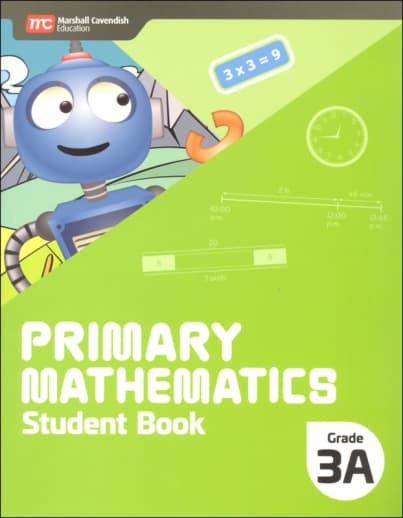
Primary Mathematics Student Book 3A (Revised edition - 2022 Edition)

SKU
014676
ISBN
9789814911405
Grade 3
Secular
Medium Teacher Involvement
Multi-Sensory
Sequential
Teaching Method
Traditional
Teacher-centered curriculum commonly used in classrooms that may include a text, teacher manual, tests, etc.
Charlotte Mason
A methodology based on the work of a 19th century educator who maintained that children learn best from literature (Living Books), not textbooks.
Classical
A methodology based on the Latin Trivium (three stages of learning), including the grammar stage (memorization and facts), logic stage (critical thinking), and rhetoric stage (developing/defending ideas).
Unit Study
A thematic or topical approach centered around one topic that integrates multiple subject areas.
Montessori (Discovery)
A methodology based on the work of a 20th century educator that emphasizes student and sensory-driven discovery learning and real-life applications.
Other
Other methodologies
Religious Content
Secular
Contains content contrary to common Christian beliefs (i.e. evolution).
Neutral
Avoids religious or theoretical topics or presents multiple viewpoints without preference.
Christian/Religious
Faith-based or including instructional religious content.
Learning Modality
Auditory
Learns through listening, talking out loud or reading out loud.
Visual
Learns through seeing, prefers written instructions and visual materials.
Kinesthetic/Tactile (Hands-On)
Learns through moving, doing and touching.
Multi-Sensory
Curriculum that employ a variety of activities/components.
Presentation
Sequential
Curriculum progresses through well-defined learning objectives. Emphasizes mastery before moving to the next topic.
Spiral
Topics and concepts are repeated from level to level, adding more depth at each pass and connecting with review.
Conceptual/Topical
Focus is on the “why,” often with a unifying concept as well as specific skills; coverage may be broader.
Teacher Involvement
Low Teacher Involvement
Student-led materials; parent acts as a facilitator.
Medium Teacher Involvement
A mix of teacher-led time and independent student work.
High Teacher Involvement
Teacher-led lessons; may utilize discussions, hands-on activities and working together.
Additional Materials Required
No other materials needed
Everything you need is included.
Other Materials Required
There are additional required resources that are a separate purchase.
Other Materials Optional
There are additional resources mentioned or recommended but are not absolutely necessary.
Consumable
Consumable
Designed to be written in; not reusable.
Non-Consumable
Not designed to be written in; reusable.
Our Price
$12.95

Description

The colorful and engaging Grade 3A Student Book is consumable. This level has a winsome robot mascot. This robot shows up on all the products for that grade level and inside pages include this critter as well as others.

Although reminiscent of the semester-based textbooks of previous Primary Math editions, these are expanded in terms of instruction as well as included practice exercises. They are not, however, designed to stand alone but to be a tool in the hand of the teacher (parent). Comprehensive instruction is the result of the instructional sequences provided by the teacher coupled with directed questions.

The general appearance of these full-size (8.5"x 11") books is uncluttered providing room for student work with just enough color and appropriate light-hearted graphics. Pages are perforated. Chapters are initiated with full-page, full-color real-world illustrated story situations. Lessons are “opened" with half-page illustrated “stories."

Instruction in the Student Book follows an Opener – Learn – Practice pattern through the daily lessons and a Recall – Instructional Sections – Performance Task – STEAM Project – Chapter Practice – Chapter Test organization through each chapter. Periodic Think! exercises focus on critical thinking skills and problem solving. The Singapore math basics are obvious throughout the course: start with the concrete, move to pictorial in the Student Book, and morph into abstract concepts.

The Practice on Your Own pages in the Student Book provide practice at the end of each lesson, but these are just the tip of the iceberg in terms of practice and homework options available. After each Section (collection of lessons) there is an exercise assignment available in the Mastery and Beyond book. These exercises are cumulative over several lessons. Differentiated instructional options for each lesson include correlated on-level practice exercises in the Additional Practice book. There is also a Reteach Book, and for those students who need additional challenge, an Extensions Book. These last two resources are only available as digital versions.

Publisher's Description of Primary Mathematics Student Book 3A (Revised edition - 2022 Edition)

The Student Book is the consumable textbook of the program.Chapters and daily lessons are based on the Readiness-Engagement-Mastery model of learning used in Singapore classrooms. In the Readiness phase, students make connections to previously learned concepts and skills to be sure they have the base knowledge to succeed with learning goals. In the Engagement phase, students learn by doing and construct new knowledge through engaging activities and guided inquiry. In the Mastery phase, students gain fluency, confidence, and deeper conceptual understanding through practice and problem solving.

Note: Two books (A and B) for each grade correspond to the two halves of the school year. Answer key in Teacher's Guide and Home Instructor's Guide.


Category Description for Primary Math - 2022 Edition Math 3

Concepts covered include: Numbers to 10,000 (create sets; group into thousands, hundreds, tens, and ones; compare and order whole numbers; write multi-digit numbers in expanded form; and use place-value models; add/subtract whole numbers). Fractions (understand concepts, compare and order; recognize equivalents; write whole numbers as fractions). Add and subtract money. Solve real-world problems involving addition and subtraction of money. Solve addition and subtraction problems with greater numbers by using a bar model. Multiply and divide up to 2-digit numbers by any number from 2 to 10. Use x, ?, and = symbols to represent multiplication and division equations. Multiply 2-digit numbers by a 1-digit number, with and without renaming. Use bar models to represent multiplication and division situations. Express a fraction as the sum of repeated unit fractions. Add and subtract money amounts. Use mental math strategies to add, subtract, multiply, and divide. Use rounding to estimate sums and differences. Understand that multiplication and division are related. Understand the relationships between the numbers in multiplication-division fact families. Use a variety of concrete, pictorial, and symbolic models for multi-digit addition, subtraction, multiplication, and division. Write addition, subtraction, multiplication, and division equations. Use and create models that demonstrate equality or inequality. Identify right angles and compare angles to right angles. Classify and sort polygons and quadrilaterals. Solve real-world problems in measurement. Solve addition, subtraction, multiplication, or division word problems involving mass in kilograms or grams and volume or capacity in liters. Tell time to the minute. Convert between hours and minutes. Add and subtract units of time. Compare angles to right angles. Measure perimeter of plane figures. Find and compare the area of plane figures in different square units. Find the area of rectangles and composite figures. Use bar graphs, picture graphs, and line plots to solve real-world problems. Build skills in addition, subtraction, multiplication, division, and measurement through problem solving. Apply the inverse relationship between multiplication and division. Solve real-world problems involving addition, subtraction, multiplication, division, measurement, and money. Consult or download the complete Scope and Sequence for a full report of covered topics and concepts.

Details
More Information
Product Format:Binder
Grade:3
Brand:Marshall Cavendish
ISBN:9789814911405
Length in Inches:10.875
Width in Inches:8.5
Height in Inches:0.6875
Weight in Pounds:1.63
Videos
This product doesn't have a video
Reviews
Product Q&A