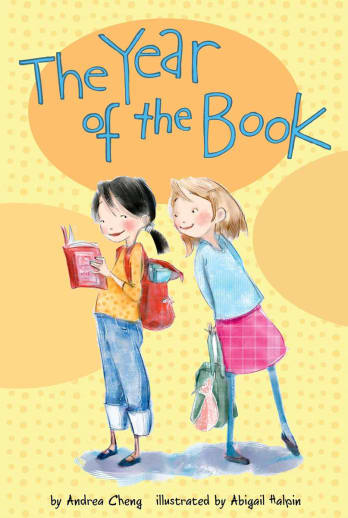
Year of the Book by Andrea Cheng introduces us to young Anna Wang, a Chinese American girl learning how to be a good friend. Anna finds solace in books, and when she feels alone, she runs to her favorite titles. But as her world begins to change, she will have to learn how to make friends and what it means to be a good friend. This sweet chapter book is written at a fourth-grade reading level and has short chapters and occasional illustrations. If you enjoy this book, don’t miss the rest of the series. Includes a pronunciation guide in the front of the book. 160 pages, softcover.
The Year of the Book by Andrea Cheng
SKU
014225
ISBN
9780544022638
Grade 3-5
These icons are designed to help you quickly understand and learn important information about our products.
Teaching Method
Traditional
Teacher-centered curriculum commonly used in classrooms that may include a text, teacher manual, tests, etc.
Charlotte Mason
A methodology based on the work of a 19th century educator who maintained that children learn best from literature (Living Books), not textbooks.
Classical
A methodology based on the Latin Trivium (three stages of learning), including the grammar stage (memorization and facts), logic stage (critical thinking), and rhetoric stage (developing/defending ideas).
Unit Study
A thematic or topical approach centered around one topic that integrates multiple subject areas.
Montessori (Discovery)
A methodology based on the work of a 20th century educator that emphasizes student and sensory-driven discovery learning and real-life applications.
Other
Other methodologies
Religious Content
Secular
Contains content contrary to common Christian beliefs (i.e. evolution).
Neutral
Avoids religious or theoretical topics or presents multiple viewpoints without preference.
Christian/Religious
Faith-based or including instructional religious content.
Learning Modality
Auditory
Learns through listening, talking out loud or reading out loud.
Visual
Learns through seeing, prefers written instructions and visual materials.
Kinesthetic/Tactile (Hands-On)
Learns through moving, doing and touching.
Multi-Sensory
Curriculum that employ a variety of activities/components.
Presentation
Sequential
Curriculum progresses through well-defined learning objectives. Emphasizes mastery before moving to the next topic.
Spiral
Topics and concepts are repeated from level to level, adding more depth at each pass and connecting with review.
Conceptual/Topical
Focus is on the “why,” often with a unifying concept as well as specific skills; coverage may be broader.
Teacher Involvement
Low Teacher Involvement
Student-led materials; parent acts as a facilitator.
Medium Teacher Involvement
A mix of teacher-led time and independent student work.
High Teacher Involvement
Teacher-led lessons; may utilize discussions, hands-on activities and working together.
Additional Materials Required
No other materials needed
Everything you need is included.
Other Materials Required
There are additional required resources that are a separate purchase.
Other Materials Optional
There are additional resources mentioned or recommended but are not absolutely necessary.
Consumable
Consumable
Designed to be written in; not reusable.
Non-Consumable
Not designed to be written in; reusable.
Our Price
$7.99 $7.99 $6.75
Rainbow Savings: $1.24
Product Overview
- Meet Anna Chang, a young Chinese American girl
- Explores themes of friendship as Anna learns to be a good friend
- Short chapters, a fourth-grade reading level, and occasional illustrations
- Book 1 in the Anna Wang series
Description
Publisher's Description of The Year of the Book by Andrea Cheng
In Chinese, peng you means friend. But in any language, all Anna knows for certain is that friendship is complicated.
When Anna needs company, she turns to her books. Whether traveling through A Wrinkle in Time, or peering over My Side of the Mountain, books provide what real life cannot—constant companionship and insight into her changing world.
Books, however, can’t tell Anna how to find a true friend. She’ll have to discover that on her own. In the tradition of classics like Maud Hart Lovelace’s Betsy-Tacy books and Eleanor Estes’ One Hundred Dresses, this novel subtly explores what it takes to make friends and what it means to be one.
Category Description for Year of the…
The Anna Wang series by Andrea Cheng is a collection of sweet coming-of-age stories following young Anna Wang, a shy Chinese American girl, as she learns important lessons in friendship, family, identity, and belonging. Each book focuses on one growing-up theme—whether learning how to make friends, how to be a good sister, or where one’s family came from. Readers will be delighted by Anna’s authentic POV! Written at a fourth-grade reading level, each book is broken into short chapters and accented with illustrations. Books include pronunciation guides for common Chinese words.
Details
| Product Format: | Paperback Book |
|---|---|
| Grades: | 3-5 |
| Brand: | Clarion |
| Author: | Andrea Cheng |
| ISBN: | 9780544022638 |
| Length in Inches: | 7.625 |
| Width in Inches: | 5.125 |
| Height in Inches: | 0.4375 |
| Weight in Pounds: | 0.3 |
Videos
Reviews