
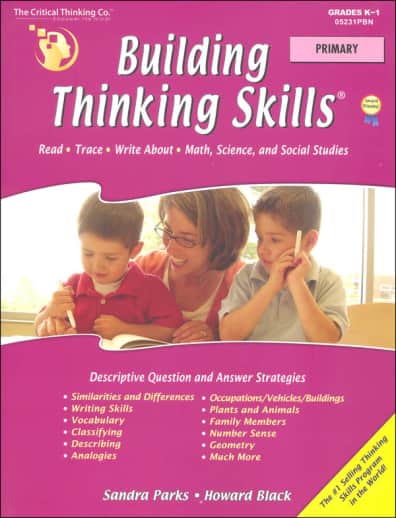

Start building critical thinking skills early with your students. These basic skills include grouping and organizing, comparing objects, identifying, sequencing, describing, analogies, and more. Photos are in full color and are used as concept illustrations (turkey is a photo of a turkey, boat is a photo of a boat, etc.) Manipulatives are required and sold separately. This book is reproducible for family and classroom use and pages are perforated for easy removal. A brief glossary and further descriptions for specific exercises are provided on the end pages. 266 pgs, pb. ~Rebecca
Building Thinking Skills Primary Grades K-1
SKU
014194
ISBN
9780894558870
Grade K-1
Neutral
Low Teacher Involvement
Multi-Sensory
Other Materials Required
Spiral
These icons are designed to help you quickly understand and learn important information about our products.
Teaching Method
Traditional
Teacher-centered curriculum commonly used in classrooms that may include a text, teacher manual, tests, etc.
Charlotte Mason
A methodology based on the work of a 19th century educator who maintained that children learn best from literature (Living Books), not textbooks.
Classical
A methodology based on the Latin Trivium (three stages of learning), including the grammar stage (memorization and facts), logic stage (critical thinking), and rhetoric stage (developing/defending ideas).
Unit Study
A thematic or topical approach centered around one topic that integrates multiple subject areas.
Montessori (Discovery)
A methodology based on the work of a 20th century educator that emphasizes student and sensory-driven discovery learning and real-life applications.
Other
Other methodologies
Religious Content
Secular
Contains content contrary to common Christian beliefs (i.e. evolution).
Neutral
Avoids religious or theoretical topics or presents multiple viewpoints without preference.
Christian/Religious
Faith-based or including instructional religious content.
Learning Modality
Auditory
Learns through listening, talking out loud or reading out loud.
Visual
Learns through seeing, prefers written instructions and visual materials.
Kinesthetic/Tactile (Hands-On)
Learns through moving, doing and touching.
Multi-Sensory
Curriculum that employ a variety of activities/components.
Presentation
Sequential
Curriculum progresses through well-defined learning objectives. Emphasizes mastery before moving to the next topic.
Spiral
Topics and concepts are repeated from level to level, adding more depth at each pass and connecting with review.
Conceptual/Topical
Focus is on the “why,” often with a unifying concept as well as specific skills; coverage may be broader.
Teacher Involvement
Low Teacher Involvement
Student-led materials; parent acts as a facilitator.
Medium Teacher Involvement
A mix of teacher-led time and independent student work.
High Teacher Involvement
Teacher-led lessons; may utilize discussions, hands-on activities and working together.
Additional Materials Required
No other materials needed
Everything you need is included.
Other Materials Required
There are additional required resources that are a separate purchase.
Other Materials Optional
There are additional resources mentioned or recommended but are not absolutely necessary.
Consumable
Consumable
Designed to be written in; not reusable.
Non-Consumable
Not designed to be written in; reusable.
Our Price
$29.99 Description
Publisher's Description of Building Thinking Skills Primary Grades K-1
This colorful, engaging 272-page book develops critical thinking skills necessary for success in reading, writing, math, science, social studies, and standardized tests in Grades K-1. It uses a series of lessons with math manipulatives and language integration techniques to teach thinking skills. This program is designed to:
- Improve young children's observation and description skills
- Stimulate vocabulary development
- Clarify thinking processes that underlie content learning (observing, describing/defining, identifying similarities and differences, sequencing, classifying, and recognizing analogy)
- Improve students' conceptualization of mathematics, social studies and science concepts taught in the primary grades
The five cognitive skills developed in this series (describing, finding similarities and differences, sequencing, classifying, and forming analogies) were selected because of their prevalence in academic disciplines and their frequency in objective tests. Since improved school performance is an important goal of thinking skills instruction, many variations of each of these thinking skills are promoted in the activities.
Thinking skills are sequenced in the order in which a child develops intellectually. A child first learns to observe and describe objects, to recognize the characteristics of an object, and then to distinguish similarities and differences between the objects. Describing, comparing, and contrasting skills are necessary to a child's ability to put things in order, to group items by class, and to think analogically.
Manipulatives - (Required, Sold Separately)
Building Thinking Skills® Primaryrequires the use of Attribute Blocks and Interlocking Cubes (required, sold separately).
Teaching Support - (Optional, Sold Separately)
Activities are modeled to reinforce reasoning skills and concepts. A Teacher's Manual eBook, optional, is sold separately.
Category Description for Building Thinking Skills Primary
This level was rewritten in 2008. Activities begin using concrete materials, so you will need to use attribute blocks and interlocking cubes (mathlink or multilink); please see our Math section if you need information on these. About half the book uses these manipulatives to help the child understand the concepts of same and different, classifying, sorting and grouping. Once the child has mastered skills with these tangible objects, pages progress to pictorial representations of real-life people and things family members, foods, animals, occupations, vehicles, and buildings. These are shown by full-color photographs. Also at this point, printing (ball and stick method) becomes a part of the course; as you can do these exercises orally, it is optional whether or not the student prints the answers. The final chapter covers analogies, the acid test as to whether the child understands the classifying and grouping of previous chapters. Activities are designed for one-on-one instruction, and answers will likely be apparent to the instructor.
s/c.
Details
| Product Format: | Paperback Book |
|---|---|
| Grades: | K-1 |
| Brand: | Critical Thinking Company |
| ISBN: | 9780894558870 |
| Length in Inches: | 11 |
| Width in Inches: | 8.5 |
| Height in Inches: | 0.75 |
| Weight in Pounds: | 1.85 |
| Ages: | 5 - 6 |
| Pages: | 265 |
| Publication Date: | 2008 |
Videos
Reviews