
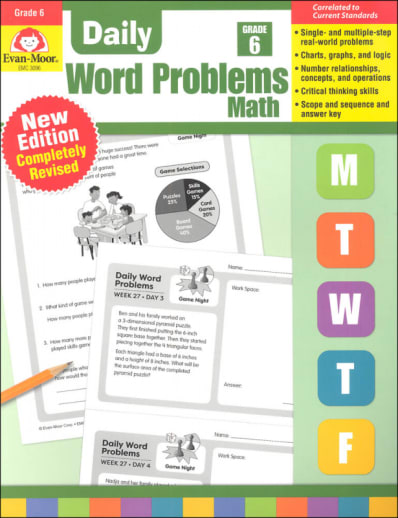
This 6th Grade Teacher Book provides a few teacher notes along with a scope and sequence chart. Student pages are reproducible for classrooms or families and there is an answer key. 128 pgs, pb
Daily Word Problems Grade 6
SKU
014012
ISBN
9781629388601
Grade 6
Neutral
Non-Consumable
These icons are designed to help you quickly understand and learn important information about our products.
Teaching Method
Traditional
Teacher-centered curriculum commonly used in classrooms that may include a text, teacher manual, tests, etc.
Charlotte Mason
A methodology based on the work of a 19th century educator who maintained that children learn best from literature (Living Books), not textbooks.
Classical
A methodology based on the Latin Trivium (three stages of learning), including the grammar stage (memorization and facts), logic stage (critical thinking), and rhetoric stage (developing/defending ideas).
Unit Study
A thematic or topical approach centered around one topic that integrates multiple subject areas.
Montessori (Discovery)
A methodology based on the work of a 20th century educator that emphasizes student and sensory-driven discovery learning and real-life applications.
Other
Other methodologies
Religious Content
Secular
Contains content contrary to common Christian beliefs (i.e. evolution).
Neutral
Avoids religious or theoretical topics or presents multiple viewpoints without preference.
Christian/Religious
Faith-based or including instructional religious content.
Learning Modality
Auditory
Learns through listening, talking out loud or reading out loud.
Visual
Learns through seeing, prefers written instructions and visual materials.
Kinesthetic/Tactile (Hands-On)
Learns through moving, doing and touching.
Multi-Sensory
Curriculum that employ a variety of activities/components.
Presentation
Sequential
Curriculum progresses through well-defined learning objectives. Emphasizes mastery before moving to the next topic.
Spiral
Topics and concepts are repeated from level to level, adding more depth at each pass and connecting with review.
Conceptual/Topical
Focus is on the “why,” often with a unifying concept as well as specific skills; coverage may be broader.
Teacher Involvement
Low Teacher Involvement
Student-led materials; parent acts as a facilitator.
Medium Teacher Involvement
A mix of teacher-led time and independent student work.
High Teacher Involvement
Teacher-led lessons; may utilize discussions, hands-on activities and working together.
Additional Materials Required
No other materials needed
Everything you need is included.
Other Materials Required
There are additional required resources that are a separate purchase.
Other Materials Optional
There are additional resources mentioned or recommended but are not absolutely necessary.
Consumable
Consumable
Designed to be written in; not reusable.
Non-Consumable
Not designed to be written in; reusable.
Our Price
$23.99 $23.99 $15.75
Rainbow Savings: $8.24
Description
Publisher's Description of Daily Word Problems Grade 6
Completely revised in 2019 to reflect grade-level standards, Daily Word Problems is the perfect resource to improve students problem-solving skills. The all-NEW word problems are written to support current math standards and expectations and provide consistent spiral review of math concepts. Students problem-solving skills improve as they participate in meaningful, real-life math practice.
The 36 weeks of activities provide practice of grade-level math concepts such as addition, multiplication, fractions, logic, algebra, and more.
Each week focuses on a theme and provides a daily word problem within the context of a real-life situation.
- Monday through Thursdays activities provide a one- or two-step word problem.
- Fridays format is more extensive and requires multiple steps. The multi-step problems require students to incorporate higher-order thinking skills by applying their understanding within a different context.
- Reproducible pages provide plenty of room for students to solve using the strategy of their choice.
Whats new in the revised edition of Daily Word Problems?
- All-new word problems to support current standards.
- New weekly themes that present problems in the context of real life
- Day-by-day skills list to help teachers identify skills practiced
Grade 6 math skill practice includes:
- positive and negative numbers
- addition and subtraction
- multiplication and division
- factors and multiples
- fractions
- decimals
- percentages
- ratios and rates
- inequalities
- time and temperature
- linear measurement
- weight and capacity
- perimeter and area
- surface area and volume
- statistics
- coordinate plane
- graphs, charts, and maps
- logical thinking
- spatial reasoning
- expressions and equations
Includes scope and sequence chart and an answer key.
Category Description for Daily Word Problems
A good, short supplement to your daily math work, these books provide one word problem for every day in 36 weeks. Each week's problems revolve around a central theme, but many topics are covered in every book to provide variety. Some problems have multiple parts, while others make use of charts and graphs. So don't let your skills get rusty - one problem a day will help to keep your math skills fresh. Books are graded for public school standards and content seems a bit simple in parts of the workbooks, so if you have a child who excels in math, you might consider the workbook that is a grade level above. ~ Stephanie
Details
| Product Format: | Softcover Book |
|---|---|
| Grade: | 6 |
| Brand: | Evan-Moor |
| Author: | Amy Beth & Wes Tuttle |
| ISBN: | 9781629388601 |
| EAN/UPC: | 023472030962 |
| Length in Inches: | 10.875 |
| Width in Inches: | 8.375 |
| Height in Inches: | 0.3125 |
| Weight in Pounds: | 0.8 |
Videos
Reviews